Questions

Solve the Following Question.(2 Marks)

Take a timed test

42 questions · self-marked practice — reveal the answer and mark yourself.

Question 12 Marks
Rewrite the following statements without using conditional:
[Hint: P → q ≡ ~p ∨ q]
(i) If price increases, then demand falls.
(ii) If demand falls, then the price does not increase.
Answer
Since, p → q ≡ ~p ∨ q, the given statements can be written as:
(i) Price does not increase or demand falls.
(ii) Demand does not fall or price does not increase.
View full question & answer
Question 22 Marks
If $A = {2, 3, 4, 5, 6, 7, 8}$, determine the truth value of each of the following statements:
(i) $∃ x \in A,$ such that $3x + 2 > 9$.
(ii) $\forall x \in A, x^2 < 18.$
(iii) $∃x \in A,$ such that $x + 3 < 11$.
(iv) $∀x \in A, x^2 + 2 \geq 5$.
Answer
(i)Clearly $x =3,4,5,6,7,8 \in A$ satisfy $3 x +2>9$.
So, the given statement is true, hence its truth value is T .
(ii) $x=5,6,7,8 \in A$ do not satisfy $x^2<18$.
So the given statement is false, hence its truth value is $F$.
(iii) Clearly $x =2,3,4,5,6,7 \in A$ which satisfy $x +3<11$.
So, the given statement is True, hence its truth value is $T$.
(iv) $x^2+2 \geq 5$ for all $x \in A$.
So, the given statement is true, hence its truth value is $T$.
View full question & answer
Question 32 Marks
Consider the following statements:
(i) If D is a dog, then D is very good.
(ii) If D is very good, then D is a dog.
(iii) If D is not very good, then D is not a dog.
(iv) If D is not a dog, then D is not very good.
Identify the pairs of statements having the same meaning. Justify.
Answer
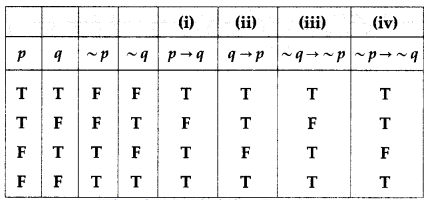
Let p : D is a dog. and q : D is very good.
Then the given statements in the symbolic form are:
(i) p → q
(ii) q → p
(iii) ~q → ~p
(iv) ~p → ~q
Image
The entries in columns (i) and (iii) are identical. Hence, these statements are equivalent.
∴ the statements (i) and (iii) have the same meaning.
Similarly, the entries in columns (ii) and (iv) are identical. Hence, these statements are equivalent.
∴ the statements (ii) and (iv) have the same meaning.
View full question & answer
Question 42 Marks
Write the dual of each of the following:
(i) (~p ∧ q) ∨ (p ∧ ~q) ∨ (~p ∧ ~q)
(ii) (p ∧ q) ∧ r ≡ p ∧ (q ∧ r)
(iii) p ∨ (q ∧ r) ≡ (p ∨ q) ∧ (p ∨ r)
(iv) ~(p ∨ q) ≡ ~p ∧ ~q.
Answer
The duals are given by:
(i) (~p ∨ q) ∧ (p ∨ ~q) ∧ (~p ∨ ~q)
(ii) (p ∨ q) ∨ r ≡ p ∨ (q ∨ r)
(iii) p ∧ (q ∨ r) ≡ (p ∧ q) ∨ (p ∧ r)
(iv) ~(p ∧ q) ≡ ~p ∧ ~q
View full question & answer
Question 52 Marks
Write the converse, inverse, contrapositive of the following statements :
If I do not work hard, then I do not prosper.
Answer
Let p : I do not work hard.
q : I do not prosper.
Then the symbolic form of the given statement is p → q.
Converse: q → p is the converse of p → q
i.e. If I do not prosper, then I do not work hard.
Inverse: ~p → ~q is the inverse of p → q
i.e. If I work hard, then I prosper.
Contrapositive: ~q → ~p is the contrapositive of p → q
i.e. If I prosper, then I work hard.
View full question & answer
Question 62 Marks
Write the converse, inverse, contrapositive of the following statements :
If a man is a bachelor, then he is happy.
Answer
Let p : A man is a bachelor.
q : He is happy.
Then the symbolic form of the given statement is p → q.
Converse: q → p is the converse of p → q
i.e. If a man is happy, then he is a bachelor.
Inverse: ~p → ~q is the inverse of p → q
i.e. If a man is not a bachelor, then he is not happy.
Contrapositive: ~q → ~p is the contrapositive of p → q
i.e., If a man is not happy, then he is not a bachelor.
View full question & answer
Question 72 Marks
Write the converse, inverse, contrapositive of the following statements :
If 2 + 5 = 10, then 4 + 10 = 20.
Answer
Let p : 2 + 5 = 10.
q : 4 + 10 = 20.
Then the symbolic form of the given statement is p → q.
Converse: q → p is the converse of p → q
i.e. If 4 + 10 = 20, then 2 + 5 = 10.
Inverse: ~p → ~q is the inverse of p → q
i.e. If 2 + 5 ≠ 10, then 4 + 10 ≠ 20.
Cotrapositive: ~q → ~p is the contrapositive of p → q,
i.e. If 4 +10 ≠ 20, then 2 + 5 ≠ 10.
View full question & answer
Question 82 Marks
Using the truth table, prove the following logical equivalences:
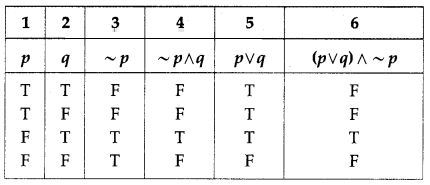
~p ∧ q ≡ (p ∨ q) ∧ ~p
Answer
~p ∧ q ≡ (p ∨ q) ∧ ~p
Image
The entries in columns 4 and 6 are identical.
∴ ~p ∧ q ≡ (p ∨ q) ∧ ~p
View full question & answer
Question 92 Marks
Using the truth table, prove the following logical equivalences:
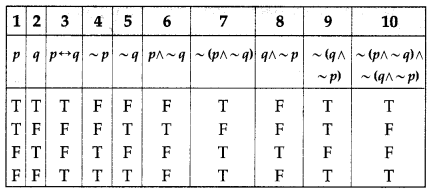
p ↔ q ≡ ~(p ∧ ~q) ∧ ~(q ∧ ~p)
Answer
p ↔ q ≡ ~(p ∧ ~q) ∧ ~(q ∧ ~p)
Image
The entries in columns 3 and 10 are identical.
∴ p ↔ q ≡ ~(p ∧ ~q) ∧ ~(q ∧ ~p)
View full question & answer
Question 102 Marks
Using the truth table, prove the following logical equivalences:
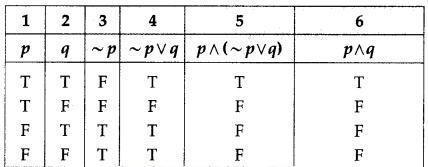
p ∧ (~p ∨ q) ≡ p ∧ q
Answer
p ∧ (~p ∨ q) ≡ p ∧ q
Image
The entries in columns 5 and 6 are identical.
∴ p ∧ (~p ∨ q) ≡ p ∧ q
View full question & answer
Question 112 Marks
Using the truth table, prove the following logical equivalences:
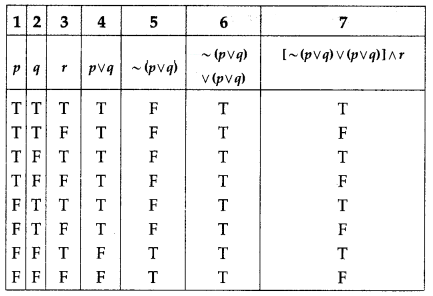
[~(p ∨ q) ∨ (p ∨ q)] ∧ r ≡ r
Answer
[~(p ∨ q) ∨ (p ∨ q)] ∧ r ≡ r
Image
The entries in columns 3 and 7 are identical.
∴ [~(p ∨ q) ∨ (p ∨ q)] ∧ r ≡ r
View full question & answer
Question 122 Marks
Using the truth table, prove the following logical equivalences:
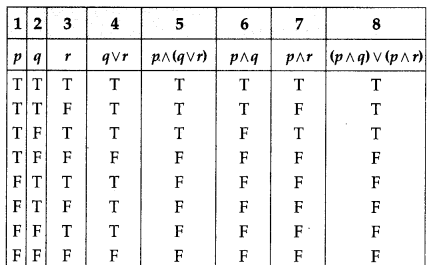
p ∧ (q ∨ r) ≡ (p ∧ q) ∨ (p ∧ r)
Answer
p ∧ (q ∨ r) ≡ (p ∧ q) ∨ (p ∧ r)
Image
The entries in columns 5 and 8 are identical.
∴ p ∧ (q ∨ r) ≡ (p ∧ q) ∨ (p ∧ r)
View full question & answer
Question 132 Marks
Determine whether the following statement patterns is a tautology or a contradiction or a contingency:
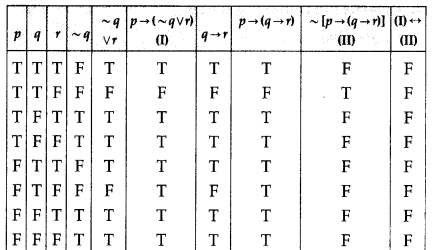
[p → (~q ∨ r)] ↔ ~[p → (q → r)]
Answer
[p → (~q ∨ r)] ↔ ~[p → (q → r)]
Image
All the entries in the last column of the above truth table are F.
∴ [p → (~q ∨ r)] ↔ ~[p → (q → r)] is a contradiction.
View full question & answer
Question 142 Marks
Determine whether the following statement patterns is a tautology or a contradiction or a contingency:
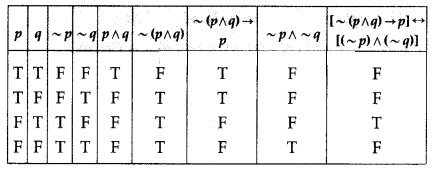
[~(p ∧ q) → p] ↔ [(~p) ∧ (~q)]
Answer
[~(p ∧ q) → p] ↔ [(~p) ∧ (~q)]
Image
The entries in the last column of the above truth table are neither all T nor all F.
∴ [~(p ∧ q) → p] ↔ [(~p) ∧ (~q)] is a contingency.
View full question & answer
Question 152 Marks
Determine whether the following statement patterns is a tautology or a contradiction or a contingency:
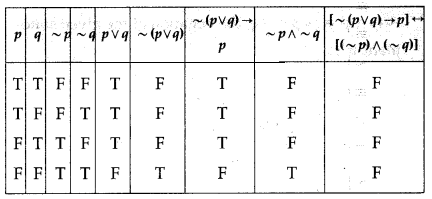
[~(p ∨ q) → p] ↔ [(~p) ∧ (~q)]
Answer
[~(p ∨ q) → p] ↔ [(~p) ∧ (~q)]
Image
All the entries in the last column of the above truth table are F.
∴ [~(p ∨ q) → p] ↔ [(~p) ∧ (~q)] is a contradiction.
View full question & answer
Question 162 Marks
Determine whether the following statement patterns is a tautology or a contradiction or a contingency:
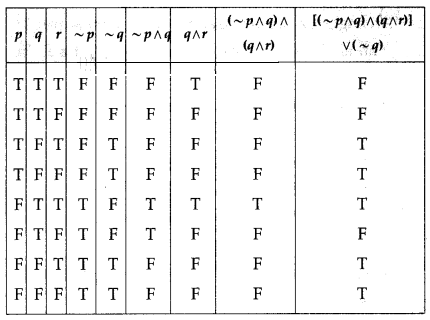
[(~p ∧ q) ∧ (q ∧ r)] ∨ (~q)
Answer
[(~p ∧ q) ∧ (q ∧ r)] ∨ (~q)
Image
The entries in the last column of the above truth table are neither all T nor all F.
∴ [(~p ∧ q) ∧ (q ∧ r)] ∨ (~q) is a contingency.
View full question & answer
Question 172 Marks
Determine whether the following statement patterns is a tautology or a contradiction or a contingency:
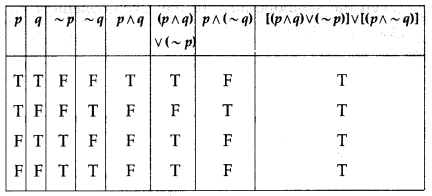
[(p ∧ q) ∨ (~p)] ∨ [p ∧ (~q)]
Answer
[(p ∧ q) ∨ (~p)] ∨ [p ∧ (~q)]
Image
All the entries in the last column of the above truth table are T.
∴ [(p ∧ q) ∨ (~p)] ∨ [p ∧ (~q)] is a tautology.
View full question & answer
Question 242 Marks
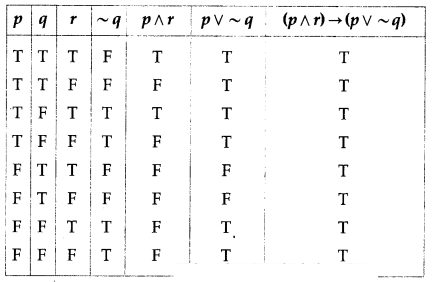
Prepare the truth tables for the following statement patterns : (p ∧ r) → (p ∨ ~q)
Answer
Here are three statements and 4 connectives.
∴ there are 2 × 2 × 2 = 8 rows and 3 + 4 = 7 columns in the truth table.
Image
View full question & answer
Question 262 Marks
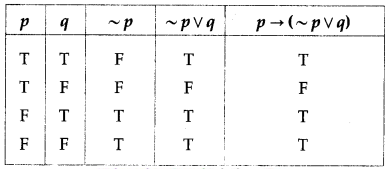
Prepare the truth tables for the following statement patterns : p → (~p ∨ q)
Answer
Here are two statements and three connectives.
∴ there are 2 × 2 = 4 rows and 2 + 3 = 5 columns in the truth table.
Image
View full question & answer
Question 272 Marks
f p : He swims.
q : Water is warm.
Give the verbal statements for the following symbolic statements:
(i) p ↔ ~q
(ii) ~(p ∨ q)
(iii) q → p
(iv) q ∧ ~p
Answer
1. p ↔ ~ q
He swims if and only if the water is not warm.
2. ~(p ∨ q)
It is not true that he swims or water is warm.
3. q → p
If water is warm, then he swims.
4. q ∧ ~p
The water is warm and he does not swim.
View full question & answer
Question 282 Marks
If p and q are true and r and s are false, find the true value of each of the following statements : ~[p ∨ (r ∧ s)] ∧ ~[(r ∧ ~s) ∧ q]
Answer
~[p ∨ (r ∧ s)] ∧ ~[(r ∧ ~s) ∧ q]
≡ ~[T ∨ (F ∧ F)] ∧ ~[(F ∧ ~F) ∧ T]
≡ ~[T ∨ F] ∧ ~[(F ∧ T) ∧ T]
≡ ~T ∧ ~(F ∧ T)
≡ F ∧ ~F
≡ F ∧ T
≡ F
Hence, the truth value of the given statement is false.
View full question & answer
Question 292 Marks
If p and q are true and r and s are false, find the true value of each of the following statements : [(p ∨ s) → r] ∨ [~(p → q) ∨ s]
Answer
[(p ∨ s) → r] ∨ ~[~(p → q) ∨ s]
≡ [(T ∨ F) → F] ∨ ~[ ~(T → T) ∨ F]
≡ (T → F) ∨ ~(~T ∨ F)
≡ F ∨ ~ (F ∨ F)
≡ F ∨ ~F
≡ F ∨ T
≡ T
Hence, the truth value of the given statement is true.
View full question & answer
Question 302 Marks
If p and q are true and r and s are false, find the true value of each of the following statements : (p → q) ↔ ~(p ∨ q)
Answer
(p → q) ↔ ~(p ∨ q) = (T → T) ↔ ~(T ∨ T)
≡ T ↔ ~ (T)
≡ T ↔ F
≡ F
Hence, the truth value of the given statement is false.
View full question & answer
Question 312 Marks
If p and q are true and r and s are false, find the true value of each of the following statements : ~[(~p ∨ s) ∧ (~q ∧ r)]
Answer
~[(~p ∨ s) ∧ (~q ∧ r)] ≡ ~[(~ T ∨ F) ∧ (~T ∧ F)]
≡ ~[(F ∨ F) ∧ (F ∧ F)]
≡ ~(F ∧ F)
≡ ~F
≡ T
Hence, the truth value of the given statement is true.
View full question & answer
Question 322 Marks
If p and q are true and r and s are false, find the true value of each of the following statements : (p → q) ∨ (r ∧ s)
Answer
(p → q) ∨ (r ∧ s) ≡ (T → T) ∨ (F ∧ F)
≡ T ∨ F
≡ T
Hence, the truth value of the given statement is true.
View full question & answer
Question 332 Marks
If p and q are true and r and s are false, find the true value of each of the following statements : p ∧ (q ∧ r)
Answer
Truth values of p and q are T and truth values of r and s are F.
p ∧ (q ∧ r) ≡ T ∧ (T ∧ F)
≡ T ∧ F
≡ F
Hence, the truth value of the given statement is false.
View full question & answer
Question 342 Marks
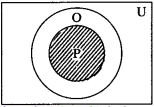
Represent the following statements by Venn diagrams : If n is a prime number and n ≠ 2, then it is odd.
Answer
Let U : set of all real numbers
P : set of all prime numbers n, where n ≠ 2
O : set of all odd numbers.
Then the Venn diagram represents the truth of the given statement is as below:
Image
P ⊂ O
View full question & answer
Question 352 Marks
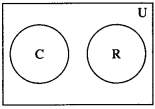
Represent the following statements by Venn diagrams : No circle is a rectangle.
Answer
Let U : set of all geometrical figures
C : set of all circles
R : set of all rectangles
Then the Venn diagram represents the truth of the given statement is as below:
Image
C ∩ R = φ
View full question & answer
Question 362 Marks
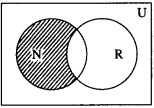
Represent the following statements by Venn diagrams : Some non-resident Indians are not rich.
Answer
Let U : set of all human beings
N : set of all non-resident Indians
R : set of all rich people.
Then the Venn diagram represents the truth of the given statement is as below:
Image
N – R ≠ φ
View full question & answer
Question 372 Marks
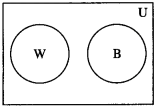
Draw the Venn diagrams for the truth of the following statements : No wicket-keeper is a bowler in a cricket team.
Answer
Let U : set of all human beings
W : set of all wicket keepers
B : set of all bowlers.
Then the Venn diagram represents the truth of the given statement is as follows:
Image
W ∩ B = φ
View full question & answer
Question 382 Marks
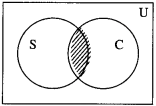
Draw the Venn diagrams for the truth of the following statements : Some share brokers are chartered accountants.
Answer
Let U : set of all human beings
S : set of all share brokers
C : set of all chartered accountants.
Then the Venn diagram represents the truth of the given statement is as below:
Image
S ∩ C ≠ φ
View full question & answer
Question 392 Marks
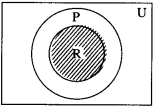
Express the truth of each of the following statements by Venn diagrams : If a quadrilateral is a rhombus, then it is a parallelogram.
Answer
Let U : set of all quadrilaterals
R : set of all rhombus
P : set of all parallelograms.
Then the Venn diagram represents the truth of the given statement is as below:
Image
R ⊂ P
View full question & answer
Question 402 Marks
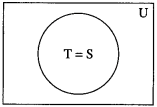
Express the truth of each of the following statements by Venn diagrams : All teachers are scholars and scholars are teachers.
Answer
Let U : set of all human beings
T : set of all teachers
S : set of all scholars.
Then the Venn diagram represents the truth of the given statement is as below:
Image
View full question & answer
Question 412 Marks
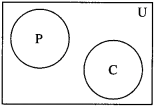
Express the truth of each of the following statements by Venn diagrams : No circles are polygons.
Answer
Let U : set of closed geometrical figures in the plane
P : set of all polygons
C : set of all circles.
Then the Venn diagram represents the truth of the given statement is as follows:
Image
P ∩ C = φ
View full question & answer
Question 422 Marks
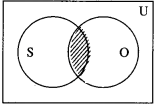
Express the truth of each of the following statements by Venn diagrams : Some hardworking students are obedient.
Answer
Let U : set of all students
S : set of all hardworking students
O : set of all obedient students.
Then the Venn diagram represents the truth of the given statement is as below:
Image
S ∩ O ≠ φ
View full question & answer