Question
Determine whether the following statement patterns is a tautology or a contradiction or a contingency:
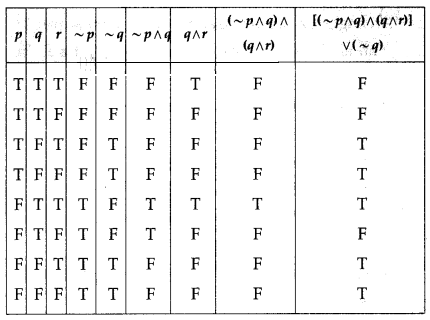
[(~p ∧ q) ∧ (q ∧ r)] ∨ (~q)

Answer

[(~p ∧ q) ∧ (q ∧ r)] ∨ (~q)
Image
The entries in the last column of the above truth table are neither all T nor all F.
∴ [(~p ∧ q) ∧ (q ∧ r)] ∨ (~q) is a contingency.

Need a full question paper?

Generate a complete, print-ready paper with questions like this in minutes — across 16+ boards, with answer keys.

Start Generating Free

Similar questions

Using the truth table, prove the following logical equivalences:
[~(p ∨ q) ∨ (p ∨ q)] ∧ r ≡ r
The equation of two regression lines are $2 x+3 y-6=0$ and $3 x+2 y-12=0$ Find (i) Correlation coefficient (ii) $\frac{\sigma_x}{\sigma_y}$
If p and q are true and r and s are false, find the true value of each of the following statements : (p → q) ↔ ~(p ∨ q)
If $A=\left[\begin{array}{ll}2 & 5 \\ 3 & 7\end{array}\right], B=\left[\begin{array}{cc}1 & 7 \\ -3 & 0\end{array}\right]$, find the matrix $A-4 B+7 I$, where I is the unit matrix of order 2 .
Express the truth of each of the following statements by Venn diagrams : No circles are polygons.
Examine whether the statement pattern

[p → (~ q ˅ r)] ↔ ~[p → (q → r)] is a tautology, contradiction or contingency.

A person takes a life policy for ₹ 2,00,000 for a period of 20 years. He pays premium for 10 years during which bonus was declared at an average rate of ₹ 20 per year per thousand. Find the paid up value of the policy if he discontinuous paying premium after 10 years.
Consider the following statements:
(i) If D is a dog, then D is very good.
(ii) If D is very good, then D is a dog.
(iii) If D is not very good, then D is not a dog.
(iv) If D is not a dog, then D is not very good.
Identify the pairs of statements having the same meaning. Justify.
A man borrowed some money and paid it back in 3 equal installments of ₹ 2,160 each. What amount did he borrow if the rate of interest was $20 \%$ per annum compounded annually? Also, find the total interest charged. [Given: $(1.2)^{-3}=0.5788$ ]
A 35-year old person takes a policy for ₹ 1,00,000 for a period of 20 years. The rate of premium is ₹ 76 and the average rate of bonus is ₹ 7 per thousand p.a. If he dies after paying 10 annual premiums, what amount will his nominee receive?