Question
Determine whether the given quadratic equations have equal roots and if so, find the roots:
$\frac{4}{3} x^2-2 x+\frac{3}{4}=0$

Answer

We have
$\frac{4}{3} x^2-2 x+\frac{3}{4}=0$
Here, $a=\frac{4}{3}, b=-2$ and $c=\frac{3}{4}$
Discriminant
$=b^2-4 a c$
$ =(-2)^2-4 \times \frac{4}{3} \times \frac{3}{4} $
$ =4-4 $
$ =0$
So, the given equation has two real and equal roots given by
$a=\frac{-b+\sqrt{b^2-4 a c}}{2 a}$
$=\frac{+2+0}{4}$
$=\frac{3}{4}$
and $\beta=\frac{-b-\sqrt{b^2-4 a c}}{2 a}$
$=\frac{+2-0}{2 \times \frac{4}{3}} $$=\frac{3}{4} .$

Need a full question paper?

Generate a complete, print-ready paper with questions like this in minutes — across 16+ boards, with answer keys.
Start Generating Free

Similar questions

Prove that:
the parallelogram, inscribed in a circle, is a rectangle.
What least number must be added to each of the numbers $6, 15, 20$ and $43$ to make them proportional?
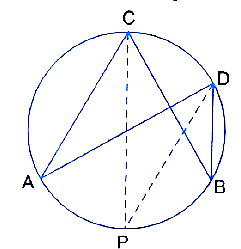
In the figure, given alongside, CP bisects angle ACB. Show that DP bisects angle ADB.
If $A =\left[\begin{array}{cc}\sec 60^{\circ} & \cos 90^{\circ} \\ -3 \tan 45^{\circ} & \sin 90^{\circ}\end{array}\right]$ and $B =\left[\begin{array}{cc}0 & \cos 45^{\circ} \\ -2 & 3 \sin 90^{\circ}\end{array}\right]$ Find $A^2$
Solve the following equation:
$\frac{\cos ^2 \theta-3 \cos \theta+2}{\sin ^2 \theta}=1$.
Prove.$\frac{\operatorname{cosec} A}{\operatorname{cosec} A-1}+\frac{\operatorname{cosec} A}{\operatorname{cosec} A+1}=2 \sec ^2 A$
Given $\left[\begin{array}{cc}2 & 1 \\ -3 & 4\end{array}\right], X=\left[\begin{array}{l}7 \\ 6\end{array}\right]$ the matrix $X$
A and B are two points on the x-axis and y-axis respectively. P (2, −3) is the mid point of AB Find the
(i) co-ordinates of A and B
(ii) slope of line AB

(iii) equation of line AB

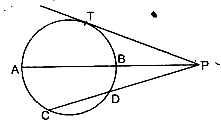
In the given figure, diameter AB and chord CD of a circle meet at P. PT is a tangent to the circle at T. CD = 7.8 cm, PD = 5 cm, PB = 4 cm. Find AB.

Use graph paper for this question.

(Take 2 cm = 1 unit along both side x-axis and y-axis.)

Plot the points O(0,0), A(-4, 4), B(-3, 0) and C(0, -3).

  1. Reflect points A and B on the y-axis and name them A' and B' respectively. Write down their co-ordinates.
  2. Name the figure OABCB'A'.
  3. iii. State the line of symmetry of this figure. [Now symmetry is not in course]