MCQ
Deviation from Markownikoff's rule occurs in presence of
- AZinc
- ✓Peroxides
- C$Hg - Zn/HCl$
- DAll of these
$\xrightarrow{presence \,of\, peroxide} \mathop {C{H_3} - C{H_2} - C{H_2} - Br}\limits_{{\rm{1 - Bromopropane }}} $
Generate a complete, print-ready paper with questions like this in minutes — across 16+ boards, with answer keys.
$\begin{array}{*{20}{c}}
{C{H_3} - C = C{H_2}C{H_2}OH} \\
{|\,\,\,\,\,\,\,\,\,\,\,\,\,\,\,\,\,\,\,\,\,\,} \\
{\,C{H_3}\,\,\,\,\,\,\,\,\,\,\,\,\,\,\,\,}
\end{array}$ is
(image)
$A \rightarrow B$ is an adiabatic process. If the total heat absorbed in the entire process ( $A \rightarrow B$ and $B \rightarrow C$ ) is $R T_2 \ln 10$, the value of $2 \log V_3$ is . . . . . [Use, molar heat capacity of the gas at constant pressure, $\mathrm{C}_{\mathrm{p}, \mathrm{m}}=\frac{5}{2} \mathrm{R}$ ]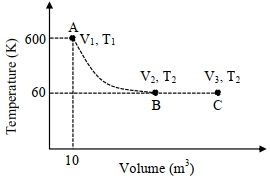
$KMnO_4 + H_2SO_4+H_2O_2 \to KHSO_4 + MnSO_4 + O_2 + H_2O$
Assertion $(A)$: Cis form of alkene is found to be more polar than the trans form
Reason $(R)$: Dipole moment of trans isomer of $2$-butene is zero.
In the light of the above statements, choose the correct answer from the options given below :
$Image$
is/are