MCQ
Diagonal relationship is shown by :
  • A
    $\ce{B−S}$
  • $\ce{Li−Mg}$
  • C
    $\ce{Mg−Ca}$
  • D
    $\ce{S−Se}$

Answer

Correct option: B.
$\ce{Li−Mg}$
As we move across the period, the size of atoms decreases and as we move down the group, the size of the atoms gradually increases. The diagonal relationship is due to the similarity in size of the atoms.
Diagonal relationship in the periodic table.
What is the Diagonal Relationship in the Periodic Table? Explain with few Examples
For example, Boron and silicon are both semiconductors that generate halides that are hydrolysed in water and have acidic oxides.
Therefore, Diagonal relationship is shown by $\ce{Li−Mg}.$

Need a full question paper?

Generate a complete, print-ready paper with questions like this in minutes — across 16+ boards, with answer keys.
Start Generating Free

Similar questions

Which of the following reagent does not oxidize $HCl$ ?
There is no ring strain in cyclohexane, but cyclobutane has an angle strin of $9^\circ 44\ ′$. If $\Delta\text{H}_\text{C}^\circ $​ of cyclohexane per $\ce{(CH_2​)}$ group is $660\text{ kJ mol}^{-1}$ and $\Delta\text{H}_\text{C}^\circ $ of cyclobutane is $2744 \text{ kJ mol}^{-1}$, what is the ring strain in $\text{kJ mol}^{-1}$ of cyclobutane?
In Lassaigne's test for the detection of halogens, the sodium fusion extract is first boiled with concentrated nitric acid. This is
An element if present in the free or the uncombined state, its each atom bears an oxidation number :
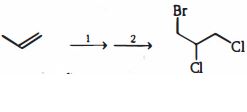
Which series of reactions will achieve the following transformation ?
What volume of $O_2(g)$ measured at standard condition will be formed by action of $100\,ml$ of $0.5\,N\,KMnO_4$ on hydrogen peroxide in an acid solution? The skeleton equation for the reaction is ............. $\mathrm{litre}$

$KMnO_4 + H_2SO_4+H_2O_2 \to KHSO_4 + MnSO_4 + O_2 + H_2O$

Carbon black, which is used in making printer's ink, is obtained by decomposition of
Two reactions are given below:

$2 \mathrm{Fe}_{(\mathrm{s})}+\frac{3}{2} \mathrm{O}_{2(\mathrm{~g})} \rightarrow \mathrm{Fe}_2 \mathrm{O}_{3(\mathrm{~s})}, \Delta \mathrm{H}^{\mathrm{o}}=-822 \mathrm{~kJ} / \mathrm{mol}$

$\mathrm{C}_{(\mathrm{s})}+\frac{1}{2} \mathrm{O}_{2(\mathrm{~g})} \rightarrow \mathrm{CO}_{(\mathrm{g})}, \Delta \mathrm{H}^{\mathrm{o}}=-110 \mathrm{~kJ} / \mathrm{mol}$

Then enthalpy change for following reaction

$3\mathrm{C}_{(\mathrm{s})}+\mathrm{Fe}_2 \mathrm{O}_{3(\mathrm{~s})} \rightarrow 2 \mathrm{Fe}_{(\mathrm{s})}+3 \mathrm{CO}_{(\mathrm{g})}$
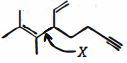
Bond $X$ is made by the overlap of which type of hybridized orbitals ?
The increasing order of electron affinity of the electronic configurations of element is
$(I)\,1s^2\,2s^2\,2p^6 \,3s^2\,3p^5$               $(II)\, 1s^2\, 2s^2\, 2p^3$
$(III)\, 1s^2\, 2s^2\,2p^5$                           $(IV)\, 1s^2\, 2s^2\,2p^6 \,3s^1$