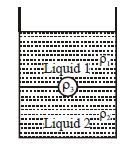
Diagram shows a jar filled with two non mixing liquids $1$ and $2$ having densities ${\rho _1}$ and ${\rho _2}$ respectively. A solid ball, made of a material of density ${\rho _3}$ , is dropped in the jar. It comes to equilibrium in the position shown in the figure. Which of the following is true for ${\rho _1}$ , ${\rho _2}$ and ${\rho _3}$ ?
Medium


Download our appand get started for free
Experience the future of education. Simply download our apps or reach out to us for more information. Let's shape the future of learning together!No signup needed.*
Similar Questions
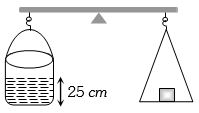
- 1A cylinder containing water up to a height of $25 cm$ has a hole of cross-section $\frac{1}{4}c{m^2}$ in its bottom. It is counterpoised in a balance. What is the initial change in the balancing weight when water begins to flow outView Solution
- 2According to Bernoulli's equation $\frac{P}{{\rho g}} + h + \frac{1}{2}\,\frac{{{v^2}}}{g} = {\rm{constant}}$ The terms $A, B$ and $ C$ are generally called respectively:View Solution
- 3The pressure at the bottom of a water tank is $4 P$. where $P$ is atmospheric pressure. If water is drawn out till the water level decreases by $\frac{3}{5}$ th, then pressure at the bottom of the tank is .........View Solution
- 4Under a constant pressure head, the rate of flow of liquid through a capillary tube is $V$. If the length of the capillary is doubled and the diameter of the bore is halved, the rate of flow would becomeView Solution
- 5A liquid flows through a horizontal tube. The velocities of the liquid in the two sections, which have areas of cross-section ${A_1}$ and ${A_2}$, are ${v_1}$ and ${v_2}$ respectively. The difference in the levels of the liquid in the two vertical tubes is $ h$View Solution
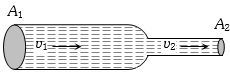
- 6A liquid flows in a tube from left to right as shown in figure. ${A_1}$ and ${A_2}$ are the cross-sections of the portions of the tube as shown. Then the ratio of speeds ${v_1}/{v_2}$ will beView Solution
- 7Two copper vessels $A$ and $B$ have the same base area but of different shapes. $A$ takes twice the volume of water as that $B$ requires to fill upto a particular common height. Then the correct statement among the following isView Solution
- 8A particle released from rest is falling through a thick fluid under gravity. The fluid exerts a resistive force on the particle proportional to the square of its speed. Which one of the following graphs best depicts the variation of its speed $v$ with time $t$ ?View Solution
- 9A spherical body of radius $R$ consists of a fluid of constant density and is in equilibrium under its own gravity. If $P ( r )$ is the pressure at $r ( r < R )$, then the correct option$(s)$ is(are)View Solution
$(A)$ $P ( I =0)=0$ $(B)$ $\frac{ P ( r =3 R / 4)}{ P ( r =2 R / 3)}=\frac{63}{80}$
$(C)$ $\frac{ P ( r =3 R / 5)}{ P ( r =2 R / 5)}=\frac{16}{21}$ $(D)$ $\frac{ P ( r = R / 2)}{ P ( r = R / 3)}=\frac{20}{27}$
- 10Water enters through end $A$ with speed ${v_1}$ and leaves through end $B$ with speed ${v_2}$ of a cylindrical tube $AB$. The tube is always completely filled with water. In case $I$ tube is horizontal and in case $ II$ it is vertical with end $ A $ upwards and in case $ III $ it is vertical with end $B$ upwards. We have ${v_1} = {v_2}$ forView Solution