MCQ
Difference between the greatest and the least values of the function$f (x) = x(ln x - 2)$ on $[1, e^2]$ is
  • A
    $2$
  • $e$
  • C
    $e^2$
  • D
    $1$

Answer

Correct option: B.
$e$
b
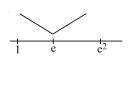
$y = x (ln x - 2)$

$y' = x\left( {\frac{1}{x}} \right) + (ln x - 2) = ln x - 1$

$\frac{{dy}}{{dx}}= ln x - 1 = 0$==>$x = e$

now$f (1) = - 2$

        $f (e) = - e$(least)

        $f (e^2) = 0$(greatest)

difference $= 0 - (-e) = e$ Ans. 
Need a full question paper?

Generate a complete, print-ready paper with questions like this in minutes — across 16+ boards, with answer keys.

Start Generating Free

Similar questions

A bag contains 5 red and 3 blue balls. If 3 balls are drawn at random without replacement, then the probability that exactly two of the three balls were red, the first ball being red, is
  1. $\frac{1}{3}$
  2. $\frac{4}{7}$
  3. $\frac{15}{28}$
  4. $\frac{5}{28}$
A continuous function $f: R \rightarrow R$ satisfies the equation $f(x)=x+\int_0^x f(t) d t$. Which of the following options true?
Let $\lambda \in R .$ The system of linear equations

$2 x_{1}-4 x_{2}+\lambda x_{3}=1$

$x_{1}-6 x_{2}+x_{3}=2$

$\lambda x_{1}-10 x_{2}+4 x_{3}=3$  is inconsistent for 

Let the set of all values of $p$, for which

$f(x)=\left(p^2-6 p+8\right)\left(\sin ^2 2 x-\cos ^2 2 x\right)+2(2-p) x+7$ does not have any critical point, be the interval $(a, b)$. Then $16 a b$ is equal to ..........

Let three vectors $\vec{a}, \overrightarrow{\mathrm{b}}$ and $\vec{c}$ be such that $\vec{a} \times \overrightarrow{\mathrm{b}}=\vec{c}, \overrightarrow{\mathrm{b}} \times \vec{c}=\vec{a}$ and $|\vec{a}|=2$

Then which one of the following is not true?

If $y = {\tan ^{ - 1}}\sqrt {{{a - x} \over {a + x}}} $, then ${{dy} \over {dx}} = $
The acute angle between the planes 2x - y + z = 0 and x + y + 2z = 3 is:
  1. 45°
  2. 60°
  3. 30°
  4. 75°
Let $A=\{1,3,7,9,11\}$ and $B=\{2,4,5,7,8,10,12\}$. Then the total number of one-one maps $\mathrm{f}: \mathrm{A} \rightarrow \mathrm{B}$, such that $\mathrm{f}(1)+\mathrm{f}(3)=14$, is :
Let $A$ and $E$ be any two events with positive probabilities:
Statement $- 1$: $P\left( {E/A} \right) \geq P\left( {A/E} \right)P\left( E \right)$
Statement $-2$ : $P\left( {A/E} \right) \geq P\left( {A \cap E} \right)$
If P(A) + P(B) = 1; then which of the following option explains the event A and B correctly?