MCQ
Different physical quantities are given in Column - $\mathrm{I}$ and their dimensional formula are given in Column - $\mathrm{II}$. Match them appropriately.
Column - $\mathrm{I}$ Column - $\mathrm{II}$
$(a)$ Viscous force $(i)$ $\left[ {{M^1}{L^1}{T^{ - 2}}} \right]$
$(b)$ Coefficient of viscosity $(ii)$ $\left[ {{M^1}{L^{ - 1}}{T^{ - 1}}} \right]$
  $(iii)$ $\left[ {{M^1}{L^{ - 1}}{T^{ - 2}}} \right]$
  • A
    $(a-i),(b-iii)$
  • $(a-i),(b-ii)$
  • C
    $(a-iii),(b-ii)$
  • D
    $(a-ii),(b-iii)$

Answer

Correct option: B.
$(a-i),(b-ii)$
b
$(a-i),(b-i i)$

Need a full question paper?

Generate a complete, print-ready paper with questions like this in minutes — across 16+ boards, with answer keys.

Start Generating Free

Similar questions

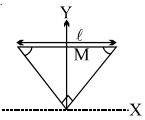
The figure shows an isosceles triangular plate of mass $M$ and base $L$. The angle at the apex is $90^o$. The apex lies at the origin and the base is parallel to $X$ -axis The moment of inertia of the plate about the $x$ -axis is
Which of the following is not the property of an ideal fluid?
An insulated container of gas has two chambers separated by an insulating partition. One of the chambers has volume $V_1$ and contains ideal gas at pressure $P_1$ and temperature $T_1$ . The other chamber has volume $V_2$ and contains ideal gas at pressure $P_2$ and temperature $T_2$. If the partition is removed without doing any work on the gas, the final equilibrium temperature of the gas in the container will be
An expression of energy density is given by $u=\frac{\alpha}{\beta} \sin \left(\frac{\alpha x}{k t}\right)$, where $\alpha, \beta$ are constants, $x$ is displacement, $k$ is Boltzmann constant and $t$ is the temperature. The dimensions of $\beta$ will be.
A ball is dropped from a bridge of $122.5$ metre above a river. After the ball has been falling for two seconds, a second ball is thrown straight down after it. Initial velocity of second ball so that both hit the water at the same time is ...... $m / s$
An electromagnetic wave going through vacuum is described by $\text{E}=\text{E}_0\sin(\text{kx}-\omega\text{t}),\text{ B}=\text{B}_0\sin(\text{kx}-\omega\text{t})$ Then:

  1. $\text{E}_0\text{k}=\text{B}_0\omega$

  2. $\text{E}_0\text{B}_0=\omega\text{k}$

  3. $\text{E}_0\omega=\text{B}_0\text{k}$

  4. None of these.

Two identical cylindrical vessels are kept on the ground and each contain the same liquid of density $d.$ The area of the base of both vessels is $S$ but the height of liquid in one vessel is $x_{1}$ and in the other, $x_{2}$. When both cylinders are connected through a pipe of negligible volume very close to the bottom, the liquid flows from one vessel to the other until it comes to equilibrium at a new height. The change in energy of the system in the process is
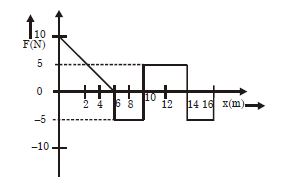
A particle is acted upon by a force $F$ which varies with position $x$ as shown in figure. If the particle at $x = 0$ has kinetic energy of $25\,J$ , then the kinetic energy of the particle at $x = 16\,m$ is .............. $\mathrm{J}$
What is the dimensions of power:
An infinite number of masses, each of one $kg$ are placed on the $+ve\, X$ axis at $1\,m, 2\,m, 4\,m,$ origin. The magnitude of the gravitational field at origin due to this distribution of masses is :