MCQ
Different points in earth are at slightly different distances from the sun and hence experience different forces due to gravitation. For a rigid body, we know that if various forces act at various points in it, the resultant motion is as if a net force acts on the c.m. (centre of mass) causing translation and a net torque at the c.m. causing rotation around an axis through the c.m. For the earthsun system (approximating the earth as a uniform density sphere).
  • A
    The torque is zero.
  • B
    The torque causes the earth to spin.
  • C
    The rigid body result is not applicable since the earth is not even approximately a rigid body.
  • D
    The torque causes the earth to move around the sun.
Answer

  1. The torque is zero.

Explanation:

As the earth is revolving around the sun in a circular motion (approximately in actual the path of earth around the sun is elliptical) due to gravitational attraction. When we consider the earth-sun as a single system and we are taking earth as a sphere of uniform density. Then the gravitational force (F) will be of radial nature, i.e. angle between position vector r and force F is zero. So, torque

$|\vec{\tau}|=|\vec{\text{r}}\times\vec{\text{F}}|=\text{r F}\sin0^0=0.$

Need a full question paper?

Generate a complete, print-ready paper with questions like this in minutes — across 16+ boards, with answer keys.

Start Generating Free

Similar questions

A ring and a disc are initially at rest, side by side, at the top of an inclined plane which makes an angle $60^{\circ}$ with the horizontal. They start to roll without slipping at the same instant of time along the shortest path. If the time difference between their reaching the ground is $(2-\sqrt{3}) / \sqrt{10} \mathrm{~s}$, then the height of the top of the inclined plane, in metres, is. . . . . . Take $g=10 \mathrm{~m} \mathrm{~s}^{-2}$.
$0.4\hat i + 0.8\hat j + c\hat k$ represents a unit vector when $c$ is
If the equation of transverse wave is $Y = 2\sin (kx - 2t),$ then the maximum particle velocity is .... $units$
$Assertion :$ The amplitude of an oscillating pendulum decreases gradually with time
$Reason :$ The frequency of the pendulum decreases with time.
A ball is projected from ground with a speed of $20\,m / s$ at an angle of $45^{\circ}$ with horizontal. There is a wall of $25\,m$ height at a distance of $10\,m$ from the projection point. The ball will hit the wall at a height of $.........\,m$
If a car is moving forward, what is the direction of the moment of the moment caused by the rotation of the tires:
A boy whose mass is $50\,kg$ stands on a spring balance inside a lift. The lift starts to ascent with an acceleration of $2\,m{s^{ - 2}}.$ The reading of the machine or balance $(g = 10\,m{s^{ - 2 }})$ is ........ $kg$
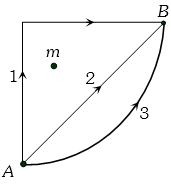
If ${W_1},\,{W_2}$ and ${W_3}$ represent the work done in moving a particle from $A$ to $B$ along three different paths $1, 2$ and $3$ respectively (as shown) in the gravitational field of a point mass m, find the correct relation between ${W_1},\,{W_2}$ and ${W_3}$
A force of $5\, N$ acts on a $15\, kg$ body initially at rest. The work done by the force during the first second of motion of the body is
The length of a simple pendulum is increased by 44%. What is the percentage increase in its time period?