Question
Differentiate between Aerobic respiration and fermentation

Answer

Aerobic respiration and fermentation:
  Aerobic respiration   Fermentation
1. Oxygen is used for deriving energy. 1. Occurs in the absence of oxygen.
2. Occurs in the cytoplasm and mitochondria. 2. Occurs in the cytoplasm.
3. End products are carbon dioxide and water. 3. End products are ethyl alcohol and carbon dioxide.
4. Complete oxidation of the respiratory substrate takes place. 4. Incomplete oxidation of the respiratory substrate takes place.
5. About 36 ATP molecules are produced. 5. Only 2 ATP molecules are produced.

Need a full question paper?

Generate a complete, print-ready paper with questions like this in minutes — across 16+ boards, with answer keys.
Start Generating Free

Similar questions

Explain the mechanism of blood coagulation in response to an injury.
Explain the structure of thoracic chamber.
Write a short note on fruit.
Algae are known to reproduce asexually by variety of spores under different environmental conditions. Name these spores and the conditions under which they are produced.
In biology period, teacher was explaining about the soil and the different nutrients essential for the growth and development of plants. She told students that out of all the elements that plants absorb, only some of them are essential for plants to grow. Rajeev had a query and asked teacher next day that how can we derive and on what basis that this particular element is essential or not for the plant?
  1. What are essential elements?
  2. Mention any four criteria that ensure the essentiality, particular element.
  3. Name some essential elements.
  4. What values you infer from Rajeev's character?
Many discoveries in science have been accidental. This is true for plant hormones also. Can you justify this statement by giving an example? Also what term is used for such accidental findings?
Write the name of three parasitic protozoans.
Name any three disorders related to bones/ skeletal system and describe them.
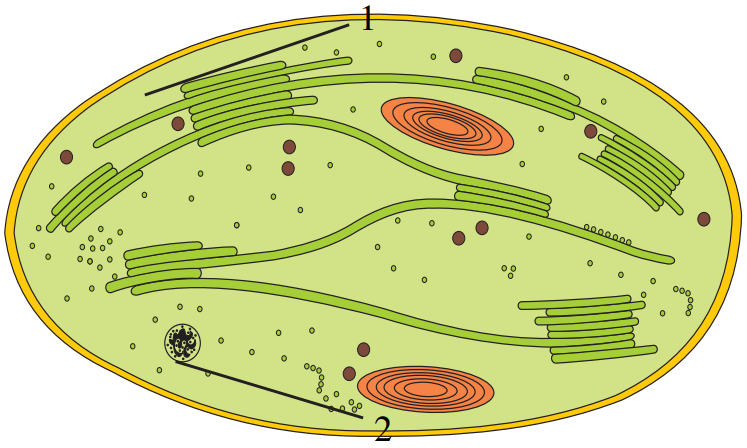
Examine the figure.
  1. Is this structure present in animal cell or plant cell?
  2. Can these be passed on to the progeny? How?
  3. Name the metabolic processes taking place in the places marked (1) and (2).
It is always taught by our teachers and parents that we should not eat food or fruits without washing our hands as it contains thousands of germs and pathogens which we cannot see with our naked eyes.
  1. What are germs?
  2. What are the basic difference between the unicellular and multicellular organisms?
  3. Name the instrument that allow us to study the unicellular organisms.
  4. What values are taught by our teachers and parents?