Questions

3 Marks Question

Take a timed test

34 questions · self-marked practice — reveal the answer and mark yourself.

Question 13 Marks
What is the significance of step-wise release of energy in respiration?
Answer
The significance of step-wise release of energy in respiration are:
  • It facilitates the utilization of the relatively higher proportion of the energy in ATP synthesis.
  • The activities of enzymes for the different steps may be enhanced or inhibited by specific compounds. This provides a mean of controlling the rate of the pathway and the energy output according to the need of the cell.
  • The same pathway may be utilized for forming intermediates used in the synthesis of other biomolecules like amino acids.
View full question & answer
Question 23 Marks
Distinguish between the following: Aerobic respiration and Anaerobic respiration
Answer
Aerobic respiration and Anaerobic respiration:
  Aerobic respiration   Anaerobic respiration
i. It occurs in the presence of oxygen. i. It occurs in the absence of oxygen.
ii. It involves the complete breakdown of respiratory material. ii. It involves the incomplete breakdown of gases.
iii. The end products are carbon dioxide and water. iii. The end products are ethanol and carbon dioxide.
iv. It involves the exchange of gases. iv. It does not involve the exchange of gases.
View full question & answer
Question 33 Marks
Differentiate between Glycolysis and Krebs’ cycle
Answer
Glycolysis and Krebs cycle:
  Glycolysis   Krebs cycle
1. It is a linear pathway. 1. It is a cyclic pathway.
2. It occurs in the cell cytoplasm. 2. It occurs in the mitochondrial matrix.
3. It occurs in both aerobic and anaerobic respiration. 3. It occurs in aerobic respiration.
4. It generates $2 \mathrm{NADH}_2$ and 2 ATP molecules on the breakdown of one glucose molecule. 4. It produces $6 \mathrm{NADH}_2, 2 \mathrm{FADH}_2$, and 2 ATP molecules on the breakdown of two acetyl-CoA molecules.
View full question & answer
Question 43 Marks
What are the main steps in aerobic respiration? Where does it take place?
Answer
The following are the main steps in aerobic respiration:
  1. Glycolysis: It is the breakdown of glucose to pyruvic acid and occurs inside the cytosol of cytoplasm.
  2. Oxidative decarboxylation of pyruvic acid to acetyl coenzyme-A: It occurs inside the mitochondrial matrix.
  3. Tricarboxylic acid cycle or Kreb's cycle: It occurs inside the mitochondrial matrix.
  4. Electron transport system and oxidative phosphorylation which occur in the inner mitochondrial membrane involving ATP synthase complex.
Aerobic respiration occurs in mitochondria.
View full question & answer
Question 53 Marks
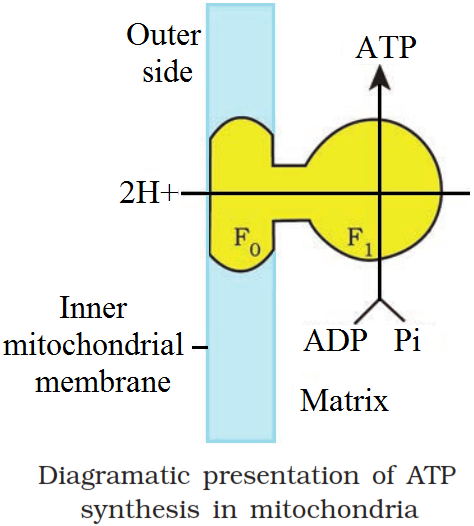
Explain how ATP synthase (complex V) helps in the synthesis of ATP in mitochondria with the help of a diagram.
Answer
Complex V or ATP synthetase consists of two components $F_0$-$F_1$

i. $F_1$ headpiece is a peripheral membrane protein complex and contains the catalytic site for ATP synthesis.
ii. $F_0$ is an integral membrane protein complex, that forms the channel through which protons cross the inner membrane.
iii. When $2 \mathrm{H}_{+}$(protons) pass through this $\mathrm{F}_0$, the energy contained in them is used for the synthesis of one ATP molecule; in other words, for every $2 \mathrm{H}^{+}$that pass through $\mathrm{F}_0$ from the intermembrane space, one ATP molecule is produced.
iv. Oxidation of one molecule of NADH gives to three molecules of ATP while oxidation of one molecule of $\mathrm{FADH}_2$, gives two molecules of ATP.
v. Oxygen acts as the terminal acceptor of hydrogen and drives the whole process by removing hydrogen from the system; hence the process is called oxidative phosphorylation.
View full question & answer
Question 73 Marks
The energy yield in terms of ATP is higher in aerobic respiration than during anaerobic respiration. Explain.
Answer
In aerobic respiration, complete oxidation of respiratory substrate produces a number of reduced coenzymes. They are used in formation of ATP ( 3 for each $\mathrm{NADH}_2$ and 2 for each FADH2.). This is in addition to substrate level ATP synthesis. In anaerobic respiration there is only substrate level ATP synthesis. Reduced coenzymes are not given out (the ones formed in glycolysis are utilised in formation of end product). Therefore, the number of ATP synthesised in aerobic respiration (38 ATP/ glucose) is much higher as compared to number of ATP produced in anaerobic respiration (2 ATP/glucose).
View full question & answer
Question 83 Marks
Differentiate between Aerobic respiration and fermentation
Answer
Aerobic respiration and fermentation:
  Aerobic respiration   Fermentation
1. Oxygen is used for deriving energy. 1. Occurs in the absence of oxygen.
2. Occurs in the cytoplasm and mitochondria. 2. Occurs in the cytoplasm.
3. End products are carbon dioxide and water. 3. End products are ethyl alcohol and carbon dioxide.
4. Complete oxidation of the respiratory substrate takes place. 4. Incomplete oxidation of the respiratory substrate takes place.
5. About 36 ATP molecules are produced. 5. Only 2 ATP molecules are produced.
View full question & answer
Question 93 Marks
Why is respiratory pathway referred to as an amphibolic pathway? Explain.
Answer
Respiration is generally assumed to be a catabolic process because during respiration, various substrates are broken down for deriving energy. Carbohydrates are broken down to glucose before entering respiratory pathways. Fats get converted into fatty acids and glycerol whereas fatty acids get converted into acetyl CoA before entering the respiration. In a similar manner, proteins are converted into amino acids, which enter respiration after deamination. During synthesis of fatty acids, acetyl CoA is withdrawn from respiratory pathway. Also, in the synthesis of proteins, respiratory substrates get withdrawn. Thus, respiration is also involved in anabolism. Therefore, respiration can be termed as amphibolic pathway as it involves both anabolism and catabolism.
View full question & answer
Question 103 Marks
Define the following:
  1. Respiration.
  2. Respiratory substrate.
  3. How does a tree trunk exchange gases with the environment although it lacks stomata?
  4. Which is the most important energy carrier? Is this compound mobile?
  5. Name the major respiratory substrates used by most organisms. It unavailable at time, what other substances can be used for respiration?
Answer
  1. Enzymes controlled process of biological oxidation of various organic food materials in a living cell, producing $\mathrm{CO}_2$ and $\mathrm{H}_2 \mathrm{O}$, and releasing energy in the form of ATP, is called respiration.
  2. The organic compounds catabolised in the living cells to release energy are called respiratory substrates.
  3. Due to the presence of lenticels in the periderm which is connected internally to the network of parenchyma with outside world.
  4. The most important energy carrier is ATP. This energy rich compound is mobile, but cannot pass from one cell to another.
  5. Carbohydrates in condition of its unavailability, proteins, fats and organic acids can be used.
View full question & answer
Question 113 Marks
Discuss “The respiratory pathway is an amphibolic pathway.”
Answer
Respiration is generally assumed to be a catabolic process because during respiration, various substrates are broken down for deriving energy. Carbohydrates are broken down to glucose before entering respiratory pathways. Fats get converted into fatty acids and glycerol whereas fatty acids get converted into acetyl CoA before entering the respiration. In a similar manner, proteins are converted into amino acids, which enter respiration after deamination. During synthesis of fatty acids, acetyl CoA is withdrawn from respiratory pathway. Also, in the synthesis of proteins, respiratory substrates get withdrawn. Thus, respiration is also involved in anabolism. Therefore, respiration can be termed as amphibolic pathway as it involves both anabolism and catabolism.
View full question & answer
Question 123 Marks
ATP is called the energy currency of the cell. In our life, we can compare ATP with which of the following? What could have happened if there were no mechanism of storing the energy in the form of ATP?
  1. ATM Machine.
  2. Bank account.
  3. Currency notes.
Answer
  1. Currency notes.
Cells have developed a wonderful mechanism of storing energy in the form of ATP. ATP provides energy as and when needed. If this mechanism were not developed, then it could have been problematic for the living beings. A living being would be in constant need of food to get the required energy. We can compare a situation in which the petrol tank of a car becomes empty. Once the tank becomes empty, there is no way to move the car further. One needs immediate refilling to start the car. We would have suffered the same fate. Because of the facility of energy being stored in the form of ATP, we need to take food at certain intervals and can also do away with food for some time if we don't get the food or don't get the time to eat.
View full question & answer
Question 133 Marks
Define RQ. What is its value for fats?
Answer
The ratio of the volume of $\mathrm{CO}_2$ evolved to the volume of $\mathrm{O}_2$ consumed in respiration is called the respiratory quotient (RQ) or respiratory ratio. $\text{RQ }\frac{\text{volume of CO}_2\text{ evolved}}{\text{volume of O}_2\text{ consumed}}$ The value of respiratory quotient depends on the type of respiratory substrate. Its value is one for carbohydrates. However, it is always less than one for fats as fats consume more oxygen for respiration than carbohydrates. For example, RQ value for tripalmitin is 0.7 which consumes 145 molecules of $\mathrm{O}_2$ for respiration while 102 molecules of $\mathrm{CO}_2$ are evolved. RQ of fats: $2(\text{C}_{51}\text{H}_{98}\text{O}_6)+145\text{O}_2\xrightarrow{\ \ \ \ \ \ \ \ \ \ \ \ \ }102\text{CO}_2+98\text{H}_2\text{O}+\text{energy}$ $\text{RQ of Fat}=\frac{102\text{CO}_2}{145\text{O}_2}=0.7$
View full question & answer
Question 143 Marks
What are the assumptions made during the calculation of net gain of ATP?
Answer
The following assumptions are made during the calculation of net gain of ATP:
  • There is a sequential, orderly pathway functioning, with one substrate forming the next and with glycolysis, TCA cycle and ETS pathway following one after another.
  • The NADH synthesised in glycolysis is transferred into the mitochondria and undergoes oxidative phosphorylation.
  • None of the intermediates in the pathway are utilised to synthesise any other compound.
  • Only glucose is being respired – no other alternative substrates are entering in the pathway at any of the intermediary stages.
View full question & answer
Question 153 Marks
Write any two energy yielding reactions of glycolysis.
Answer
The ATP yielding reactions of glycolysis are:
  1. Two molecules 1, 3-diphosphoglycerate reacts with ADP in presence of enzyme phosphoglycerate kinase to form two molecules of 3-phosphoglycerate and two ATP molecules.
1, 3-diphosphoglycerate + ADP → 3-phosphoglycerate +ATP.
  1. The two molecules of phosphoenol pyruvate in presence of Pyruvate kinase get phosphorylated to produces two molecules of pyruvate and two ATP.
Phosphoenol pyruvate + ADP → Pyruvate +ATP.
View full question & answer
Question 163 Marks
Distinguish between the following: Glycolysis and Fermentation
Answer
Glycolysis and Fermentation:
 
Glycolysis
 
Fermentation
i.
It is the first step of respiration which occurs without oxygen and is common to both aerobic and anaerobic modes of respiration.
i.
It is anaerobic respiration which does not require oxygen.
ii.
It produces pyruvic acid.
ii.
It produces different products such as ethanol and lactic acid.
iii.
It produces two molecules of NADH per glucose molecule.
iii.
It generally utilises NADH produced during glycolysis.
iv.
It forms 2 ATP molecules per glucose molecule.
iv.
It does not produce ATP.
View full question & answer
Question 173 Marks
Distinguish between the following: Glycolysis and Citric acid cycle
Answer
Glycolysis and Citric acid cycle:
 
Glycolysis
 
Citric acid cycle
i.
It occurs inside the cytoplasm.
i.
It operates inside the mitochondria.
ii.
It is a straight or linear pathway.
ii.
It is a cyclic pathway.
iii.
It is the first step of respiration in which glucose is broken down to the level of pyruvate.
iii.
It is the second step in respiration where an active acetyl group is broken down completely.
iv.
The net gain of energy is equal to 8 ATP.
iv.
The net gain of energy is equal to 24 molecules of ATP.
View full question & answer
Question 183 Marks
Define respiration. Mention the value of Respiratory Quotient (RQ) for proteins and fats.
Answer
  1. It is the process of breaking of the C-C bonds of complex compounds through oxidation within the cells, to release considerable amount of energy.
  2. RQ for proteins is 0.9.
  3. RQ for fats is 0.7.
View full question & answer
Question 203 Marks
  1. Name the end products of fermentation.
  2. Write the role of oxygen in the electron transport system.
  3. What is respiratory quotient? What is the RQ for fat?
Answer
  1. Ethanol and $\mathrm{CO}_2$ in yeast and lactic acid in lactic acid bacteria.
  2.  
  1. Oxygen functions as the terminal acceptor of hydrogen.
  2. It drives the whole process by removing hydrogen from the system.
  1. Respiratory quotient is defined as the ratio between the volume of carbon dioxide evolved and the volume of oxygen consumed in respiration.
View full question & answer
Question 213 Marks
When a substrate is being metabolized, why does not all the energy that released in one step. It is released in multiple steps.What is the advantage of step-wise release?
Answer
A single step release of large amount of energy will be harmful to the cell as most of it will remain unutilized and would cause damage to cellular organisation. Step-wise release of small amount of energy is useful as:
  1. It can be trapped and stored for later use.
  2. There will be little wastage.
  3. Process of energy release can be controlled as per requirement.
  4. It produces a number of intermediates which are used for synthesis of several types of substances.
View full question & answer
Question 233 Marks
Does pyruvic acid enter the 'Krebs' cycle directly?
Answer
No, before pyruvic acid as such does not enter 'Krebs' cycle, pyruvate ie first decarboxylated, and then oxidized by the enzyme pyruvate dehydrogenase to form acetyl Co-A. This molecule enters the mitochondria for further oxiation reaction. This is the connecting link between glycolysis and Krebs' cycle. During the process, $\mathrm{NAD}^{+}$is reduced to $\mathrm{NADH}+\mathrm{H}^{+}$. The summary of the reaction is given below: $\text{Pyruvic acid}+\text{Co}-\text{A}+\text{NAD}^+\xrightarrow[\text{Mg}^{2+}]{\text{Pyruvate dehydrogenase}}\text{Acetyl}$ $\text{Co}-\text{A}+\text{Co}_2+\text{NADH}+\text{H}^+$ During this process, two molecules of NADH are produced (from the metabolism of two molecules of pyruvic acid produced during glycolysis), and thus, it results in a net gain of 6 ATP molecules (2 NADH × 3 = 6 ATP).
View full question & answer
Question 243 Marks
When does anaerobic respiration occur in man and yeast?
Answer
In alcoholic fermentation (by yeast), incomplete oxidation of glucose occurs under anaerobic conditions by sets of reactions where pyruvic acid is converted to ethanol and $\mathrm{CO}_2$.
$\mathrm{PA} \rightarrow \text { Ethanol }+\mathrm{CO}_2$
In animal cells also, like muscles during exercise, when oxygen is inadequate for cellular respiration pyruvic acid is reduced to lactic acid.
View full question & answer
Question 253 Marks
Explain various steps involved in cellular respiration.
Answer
Steps of cellular respiration:
  1. Glycolysis: Glycolysis is the first step in cellular respiration. During glycolysis glucose undergoes partial oxidation and makes pyruvic acid. From 1 molecule of glucose 2 molecules of pyruvic acid is formed.
  2. Fermentation: The pyruvic acid undergoes fermentation in anaerobic conditions. There can be lactic acid fermentation or ethanol fermentation. By lactic acid fermentation pyruvic acid is converted into lactic acid, while in another case the pyruvic acid is converted to ethyl alcohol. Fermentation does not ensure complete oxidation of glucose.
  3. Citric Acid Cycle: Under aerobic conditions the pyruvic acid undergoes citric acid cycle. This converts the pyruvic acid into citric acid. ATP is also released which is stored by mitochondria.
$\text{Pyruvic Acid}+ \text{CoA}+\text{NAD}^+\xrightarrow{\ \ \ \ \text{Mg}^{2+}\ \ \ }\text{ Acety}\text{ CoA}+ \text{NADH}+\text{H}^+$
View full question & answer
Question 263 Marks
Neha while learning for her test, got confused how aerobic pyruvic acid is transported to mitochondria for further oxidation. She asked her elder sister (who is a graduate in biology) about this and also asked her to explain the same process in detail. Her sister explained her that it gets completely oxidised into $\mathrm{CO}_2$ and water along with the formation of ATP.
  1. Mention the sites in the mitochondria, where these events occur.
  2. What happens to pyruvic acid before it enters 'Krebs' cycle?
  3. Write the summary equation for the 'Krebs' cycle.
  4. Mention the value implicit through Neha's character.
Answer
  1. Mitochondrial matrix, and electron transport particles.
  2. It is converted into acetyl Co-A
  3. $\text{Pyruvic acid}+4\text{NAD}+\text{FAD}^++2\text{H}_2\text{O}+\text{ADP}+\text{Pi}$
$\xrightarrow[\text{matrix}]{\text{Mitochondrial}}3\text{CO}_2+4\text{NADH}+4\text{H}^++\text{FADP}+\text{ATP}$
  1. Neha is attentive, inquisitive and listens patiently to the explanation provided.
View full question & answer
Question 273 Marks
How do plants manage exchange of gases? Give an overview of respiration in plants.
Answer
Plant Respiration:
  1. Plants, unlike animals, have no specialised organs for gaseous exchange but they have stomata and lenticels for this purpose. There are several reasons why plants can get along without respiratory organs.
  2. Each plant part takes care of its own gas-exchange needs. There is very little transport of gases from one plant part to another.
  3. Plants do not present great demands for gas exchange. Roots, stems and leaves respire at rates far lower than animals do. Only during photosynthesis are large volumes of gases exchanged and, each leaf is well adapted to take care of its own needs during these periods. When cells photosynthesise, availability of $\mathrm{O}_2$ is not a problem in these cells since $\mathrm{O}_2$ is released within the cell.
  4. The distance that gases must diffuse even in large, bulky plants is not great. Each living cell in a plant is located quite close to the surface of the plant. Even in woody stems, 'the living' cells are organised in thin layers inside and beneath the bark. They also have openings called lenticels. The cells in the interior are dead and provide only mechanical support. Thus, most cells of a plant have at least a part of their surface in contact with air. This is also facilitated by the loose packing of parenchyma cells in leaves, stems and roots, which provide an interconnected network of air spaces.
  5. The complete combustion of glucose, which produces $\mathrm{CO}_2$ and $\mathrm{H}_2 \mathrm{O}$ as end products, yields energy most of which is given out as heat.
           $\mathrm{C}_6 \mathrm{H}_{12} \mathrm{O}_6+6 \mathrm{O}_2 \rightarrow 6 \mathrm{CO}_2+6 \mathrm{H}_2 \mathrm{O}+\mathrm{Heat}$
  1. If this energy is to be useful to the cell, it should be able to utilise it to synthesise other molecules that the cell requires. The strategy that the plant cell uses is to catabolise the glucose molecule in such a way that not all the liberated energy goes out as heat. The key is to oxidise glucose not in one step but in several small steps enabling some steps to be just large enough such that the energy released can be coupled to ATP synthesis.
View full question & answer
Question 283 Marks
Complete the following equation of conversion of pyruvic acid int acetyl coenzyme-A. Where does this process occur inside the cell? $\text{Pyruvic acid}+\text{Co}-\text{A}+\ ...\xrightarrow[\text{pyruvate dehydrogenate}]{\text{Mg}^{2+}}\text{Acetyl}$ $\text{Acetyl}\text{ Co}-\text{A}+\ ...+\ ...$
Answer
$\text{Pyruvic acid}+\text{Co}-\text{A}+\text{NAD}^+\xrightarrow[\text{Pyruvate dehydrogenate}]{\text{Mg}^{2+}}\text{Acetyl}$ $\text{Co}-\text{A}+\text{NADH}$ The pyruvic acid, produced in the cytosol by the process of EMP Pathway, enters into mitochondria where it is converted into acetyl Co-A inside the matrix.
View full question & answer
Question 293 Marks
Different substrates get oxidized during respiration. How does Respiratory Quotient (RQ) indicate which type of substrate, i.e., carbohydrate, fat or protein is getting oxidized? $\text{R}.\text{Q}=\frac{\text{A}}{\text{B}}$ What do A and B stand for? What type of substrates have R.Q. of 1, < 1 or > 1?
Answer
The ratio of $\mathrm{CO}_2$ evolved and consumption of $\mathrm{O}_2$ in respiration is called the Respiratory Quotient (RQ) or respiratory ratio. $\text{R}.\text{Q}=\frac{\text{A}}{\text{B}}=\frac{\text{Volume of}\ \text{CO}_2\text{Evolved}}{\text{Volume of}\ \text{O}_2\text{Consumed}}$ Substrates like carbohydrates have RQ =1 during, aerobic respiration. Proteins and fats have RQ of < 1 and it occurs during germination of seeds. Substrates like organic acids have RQ of > 1 under aerobic conditions.
View full question & answer
Question 303 Marks
ATP produced during glycolysis is a result of substrate level phosphorylation. Explain.
Answer
When formation of ATP happens by direct transfer of a phosphoryl (PO3) group to ADP from a phosphorylated reactive intermediate; this is called substrate level phosphorylation. During glycolysis, ATP is formed at two stages because of direct transfer of phosphoryl group to ADP. When BPGA (biphosphoglyceric acid) is converted into PGA (phosphoglyceric acid). When PEP (phosphoenolpyruvate) is converted into pyruvic acid.
View full question & answer
Question 313 Marks
Plants have no respiratory system. Give three reasons as to how plants can get along without respiratory organs?
Answer
Following are the reasons why plants can get along without respiration organs:
  1. Every part of the plant takes care of its own gas exchange needs and there is very little transport of gases from one part of the plant to another.
  2. Plants do not have great demands for gas exchange; the rate of respiration is far lower than that of animals.
  3. The distance for which the gases diffuse, even in large, bulky plants is not great as living cells in a plant are located quite close to the surface of the plant.
View full question & answer
Question 323 Marks
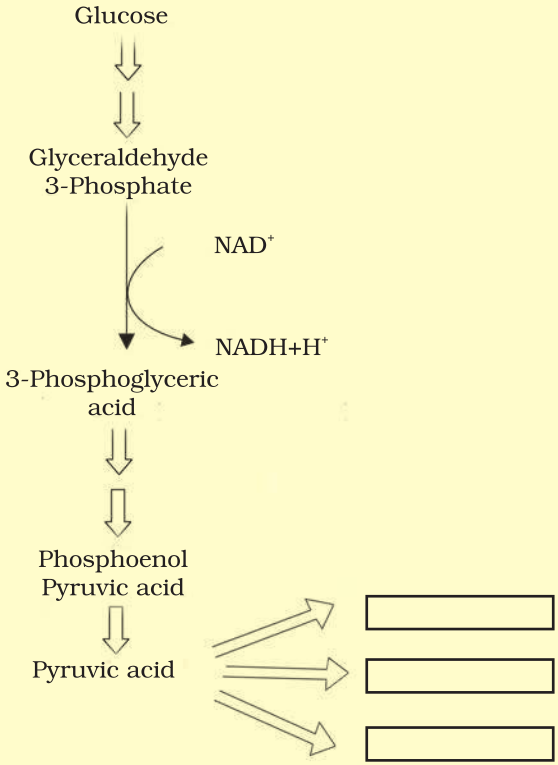
Pyruvic acid is the end product of glycolysis. What are the three metabolic products of pyruvic acid produced under aerobic and anaerobic conditions? Write their name in the space provided in the diagram.
View full question & answer
Question 333 Marks
Respiratory pathway is believed to be a catabolic pathway. However, nature of TCA cycle is amphibolic. Explain.
Answer
During breakdown and synthesis of protein, respiratory intermediates form the link. Breaking down processes within the living organism is catabolism, and synthesis is anabolism. Because the respiratory pathway is involved in both anabolism and catabolism, it would hence be better to consider the respiratory pathway as an amphibolic pathway rather than as a catabolic one.
View full question & answer
Question 343 Marks
Which of the following will release more energy on oxidation? Arrange 1 them in ascending order.
  1. 1gm of fat.
  2. 1gm of protein.
  3. 1gm of glucose.
  4. 0.5g of protein + 0.5g glucose.
Answer
On oxidation 1gm of fat releases 9.45 Kcal of energy, 1gm of protein releases 5.65Kcal of energy, and 1gm of glucose releases 4.1Kcal of energy. 0.5g of protein + 0.5g of glucose release 2.825Kcal + 2.05K cal = 4.875 Kcal of energy. The arrangement of amount of energy released in ascending order is: 1gm of glucose < 0.5gm of protein + 0.5gm of glucose < 1gm of protein < 1gm of fat.
View full question & answer