50 questions · timed · auto-graded


For example the fore limbs of some animals (Vertebrates) like whales, bats, cheetah and human have similar anatomical strucuture (i.e. humerus, radius, ulna, carpals, metacarpals and phalanges) develop differently to meet different needs/to perform different functions.
| | Divergent | Convergent |
| 1. | same structure developed along different direction. | Different structures evolving for the same function. |
| 2. | due to adaptation to different needs. | due to adaptation to meet similar needs. |
| 3. | Examples:
| Examples:
|
| Ramapithecus | : | hairy/walked like gorillas and chimpanzees, more man like. |
| Dryopithecus | : | hairy/walked like gorillas and chimpanzees, more ape-like. |
| Neanderthal man | : | brain size is 1400cc, used hides to protect their body/buried their dead. |
| Homology | Analogy |
| Organisms having the same structure developed along different directions due to adaptations/different functions. | Different structures having the same function. (in different organisms) |
| Result of divergent evolution. | Result of convergent evolution. |
| Indicates common ancestry. | Does not indicate common ancestry. |
| Anatomically same structures. | Anatomically different structures. |
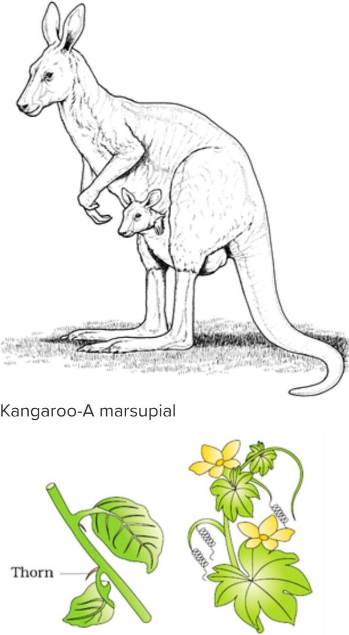
| Example: Forelimbs of whale - bats - cheetah – human// Thorns of Bougainvillea - tendrils of cucurbits. | Example: Wings of butterfly and birds// Sweet potato and potato. |


Total genes and their alleles in a population or gene pool remains constant. (called as genetic equilibrium)
Sum total of all the allelic frequencies is: 1/[p + q = 1/(p + q)² = 1]
$\text{A} = \text{T},\ \ \text{A} = 520\ \ \text{hence}\ \ \text{ T} = 520$
$\text{A + T} = 520 + 520 = 1040$
$\text{so}\ \ \text{G + C} = 2000 - 1040 = 960$
$\text{G = C}, \text{so}\ \ \text{C}=\frac{960}{2}=480$
$\text{so pyrimidines}=\text{C + T}$
$= 480 + 520 = 1000$

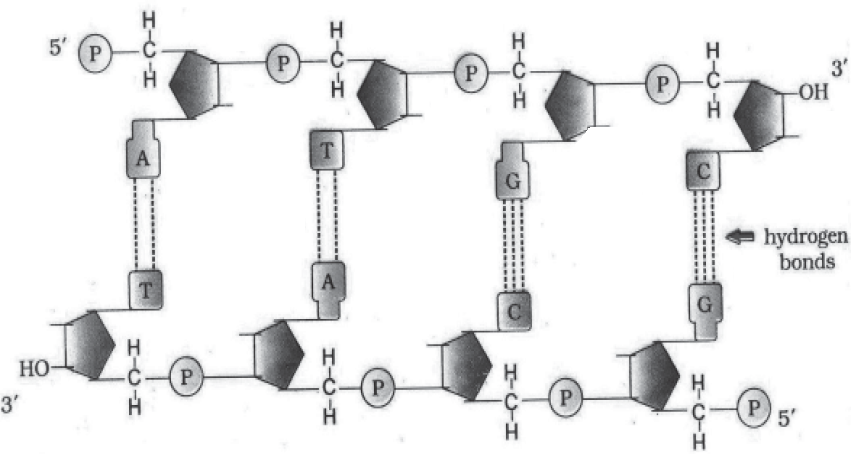
Diagram showing polarity:
N- base
H - bond
Deoxyribose sugar.
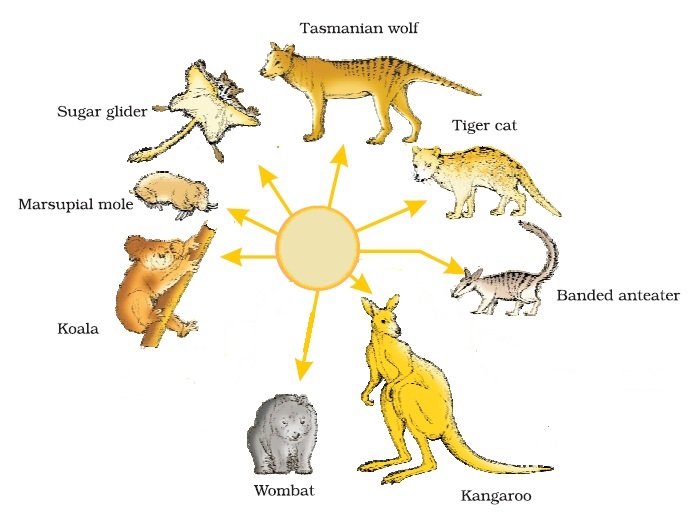
| Placental mammals | Australian marsupials |
| Wolf | Tasmanian wolf |
| Mole | Marsupial mole |
| Anteater | Numbat (anteater) |
| Mouse | Marsupial mouse |
| Lemur | Spotted cuscus |
| Flying squirrel | Flying phalanger |
| Bobcat | Tasmanian tiger cat |


| | Analogous Organs | Homologous Organs |
| i. | Those organs which are structurally dissimilar but functionally similar are called analogous organs. | Those organs, which are structurally similar but functional dissimilar are called homologous organs. |
| ii. | They lead to convergent evolution. | They lead to divergent evolution. |
| iii. | Eg. Wings of birds and insects. | Eg. Forelimbs of terrestrial vertebrates such as frog, lizard, bird, bat, horse, man. |
Carboniferous, Silurian, Jurassic.
| | Homo habilis | Homo erectus |
| 1 | This creature probably lived in East African grassland around two mya | This creature lived about 15 mya and its fossils were discovered in Java in 1891. |
| 2 | Brain capacity of this creature was 650–800cc. | Brain capacity was around 900cc. |
| 3 | They did not eat meat. | They probably ate meat. |
The distribution of genes is described by the relationship A2 + 2Aa + a2 = 1 where A2 represents the frequency of the homozygous dominant genotype. 2Aa represents the frequency of the heterozygous genotype and a2 represents the frequency of the homozygous recessive genotype.
Two ways in which study of fossils support biological evolution: