Question
Differentiate between incomplete dominance and co-dominance. Substantiate your answer with one example of each.

Answer

Co-dominance is the phenomenon in which both the alleles of a contrasting character are expressed in the heterozygous condition. Both the alleles of a gene are equally dominant. ABO blood group in human beings is an example of co-dominance. The blood group character is controlled by three sets of alleles, namely, IA, IB, and i. The alleles, IA and IB, are equally dominant and are said to be co­­-dominant as they are expressed in the AB blood group. Both these alleles do not interfere with the expression of each other and produce their respective antigens. Hence, the AB blood group is an example of co-dominance.
Allele from Parent 1
Allele from Parent 2
Genotype of offspring
Blood type of offspring
IA
IA
IA IA
A
IA
IB
IAIB
AB
IA
i
IA i
A
IB
IA
IA IB
AB
IB
IB
IBIB
B
IB
i
IB i
B
i
i
i i
O
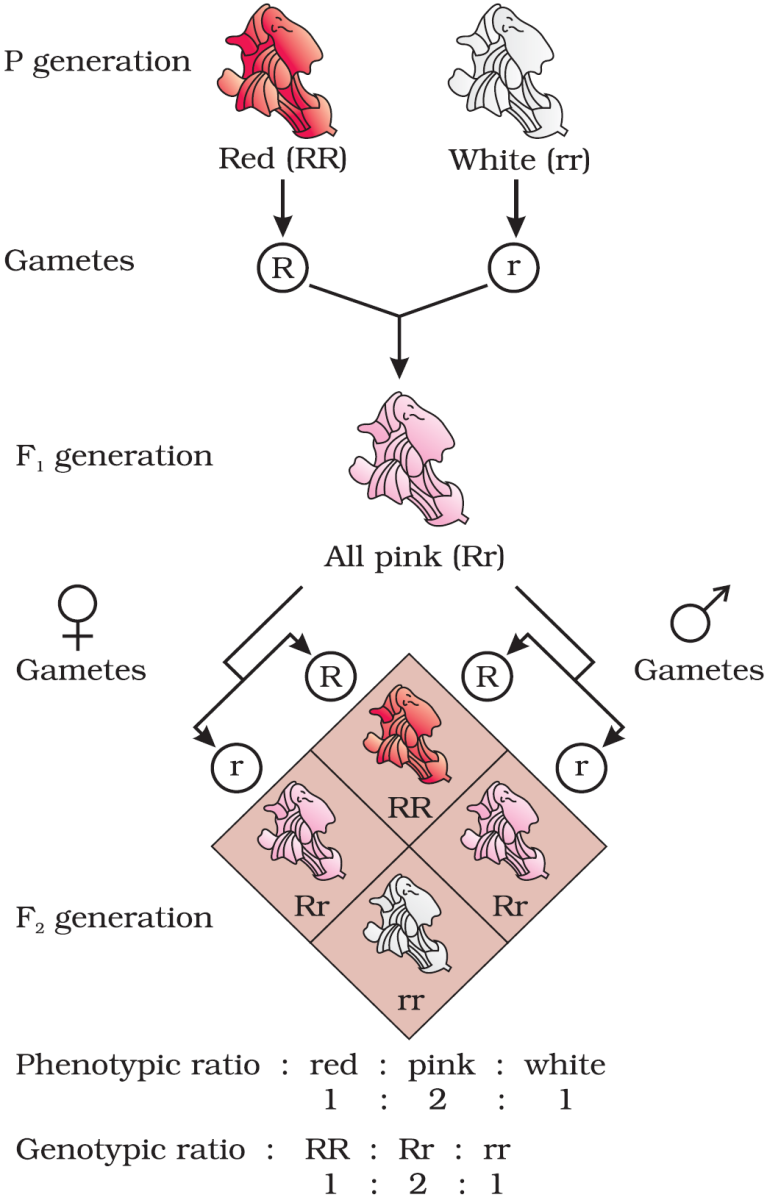
Incomplete dominance is a phenomenon in which one allele shows incomplete dominance over the other member of the allelic pair for a character. For example, a monohybrid cross between the plants having red flowers and white flowers in Antirrhinum species will result in all pink flower plants in the F1 generation. The progeny obtained in Fgeneration does not resemble either of the parents and exhibits intermediate characteristics. This is because the dominant allele, R, is partially dominant over the other allele, r. Therefore, the recessive allele, r, also gets expressed in the F1 generation resulting in the production of intermediate pink flowering progenies with Rr genotype.

Need a full question paper?

Generate a complete, print-ready paper with questions like this in minutes — across 16+ boards, with answer keys.
Start Generating Free

Similar questions

A flower of brinjal plant following the process of sexual reproduction produces 360 viable seeds.
Answer the following questions giving reasons:
How many megaspore mother cells are involved?
What is mutualism? Describe any four examples.
Restriction enzymes are found in bacteria (and other prokaryotes). They recognize and bind to specific sequences of DNA, called restriction sites. Each restriction enzyme recognizes just one or a few restriction sites.
When it finds its target sequence, a restriction enzyme will make a double-stranded cut in the DNA molecule.
i. Write the palindromic nucleotide sequence for the following DNA segment.
5'-GAATTC-3'
ii. Name the restriction endonuclease that recognises this sequence.
iii. How are sticky ends produced? Mention their role.
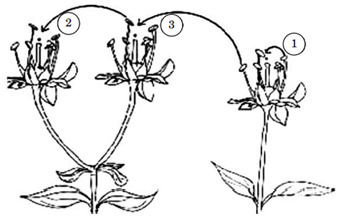
Study the diagram given below showing the modes of pollination. Answer the questions that follow.
Image
i. The given diagram shows three methods of pollen transfer in plants. What are the technical terms used for pollen transfer methods 1, 2 and 3?
ii. How do the following plants achieve pollination successfully?
1. Water lily
2. Vallisneria
iii. Flowering plants have developed many devices to avoid inbreeding depression. Explain one hereditary and one physiological device which helps plants to achieve this target.
From which plant is cocoa alkaloid or cocaine obtained? What are its effect on the human body? Write the chemical structure of morphine.
How did geographical evolution helpful in explaining evolution? Justify your answer with suitable example?
While writing the properties of genetic material, confirm that DNA is a genetic material with the help of experiment of Hershey and Chase.
What is Implantation? Describe the process of implantation with diagram.
The density of a population in a habitat per unit area is measured in different units. Write the unit of measurement against the following:
a.
Bacteria
____________
b.
Banyan
____________
c.
Deer
____________
d.
Fish
____________
The following is the illustration of the sequence of ovarian events (a – i) in a human female.

Identify the figure that illustrates ovulation and mention the stage of oogenesis it represents.