Question
How did geographical evolution helpful in explaining evolution? Justify your answer with suitable example?

Answer

Geographical distribution of animals provides evidence of biological evolution. Diverse types of animals and plants are found in different regions of the world. Although some countries are geographically different but they have similar types of flora and fauna there. While some countries with similar climates have wide variety of animals and plants. For example, elephants and lions are found in Africa, but not in Australia and America. Tiger is found in India but not in America and Australia. Similarly, animals of the marsupialia order like kangaroo, Tasmanian wolfin Australia, hippopotamus, giraffe gorilla in Africa are found, which are not found anywhere else in the world. Darwin observed black finches on Galapagos Island in the Pacific Ocean on the western coast of South America. In the study of finches, it was found that these birds are similar to the birds found in America, but there is a difference in the shape and structure of their beak. He said that the difference in the beak of these birds is the result of their adaptability to the local environment and the food available in it. In this way, many species and subspecies evolved from birds originally of one species which adapted to different environments. In this way, the geographical distribution of animals was helpful in biological evolution. Therefore, the process of evolution of different species starting from one point in a particular geographical area and spreading to other geographical areas is called adaptive radiation. Another example is the Australian marsupials. Most of the marsupials that were completely different from each other evolved from a single ancestral influence and all of them evolved within the continent of Australia. When more than one adaptive radiation appears in an isolated geographical area, it is called convergent evolution. The placental mammals of Australia are also said to display an adaptive distribution in the evolution of this type of mammalian species, each resembling a matching marsupial.
Need a full question paper?

Generate a complete, print-ready paper with questions like this in minutes — across 16+ boards, with answer keys.

Start Generating Free

Similar questions

Give a schematic labelled diagram to represent oögenesis (without descriptions)
State the Mendelian principle which can be derived from such a cross and not from monohybrid cross.
  1. Why is haemophilia generally observed in human males? Explain the conditions under which a human female can be haemophilic.
  2. A pregnant human female was advised to undergo M.T.P. It was diagnosed by her doctor that the foetus she is carrying has developed from a zygote formed by an XX-egg fertilised by Y-carrying sperm. Why was she advised to undergo M.T.P.?
(a) Describe the observations made on collection of white winged moths and dark winged moths in England between the years 1850 and 1920. What did these observations lead to?
(b) How is the use of herbicides, pesticides and antibiotics by humans for various, comparable with the observations made on moths in the above question? What is this type of phenomenon called?
Which methodology is used while sequencing the total DNA from a cell? Explain it in detail.
What is spermatogenesis? Briefly describe the process of spermatogenesis.
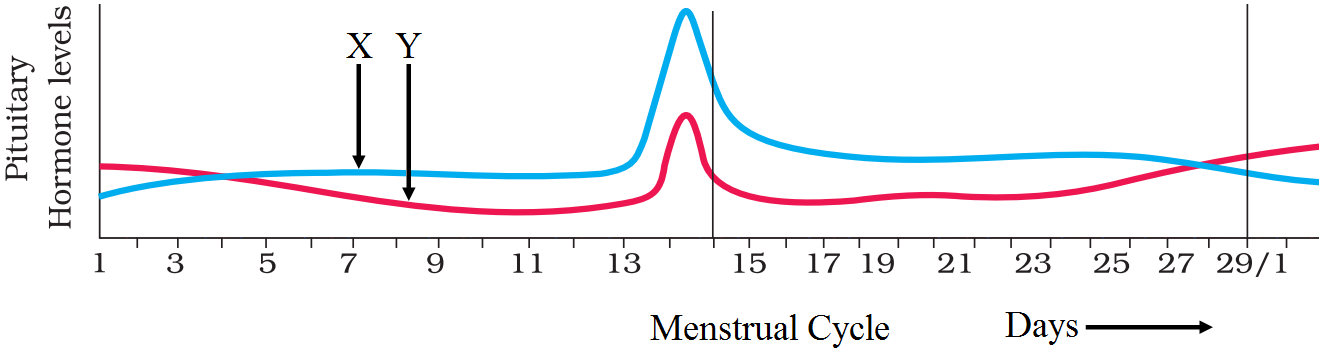
Study the graph given below and answer the questions that follow:

Name the hormones ‘X’ and ‘Y’.

(i) What is called immunity?
(ii) Write the difference between active immunity and passive immunity. (Sr. Sec. Board Exam., 2023)
(iii) Explain passive immunization. (iv) Make a labeled diagram of the stages of life cycle of Plasmodium in mosquito host.
Draw a labelled schematic structure of a transcription unit. Explain the function of each component in the unit in the process of transcription.
A child has blood group O. If the father has blood group A and mother blood group B, work out the genotypes of the parents and the possible genotypes of the other offsprings.