Question
Differentiate between meristematic and permanent tissues in plants.

Answer

Meristematic
Permanent
Cells of this tissue divide throgh out their life.
They lose the ability to divide to take up specific function.
They are located at specific regions of the plant viz apical lateral, intercalary.
They are distributed throught the plant body.
Cells of this tissue are very active, have dense cytoplasm, thin walls and prominent. They lack vacuoles.
They are vacuolated vary in shape and size. their cell wall may be thick.
Cell wall is cellulosic.
Cell wall is made up of cellulose.

Need a full question paper?

Generate a complete, print-ready paper with questions like this in minutes — across 16+ boards, with answer keys.
Start Generating Free

Similar questions

Name the three major functional regions of cells. Briefly mention the components of each and explain the function of each.
The distance between Delhi and Agra is $200\ km.$ A train travels the first $100\ km$ at a speed of $50\ km/h.$ How fast must the train travel the next $100\ km,$ so as to average $70\ km/h$ for the whole journey$?$
Explain what will happen if in a cultivated field only manures are supplied and in another field only fertilizers are supplied, keeping all other conditions similar.
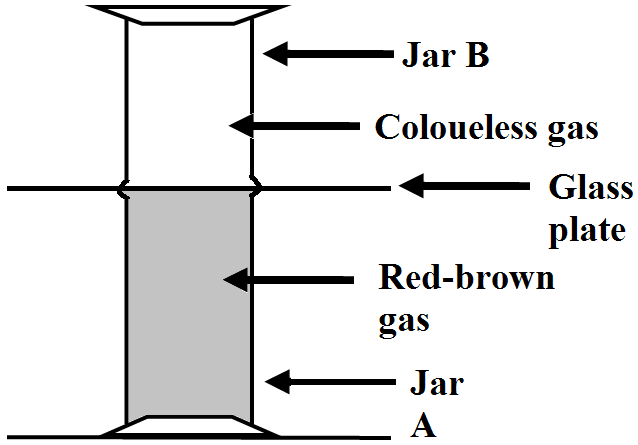
Look at the diagram on the right side. Jar $A$ contains are d-brown gas whereas Jar $B$ contains a colourless gas. The two gas jars are separated by a glass plate placed between them:
  1. What will happen when the glass plate between the two jars is pulled away?
  2. What name is given to the phenomenon which takes place?
  3. Name the brown gas which could be in jar $A$.
  4. Which is the colorless gas most likely to be present in jar $B$?
  5. Name one coloured solid and one colourless liquid which can show the same phenomenon.
Differentiate between sclerenchyma and parenchyma tissue. Draw well labelled diagram.
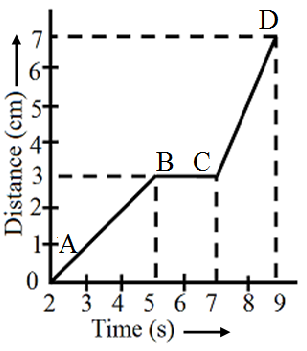
The graph given alogside shows the positions of a body at different times. Calculate the speed of the body as it moves from:
  1. $A$ to $B.$
  2. $B$ to $C.$
  3. $C$ to $D.$
Name major phyla of Animal kingdom. Write down one character and one example of each of them.
A body of $2kg$ falls from rest. What will be its kinetic energy during the fall at the end of $2s? ($Assume $g = 10m/s^2)$
How would you prepare a saturated solution of sodium chloride in water at $25^\circ C$? What will happen if this solution is cooled to $10^\circ C$?
Write an essay on crop protection management.