Question
Differentiate between primary and accessory reproductive organs

Answer

Primary Reproductive OrgansAccessory Reproductive Organs
The primary reproductive organs produce sex cells.The accessory reproductive organs help in the transfer and meeting of two kinds of sex cells leading to fertilization.
The primary reproductive organs do not help in the development of baby.The accessory organs help in the growth and development of egg up to the birth of baby.
Example: Testes in males and ovaries in females.Example: penis in males, Uterus, vagina in female.

Need a full question paper?

Generate a complete, print-ready paper with questions like this in minutes — across 16+ boards, with answer keys.
Start Generating Free

Similar questions

Mention characteristic features of mitosis.
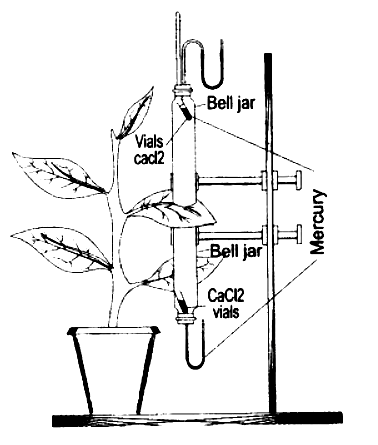
The apparatus shown here is Girreau’s poto-meter designed to demonstrate unequal transpiration from the two surfaces of a dorsiventral leaf. Before keeping the leaf in between the cups, anhydrous calcium chloride ($CaCl_2$) contained in two small vials were weighed and placed in both the cups. The ends of the cups were closed with corks through which two mercury manometers were connected. After a few hours, $CaCl_2$​​​​​​​ vials were taken out and weighed again.

(i) What is the purpose of keeping $CaCl_2$ vials inside the cup?
(ii) After a few hours, the $CaCl_2$ vials were taken out and weighed again. Will you expect any difference in weight? If so, give reasons.
(iii) What was the purpose of using a mano-meter?
(iv) What do you mean by transpiration?
Differentiate between the following:
Hydrotropism and Geotropism
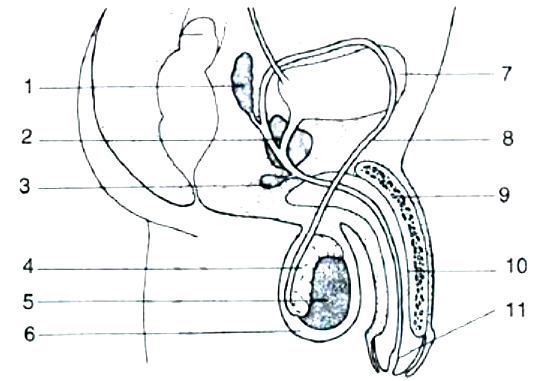
Given below is the schematic diagram of the sectional view of the human male reproductive system.
State the functions of the parts numbered 1, 2, 3, 5, 8 and 11.
Describe an experiment to prove that transpiration occurs more from the undersurface of dorsiventral leaves.
State Mendel’s law of Independent Assortment.
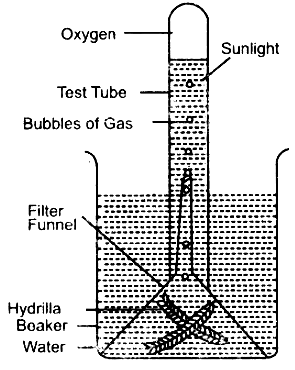
The figure below represents an experiment set up to study a physiological process in plants:

(i) Name the physiological process being studied.
(ii) Explain the process.
(iii) What is the aim of the experiment?
(iv) Give a well-balanced equation to represent the process.
Explain the following term : Homozygous
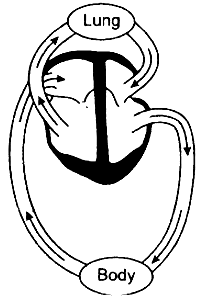
The diagram represents the ‘closed system’ or ‘double circulation’ of blood in mammals.

Justify the above statement.
State two structural and two functional differences between the arteries and veins.
State the changes in the composition of blood as it passes through the following organs:
$(a)$ Lungs $(b)$ Gut $(c)$ Liver $(d)$ Kidneys.