Question 13 Marks
Given below is a portion of the diagram to show the diagrammatic highly magnified view of a single human sperm. Complete the diagram to show its normal structure.

11 questions · timed · auto-graded
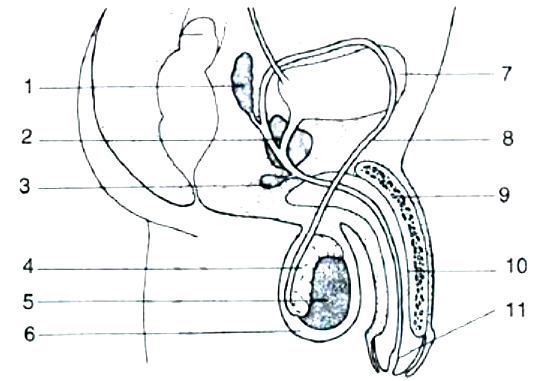
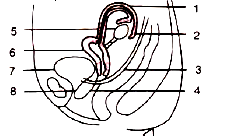
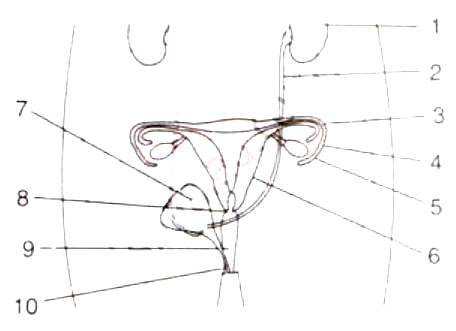
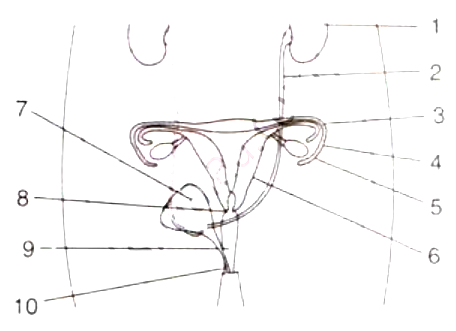
| 1 | Kidney |
| 2 | Ureter |
| 3 | Fallopian Tube |
| 4 | Infundibulum |
| 5 | Ovary |
| 6 | Uterus |
| 7 | Urinary Bladder |
| 8 | Cervix |
| 9 | Vagina |
| 10 | Vulva |
| Primary Reproductive Organs | Accessory Reproductive Organs |
| The primary reproductive organs produce sex cells. | The accessory reproductive organs help in the transfer and meeting of two kinds of sex cells leading to fertilization. |
| The primary reproductive organs do not help in the development of baby. | The accessory organs help in the growth and development of egg up to the birth of baby. |
| Example: Testes in males and ovaries in females. | Example: penis in males, Uterus, vagina in female. |
| Structure | Function | ||
| 1 | Corpus luteum | 1 | …………… |
| 2 | ……………. | 2 | Produces male gametes in mass |
| 3 | Placental disc | 3 | …………………….. |
| 4 | . ……………. | 4 | Increases the force in uterine contractions during child birth |
| 5 | Umbilical cord | 5 | …………………. |
| 6 | Fallopian tube | 6 | ………………… |
| Structure | Function | ||
| 1 | Corpus luteum | 1 | secretes progesterone & other hormones to prepare the uterine wall for the receival of the embryo. |
| 2 | Testes | 2 | produces male gametes in mass |
| 3 | Placental disc | 3 | supplies oxygen and nutrients to embryo |
| 4 | Oxytocin | 4 | increases the force in uterine contractions during child birth |
| 5 | Umbilical cord | 5 | connects placenta with foetus |
| 6 | Fallopian tube | 6 | The site of fertilization for the sperm and ovum |