Question
Differentiate between primary and secondary growth in plants.
Answer

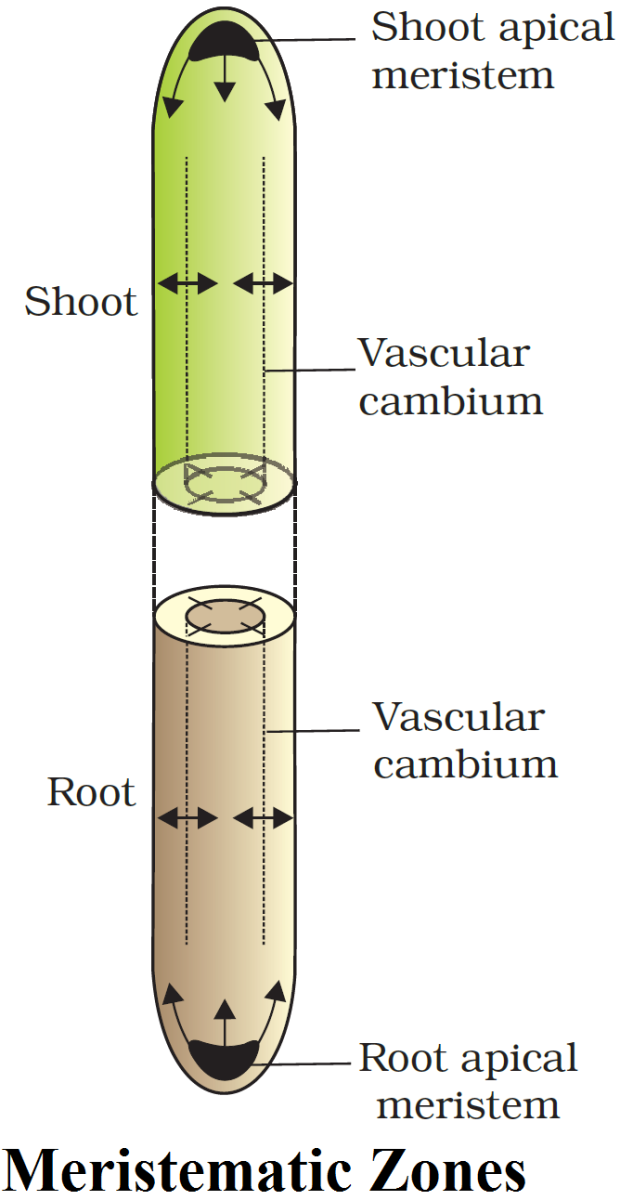
Apical, lateral and intercalary are the special regions, where growth is localised in plants. At the apex of every root and shoot apical meristems are present which are responsible for the elongation of plant along their axis. This is known as primary growth of the plant. The lateral meristems, vascular cambium and cork cambium appear later in life in dicotyledonous plants and gymnosperms and are responsible for the increase in the girth of the stem. This increase in girth is known as secondary growth of the plant. Diagrammatic representation if locations of root apical meristem, shoot apical meristem and vascular cambium. Arrows exhibit the direction of growth of cells and organ.

Need a full question paper?

Generate a complete, print-ready paper with questions like this in minutes — across 16+ boards, with answer keys.

Start Generating Free

Similar questions

Define RQ. What is its value for fats?
Differentiate between Rough Endoplasmic Reticulum (RER) and Smooth Endoplasmic Reticulum (SER).
Enlist the functions of polysaccharides.
Why biologists do not favour common names? Discuss briefly.
We know that photosynthesis is the only means because of which we get food. Here are two suggestions to increase the availability of food for human beings. Which of them is good and why?
  1. We should replace all plants with those plants from which we get food.
  2. We should maintain the diversity of plant species because all plants are To important for us.
Draw a labelled diagram showing reabsorption and secretion of major substances at different partsof the nephron.
How do plants manage exchange of gases? Give an overview of respiration in plants.
ATP is called the energy currency of the cell. In our life, we can compare ATP with which of the following? What could have happened if there were no mechanism of storing the energy in the form of ATP?
  1. ATM Machine.
  2. Bank account.
  3. Currency notes.
Amrita's biology teacher taught in biology class that food helps in building the body and alsoprovides us energy to work. However, she was not able to understand the mechanisms involved. So, she discussed it with his father who is a professor of biology in a college. He answered that in living organisms certain structures, present in the cells and known as power houses of cells, which are responsible for conversion of food into energy. Read the above passage and answer the following questions.
  1. Which cell organelles are known as power house of cell? Why?
  2. List major components of mitochondrion.
  3. What values are displayed by Amrita's father?
Discuss “The respiratory pathway is an amphibolic pathway.”