Question
Differentiate between rate of reaction and reaction rate constant.

Answer

S. No Rate of Reaction Reaction Rate Constant
(i) Rate of reaction is the change in concentration of a reactant or product in a unit interval of time. It is the rate of reaction when the molar concentration of each of the reactants is unity.
(ii) The rate of reaction at any instant of time depends upon the molar concentrations of the reactants at that time. The rate constant does not depend upon the concentrations of the reactants.
(iii) Its units are always mol litre–1 time–1. Its units depend upon the order of reaction.

Need a full question paper?

Generate a complete, print-ready paper with questions like this in minutes — across 16+ boards, with answer keys.
Start Generating Free

Similar questions

An organic compound 'A' (molecular formula C3H6O) is resistant to oxidation but forms a compound 'B' (
C3H8O) on reduction. 'B' reacts with HBr to form a bromide'C' which on treatment with alcoholic KOH forms an alkene 'D' (C3H6). Deduce the structures of A, B, C and D.
Explain how does the - OH group attached to a carbon of benzene ring activate it towards electrophilic substitution?
State two advantages of H2-O2 fuel cell over ordinary cell.
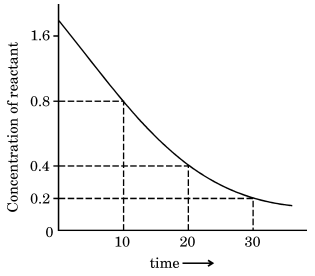
Analyse the given graph, drawn between concentration of reactant vs. time.
Image
(a) Predict the order of reaction.
(b) Theoretically, can the concentration of the reactant reduce to zero after infinite time? Explain.
What is Popaff's rule? Explain with example.
For the first order thermal decomposition reaction, the following data were obtained:
$\text{C}_{2}\text{H}_{5}\text{Cl}\text{(g)}\rightarrow \text{C}_{2}\text{H}_{4}\text{(g)} + \text{HCl}\text{(g)} $
Time/sec Total pressure/atm
0 0.30
300 0.50
Calculate the rate constant
(Given: log 2 = 0.301, log 3=0.4771, log 4 =0.6021)
How would you account for the following:
Cobalt(II) is stable in aqueous solution but in the presence of complexing reagents it is easily oxidised.
(a) How will you distinguish between the following pairs of compounds :
(i) Aniline and Ethanamine
(ii) Aniline and $N$-methylaniline
(b) Arrange the following compounds in decreasing order of their boiling points :
Butanol, Butanamine, Butane.
Complete the following equations :
(i) $CH _3- CH _2- Cl \xrightarrow{+ A } B \xrightarrow{ C } CH _3- CH _2- NH _2+ HCOOH$
(ii) $CH _3- I \xrightarrow{+ A } B \xrightarrow{ C } CH _3- NH - CH _3$
Compare the chemistry of actinoids with that of the lanthanoids with special reference to:
Oxidation state