Question
Differentiate between :
Turgidity and Flaccidity

Answer

 
TurgidityFlaccidity
 When the cell is filled with water, so that its cell wall   is   in a state of tension, it is said to be turgid and the   condition is called turgidity. When a cell loses water from its cytoplasm   under plasmolytic conditions, it is said to be   flaccid and the condition is known as flaccidity.
It is caused by endosmosis. It is caused by exosmosis.
 Plasma membrane is pushed against the cell wall. Plasma membrane is not pushed tightly against   the cell wall.
 

Need a full question paper?

Generate a complete, print-ready paper with questions like this in minutes — across 16+ boards, with answer keys.
Start Generating Free

Similar questions

All life owes its existence to chlorophyll. Give reason.
Explain in brief the opening and closing mechanism of stomata.
Differentiate between:
Arteries and Veins.
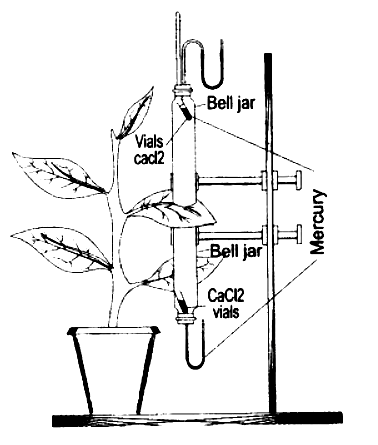
The apparatus shown here is Girreau’s poto-meter designed to demonstrate unequal transpiration from the two surfaces of a dorsiventral leaf. Before keeping the leaf in between the cups, anhydrous calcium chloride ($CaCl_2$) contained in two small vials were weighed and placed in both the cups. The ends of the cups were closed with corks through which two mercury manometers were connected. After a few hours, $CaCl_2$​​​​​​​ vials were taken out and weighed again.

(i) What is the purpose of keeping $CaCl_2$ vials inside the cup?
(ii) After a few hours, the $CaCl_2$ vials were taken out and weighed again. Will you expect any difference in weight? If so, give reasons.
(iii) What was the purpose of using a mano-meter?
(iv) What do you mean by transpiration?
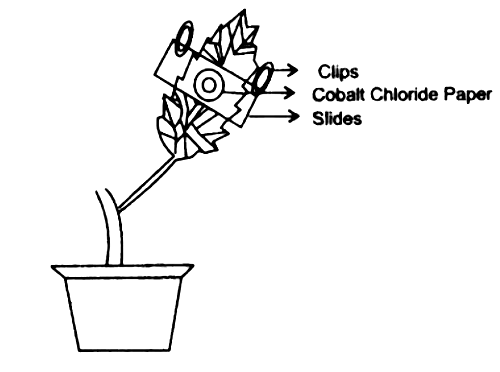
Given below is the diagram of an experimental set up to study the process of transpiration in plants. Study the same and then answer the questions that follow:

(i) What is the colour of dry cobalt chloride paper?
(ii) Is the experimental leaf a monocot or a dicot? Give a reason to support your answer.
(iii) Why axe glass slides placed over the dry cobalt chloride papers?
(iv) After about half an hour what change, if any, would you expect to find in the cobalt chloride paper placed on the dorsal and ventral sides of the leaf? Give a reason to support your answer.
(v) Define the term ‘transpiration’.
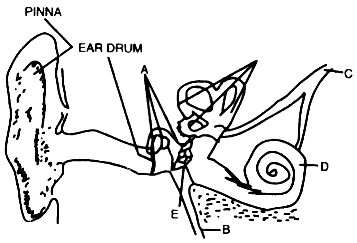
Given below is the diagram of the human ear. Study the same and answer the questions that follow:
(i) Give the biological term for the part labeled ‘A’ and state its function.
(ii) Name the part labeled ‘B’ and state its function.
(iii) Name the part labeled ‘C’ and state its function.
(iv) Give the function of ear wax.
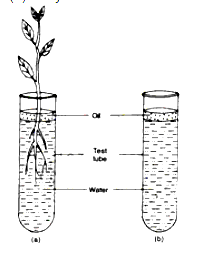
The figure below represents the set-up at the start of certain experiment to demonstrate an activity of plants:
(i) What is the aim of the experiment?
(ii) Why has oil been put in each test tube?
(iii) What will be the observations in the two test-tubes after about 2-3 days?
(iv) Give reasons to explain any change observed as answered in (iii) above.
(v) Why has the test-tube b without the plant, been taken in the experiment?
What is a monohybrid cross? How did Mendel perform this cross?
What is dialysis? Under what condition is it carried out?
Differentiate between the following:
Ethylene and Abscisic Acid