Questions

[3 marks Question Answer]

🎯

Test yourself on this topic

12 questions · timed · auto-graded
Question 23 Marks
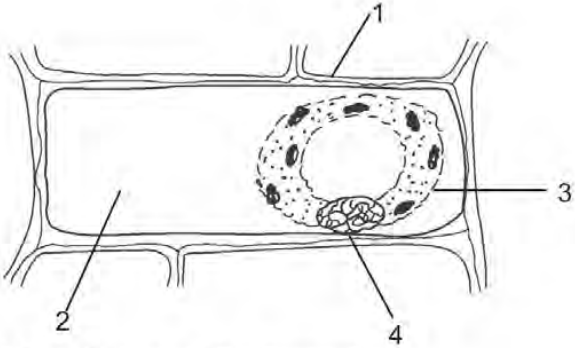
The diagram given below represents a plant cell after being placed in a strong sugar solution:

Image
(i) What is the state of the cell shown in the diagram?
(ii) Name the structure that acts as a selectively permeable membrane.
(iii) How can the above cell be brought back to its original condition? Mention the scientific term for the recovery of the cell.
Answer
(i) The cell shown in given diagram is plasmolysed cell.
(ii) Cell membrane (3) acts as a selectively permeable membrane.
(iii) The plasmolysed cell should be placed in normal water which will bring back the cell to its original condition. The term used for the recovery of a plasmolysed cell is known as deplasmolysis.
View full question & answer
Question 33 Marks
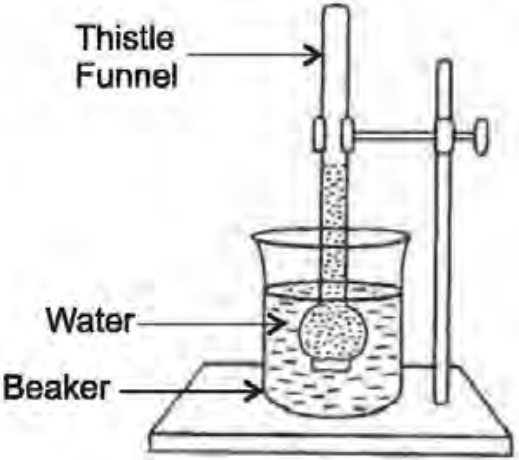
Given diagram represents an apparatus set-up to study a very important physiological process.
(i) Name the process being studied.
(ii) Explain the process.
(iii) What change would you observe in the thistle funnel containing sugar Thistle Funnel solution after about 10 minutes?

Image
Answer
(i) Osmosis is being studied in the given set up.
(ii) Osmosis is defined as the net movement of water molecules from a region of their higher concentration to a region of their lower concentration through a semipermeable membrane.
(iii) After 10 minutes, the level of sugar solution rises in the tube of thistle Water Beaker funnel, whereas water level in the beaker falls.
View full question & answer
Question 43 Marks
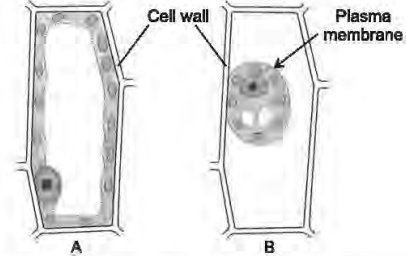
Given below are diagrams of plant cells as seen under the microscope after having been placed in two different solutions :

Image

(i) What is the technical term for the condition of the following?
(a) Cell A
(b) Cell B
(ii) From the solutions given in brackets (water, strong sugar solution, $1 \%$ salt solution) name the solution into which :
(a) Cell A
(b) Cell B, was placed before being viewed under the microscope,
(iii) Under what conditions in the soil will the root hair cell resemble:
(a) Cell A
(b) Cell $B$
Answer
(i) (a) Condition of Cell A is called turgid cell.
(b) Condition of Cell B is called plasmolysed or flaccid cell.
(ii) (a) Cell A was placed in water before being viewed under the microscope.
(b) Cell B was placed in strong sugar solution before being viewed under the microscope.
(iii) (a) The root hair cell will resemble cell A when the soil around the roots is well watered. This causes the root cells to become turgid.
(b) The root hair cell will resemble cell B when the roots are surrounded by high concentration of salts (like fertilisers) and less water content is available in the soil.
View full question & answer
Question 53 Marks
What is the significance of osmosis? Explain in brief.
Answer
Osmosis is the diffusion of water molecules only. It is defined as the net movement of water molecules from a region of higher concentration to a region of lower concentration through a semi-permeable membrane. It can be of two types i.e. endosmosis or exosmosis.
Significance of osmosis :
• It helps in the absorption of water and minerals by the plants.
• It develops turgidity in cells and thus, maintains turgor pressure in them.
• It allows the movement of water from one cell to another thereby, ensuring flow of minerals too.
• It regulates the opening and closing of stomata.
• The soft organs such as leaves, flowers, fruits and young stems are able to keep themselves stretched and erect due to turgidity of their cell which is dependent upon osmosis.
View full question & answer
Question 63 Marks
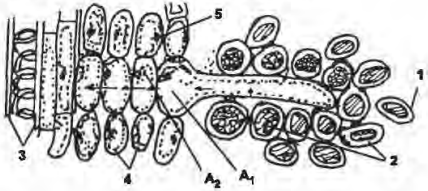
The figure given below is a diagramatic representation of a part of the cross section of the root in the root hair zone. Study the same and answer the questions that follow:
Image
(i) Name the parts indicated by guidelines 1 to 5 .
(ii) Name the process responsible for the passage of water molecules from soil into $A_1$ and then into $A_2$.
(iii) How is this pressure set up?
Answer
(i) 1. Film of water around soil particles
2. Soil particles
3. Xylem vessel
4. Cortex
5. Vacuole
(ii) Osmosis
(iii) Due to difference in the concentration of salts in the cells, this pressure set up.
View full question & answer
Question 73 Marks
What is the difference between diffusion and osmosis? State the significance of osmosis in plant physiology.
Answer
Diffusion
• It is the movement of any type of substances from the region of their higher concentration to that of lower concentration.
• No membrane is required.
Osmosis
• It is the movement of water molecules from a solution of lower concentration to that of higher concentration.
• It occurs through a semi-permeable membrane.
Significance of Osmosis : Osmosis is mainly responsible for the movement of water from non-living xylem elements into living cells. Osmosis depends on the stretched and rigid condition of cells which makes growth possible and is responsible for keeping the young stem erect and leaves extended.
View full question & answer
Question 83 Marks
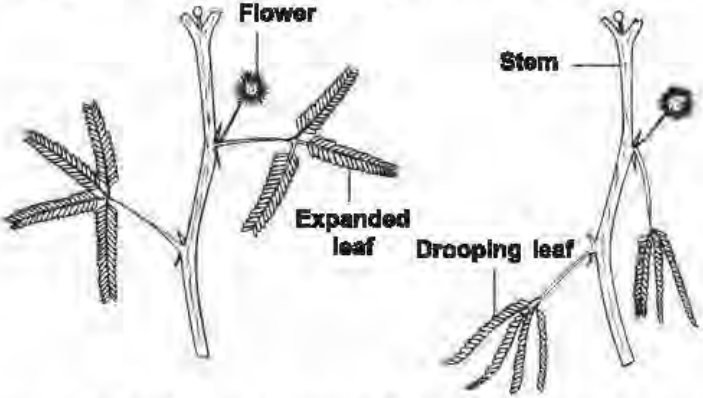
Leaves of a sensitive plant wilt and droop down on a slight touch. What mechanism brings about this change?
Answer
Drooping of the leaflets of sensitive plant : If any leaf of Mimosa (Touch-me-not plant) is touched, it gets folded and within 2-3 seconds the entire leaf droops. Slowly the leaf recovers. Stimulus of touch leads to loss of turgor pressure at the base of leaflets and base of petioles, causing the leaf to wilt temporarily.

Image
View full question & answer
Question 93 Marks
State three ways in which roots are suited for absorbing water.
Answer
In land plants most of the water is absorbed through the roots. Roots are suited for absorbing water in the following ways :
(i) Surface area of roots : Roots are branched extensively, ending in millions of root tips. Numerous root hairs are present in the root hair zone of the root tip. Therefore, all together the roots of plants provide tremendous surface area which facilitates absorption of water.
(ii) Root hair contains cell sap of a concentration higher than that of the surrounding water. This characteristic is an important requirement to draw in the water from outside.
(iii) Root hairs have thin walls : Root hairs are an extension of the epidermal cell of the root. The cell wall is thin and allows the movement of water molecules and dissolved substances freely in and out. The cell membrane is thin but semi-permeable, i.e., it allows water molecules to pass through but not the larger molecules of the dissolved salts.
View full question & answer
Question 103 Marks
Differentiate between :
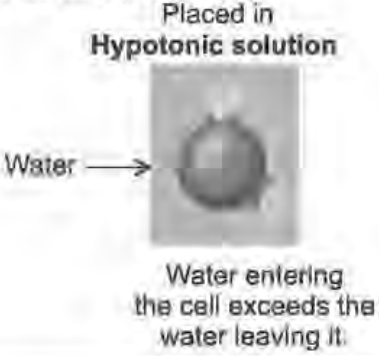
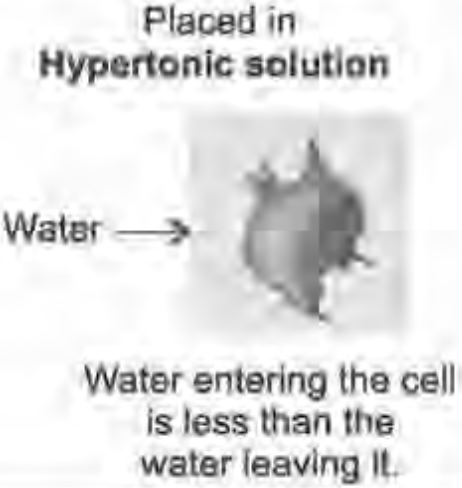
Hypotonic solution and Hypertonic solution
View full question & answer
Question 113 Marks
Differentiate between :
Plasmolysis and Deplasmolysis
Answer
 
PlasmolysisDeplasmolysis
 It is the shrinkage of protoplasm of a cell,   when it is kept in hypertonic solution. When the plasmolysed cell is kept in normal water,
 protoplasm returns to its original position, it is called   deplasmolysis.
 It is a result of movement of water out of the   cell. It is the result of entry of water into a plasmolysed cell.
 It occurs when cells are placed in hypertonic   solution. It occurs when cells are placed in hypotonic solution.
 
View full question & answer
Question 123 Marks
Differentiate between :
Turgidity and Flaccidity
Answer
 
TurgidityFlaccidity
 When the cell is filled with water, so that its cell wall   is   in a state of tension, it is said to be turgid and the   condition is called turgidity. When a cell loses water from its cytoplasm   under plasmolytic conditions, it is said to be   flaccid and the condition is known as flaccidity.
It is caused by endosmosis. It is caused by exosmosis.
 Plasma membrane is pushed against the cell wall. Plasma membrane is not pushed tightly against   the cell wall.
 
View full question & answer