Question
Differentiate the following from first principle$\tan\text{2x}$

Answer

$\text{f}(\text{x})=\tan\text{2x}$$\text{f}'(\text{x})=\lim_\limits{\text{h}\rightarrow0}\frac{\text{f}(\text{x}+\text{h})-\text{f}(\text{x})}{\text{h}}$
$=\lim_\limits{\text{h}\rightarrow0}\frac{\tan2(\text{x}+\text{h})-\tan2\text{x}}{\text{h}}$
$=\lim_\limits{\text{h}\rightarrow0}\frac{\sin(\text{2x}+\text{2h}-\text{2x})}{\text{h}.\cos(\text{2x}+\text{2h})\cos\text{2x}}\ \Big[\because\tan\text{A}-\tan\text{B}=\frac{\sin\text{A}-\text{B}}{\cos\text{A}.\cos{\text{B}}}\Big]$
$=\lim_\limits{\text{h}\rightarrow0}\frac{\sin2\text{h}}{\text{h}.\cos(\text{2x}+\text{2h})\cos2\text{x}}$
$=\lim_\limits{\text{h}\rightarrow0}\Big(\frac{\sin2\text{h}}{2\text{h}}\Big)\times\frac{1\times2}{\cos(\text{2h}+\text{2x})\cos2\text{x}}$
$=\frac{2}{\cos2\text{x}.\cos2\text{x}}\ \Big[\because\lim_\limits{\text{h}\rightarrow0}\frac{\sin2\text{h}}{2\text{h}}=1\Big]$
$=2\sec^22\text{x}\ \Big[\because\frac{1}{\cos^2\text{x}}=\sec^2\text{x}\Big]$

Need a full question paper?

Generate a complete, print-ready paper with questions like this in minutes — across 16+ boards, with answer keys.
Start Generating Free

Similar questions

If X lies in the first quadrant and $\cos\text{x}=\frac{8}{17},$ then prove that
$\cos\Big(\frac{\pi}{6}+\text{x}\Big) +\cos\Big(\frac{\pi}{4}-\text{x}\Big)+\cos\Big(\frac{2\pi}{3}-\text{x}\Big)=\Big(\frac{\sqrt{3}-1}{2}+\frac{1}{\sqrt{2}}\Big)\frac{23}{17}$
Find the values of the parameter a so that the point (a, 2) is an interior point of the triangle formed by the lines x + y - 4 = 0, 3x - 7y - 8 = 0 and 4x - y - 31 = 0.
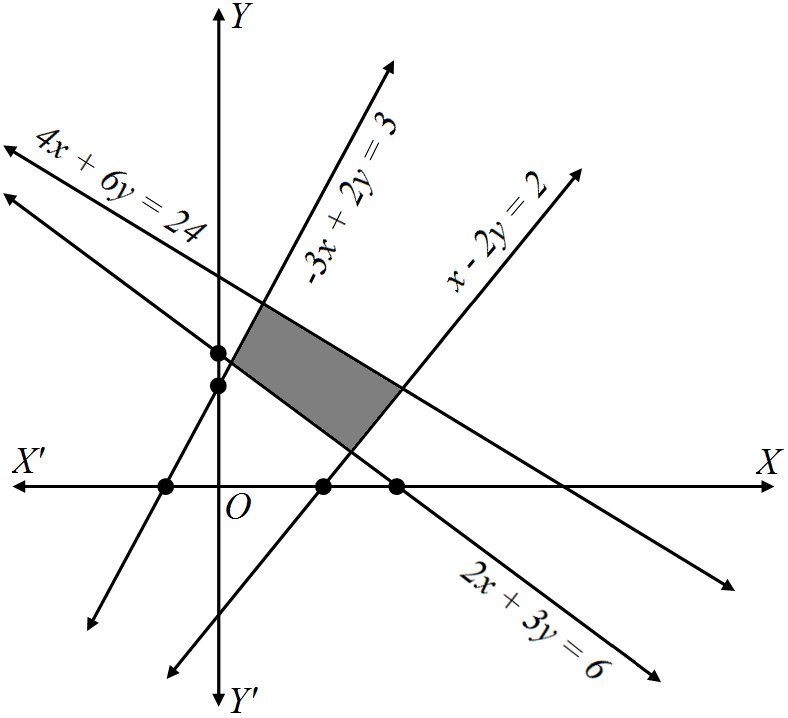
Find the linear inequations for which the solution set is the shaded region given in Fig.
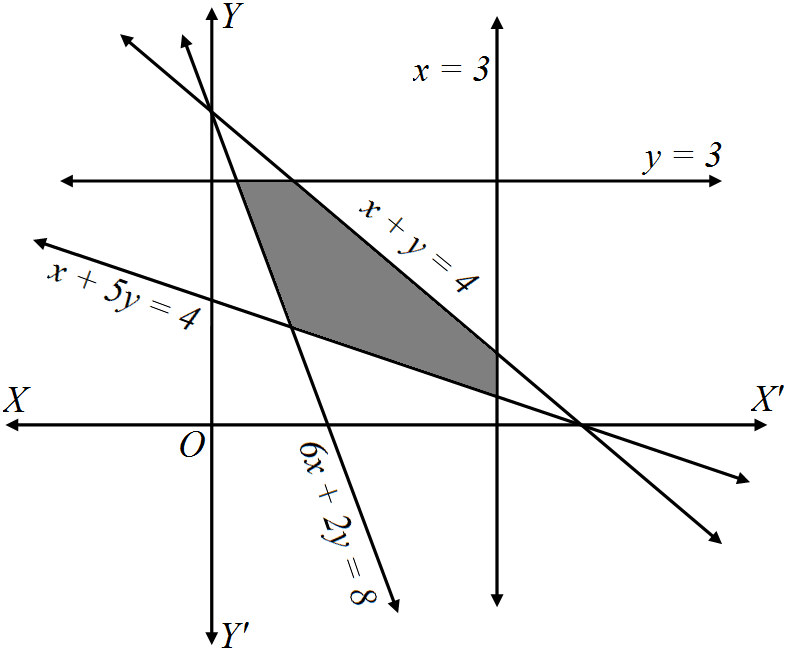
Find the linear inequations for which the shaded area in Fig. is the solution set. Draw the diagram of the solution set of the linear inequations:
Determine the values of $p$ and $q$ that make the function $f(x)$ differentiable on $R$ where
$f(x) = px^3,$ for $x < 2$
$= x^2 + q,$ for $x \geq 2$
Solve the following linear equations by using Cramer’s Rule : $\frac{-2}{x}-\frac{1}{y}-\frac{3}{z}=3, \frac{2}{x}-\frac{3}{y}+\frac{1}{z}=-13$ and $\frac{2}{x}-\frac{3}{z}=-11$
For any two sets A and B, prove that
$(\text{A}\cap\text{B})-\text{B = A}- \text{B}$
Find the number of:
  1. Diagonals.
  2. Triangles formed in a decagon.
Two tangents to the parabola $y^2=8 x$ meet the tangents at the vertex in the points $P$ and

Q. If PQ = 4, prove that the equation of the locus of the point of intersection of two

tangents is $y^2=8(x+2)$.

The cost of $2$ books, $6$ notebooks and $3$ pens is $Rs.120.$ The cost of $3$ books, $4$ notebooks and $2$ pens is $Rs. 105.$ while the cost of $5$ books, $7$ notebooks and $4$ pens is $Rs. 183.$ Using this information find the cost of $1$ book, $1$ notebook and $1$ pen.