Question
Differentiate the following:
  1. Wave velocity and particle velocity.
  2. Harmonics and overtones.

Answer

  1.  
Wave velocity
Particle velocity
The velocity of wave motion through a particular medium is constant. It depends only on the nature of the medium, does not depends upon its frequency or wavelength or intensity.
Velocity of the particles during their vibration is different at different position.
  1.  
Harmonics
Overtones
Harmonics are the notes/ seconds of frequency equal to or an integral multiple of fundamental frequency (n). Thus, first, second, third, ... harmonics have frequencies n, 2n, 3n, ... respectively.
Overtones are the notes/ seconds of frequency twice/ thrice/ four times ... the fundamental frequency (n). Thus, first, second, third, ... overtones have frequencies 2n, 3n, 4n, ... respectively and so on.

Need a full question paper?

Generate a complete, print-ready paper with questions like this in minutes — across 16+ boards, with answer keys.
Start Generating Free

Similar questions

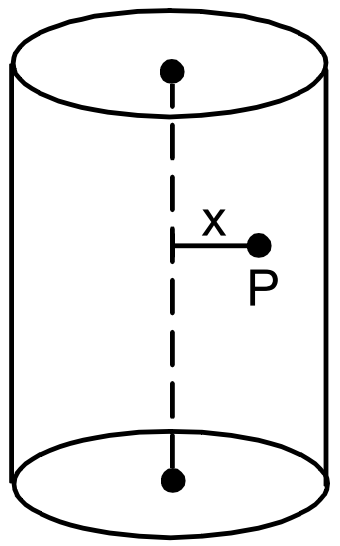
A long cylindrical volume contains a uniformly distributed charge of density $\rho.$ Find the electric field at a point P inside the cylindrical volume at a distance x from its axis (figure).
What is a simple periodic damped oscillator? Explain. Establish an equation for its motion and show that its amplitude decreases exponentially with time and the total energy decreases exponentially with time.
A body of mass m falls from a height h on to the pan of a spring balance. The masses of the pan and spring are negligible. The spring constant of the spring is k. Having stuck to the pan the body starts performing harmonic oscillations in the vertical direction. Find the amplitude and energy of oscillation.
Why does blowing over a spoonful of hot tea cools it? Does evaporation play a role? Does radiation play a role?
Two identical steel cubes (masses $50g$, side $1cm$) collide head-on face to face with a speed of $10cm/ s$ each. Find the maximum compression of each. Young’s modulus for steel = $Y = 2 \times 1011 N/ m^2$.
Explain with the suitable example that a reversible process must be carried slowly and a fast process is necessarily irreversible.
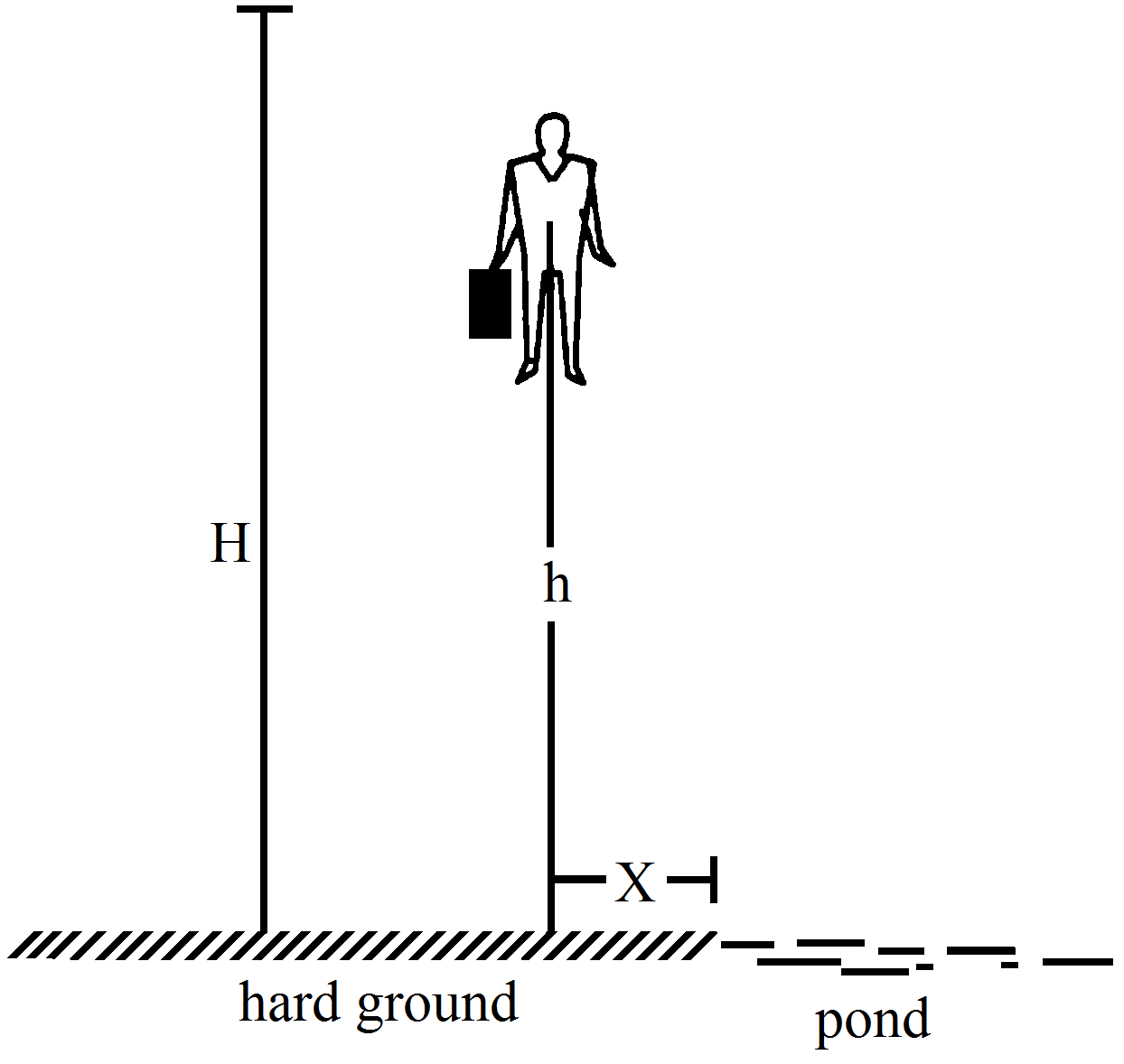
A man of mass M having a bag of mass m slips from the roof of a tall building of height H and starts falling vertically. When at a height h from the ground, he notices that the ground below him is pretty hard, but there is a pond at a horizontal distance x from the line of fall. In order to save himself he throws the bag horizontally (with respect to himself) in the direction opposite to the pond. Calculate the minimum horizontal velocity imparted to the bag so that the man lands in the water. If the man just succeeds to avoid the hard ground, where will the bag land?
The time constant of an LR circuit is 40ms. The circuit is connected at t = 10 and the steady-state current is found to be 2.0A. Find the current at:
  1. t = 10ms
  2. t = 20ms
  3. t = 100ms
  4. t = 1s.
A parallel-plate capacitor of plate area $40cm^2$ and separation between the plates 0.10mm, is connected to a battery of emf 2.0V through a $16\Omega$ resistor. Find the electric field in the capacitor 10ns after the connections are made.
A spaceship is stationed on Mars. How much energy must be expended on the spaceship to launch it out of the solar system? Mass of the space ship $=1000 \mathrm{~kg}$; mass of the sun $=2 \times 10^{30} \mathrm{~kg}$; mass of mars $=6.4 \times 10^{23} \mathrm{~kg}$; radius of mars $=3395 \mathrm{~km}$; radius of the orbit of mars $=2.28 \times 10^8 \mathrm{~km} ; G=6.67 \times 10^{-11} \mathrm{~N} \mathrm{~m}^2 \mathrm{~kg}^{-2}$.