Question
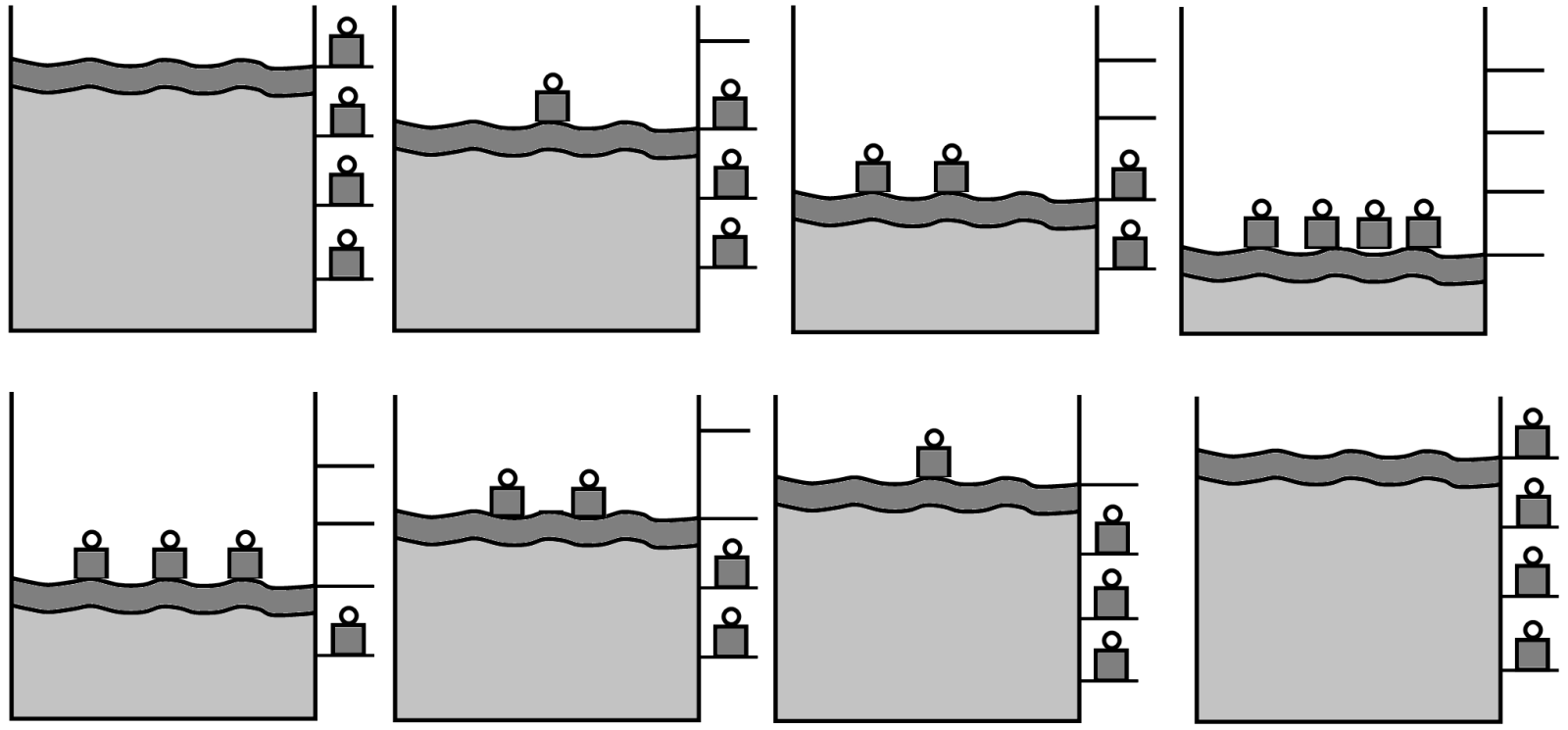
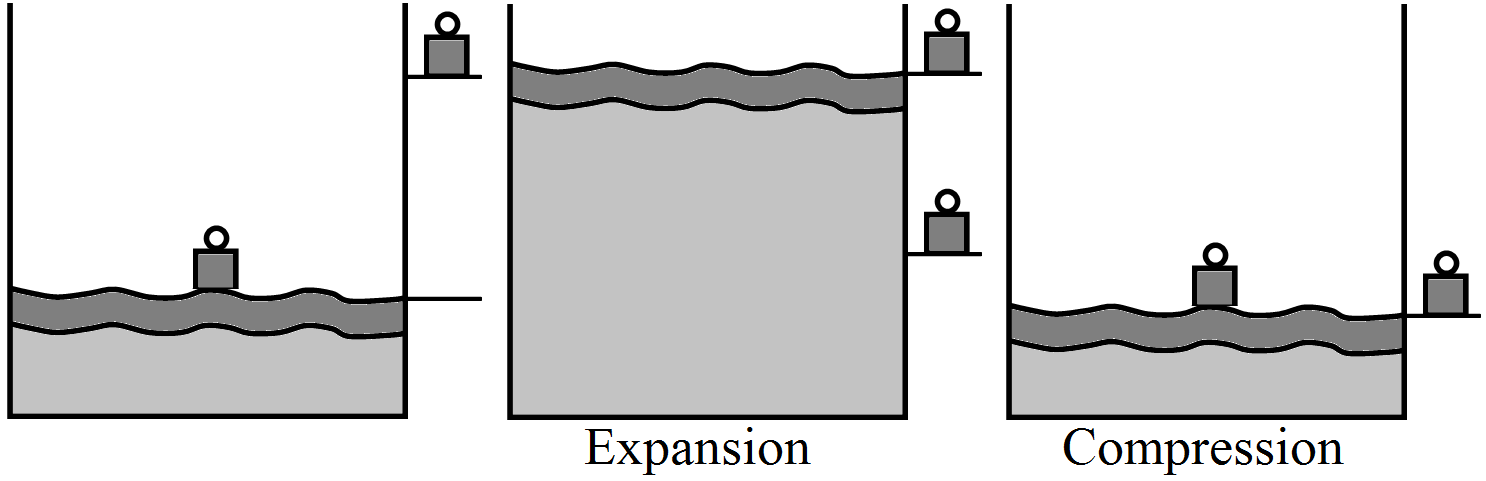
Explain with the suitable example that a reversible process must be carried slowly and a fast process is necessarily irreversible.
Answer

A reversible process must pass through equilibrium states which are very close to each other so that when process is reversed, it passes back through these equilibrium states. Then, it is again decompressed or it passes through same equilibrium states, system can be restored to its initial state without any change in surroundings. e.g. If a gas is compressed as shown But a reversible process can proceeds without reaching equilibrium in intermediate states.
Need a full question paper?

Generate a complete, print-ready paper with questions like this in minutes — across 16+ boards, with answer keys.

Start Generating Free

Similar questions

Find the time period of small oscillations of the following systems.
  1. A metre stick suspended through the $20cm$ mark.
  2. A ring of mass in and radius r suspended through a point on its periphery.
  3. A uniform square plate of edge a suspended through a corner.
  4. A unifrom disc of mass m and radius r suspended through a point $\frac{\text{r}}{2}$ away from the centre.
If a liquid is flowing through a horizontal tube, write down the formula for the volume of the liquid flowing per second through it. Water is flowing through a horizontal tube of radius $2r$ and length $1m$ at a rate of $60L/s$, when connected to a pressure difference of h cm of water. Another tube of same length but radius is connected in series with this tube and the combination is connected to the same pressure head. Find out the pressure difference across each tube and the rate of flow of water through the combination.
If a drop of liquid breaks into smaller droplets, it results in lowering of temperature of the droplets. Let a drop of radius R, break into N small droplets each of radius r. Estimate the drop in temperature.
A progressive harmonic wave on a string is expressed as follow
$
y(x, t)=7.5 \sin (0.0050 x+12 t+\pi / 4)
$
(a) Find the speed at a point $x=1 cm$ on time $t=1$ sec. Is this speed is equal to the speed of wave propagation?
(b) Find the location of those points of the string whose tranverse displacement and speed are the same as that of the point located at $x=1 cm$ at times $t =2 s, 5 s$ and $11s.$
What is meant by thermal radiation? What is the nature of thermal radiation? Explain.
A body performs simple harmonic motion according to the following equation :
$
x=6 \sin \left(3 \pi t+\frac{\pi}{3}\right)
$
Find out : (i) amplitude (ii) period (iii) initial art (iv) displacement, velocity and acceleration at time $t = 2$.
A chain of length l and mass m lies on the surface of a smooth sphere of radius R>1 with one end tied to the top of the sphere.
  1. Find the gravitational potential energy of the chain with reference level at the centre of the sphere.
  2. Suppose the chain is released and slides down the sphere. Find the kinetic energy of the chain, when it has slid through an angle $\theta.$
  3. Find the tangential acceleration $\frac{\text{dv}}{\text{dt}}$ of the chain when the chain starts sliding down.
A compound microscope has a magnifying power of $100$ when the image is formed at infinity. The objective has a focal length of $0.5cm$ and the tube length is $6.5cm$. Find the focal length of the eyepiece.
Explain how stationary waves are formed in open and closed pipes. Compare the first three harmonics produced in them.
Suppose the rod with the balls $A$ and $B$ of the previous problem is clamped at the centre in such a way that it can rotate freely about a horizontal axis through the clamp. The system is kept at rest in the horizontal position. $A$ particle $P$ of the same mass $m$ is dropped from a height $h$ on the ball $B.$ The particle collides with $B$ and sticks to it:
  1. Find the angular momentum and the angular speed of the system just after the collision.
  2. What should be the minimum value of $h$ so that the system makes a full rotation after the collision.