MCQ
Diffusion current in a p-n junction is greater than the drift current in magnitude:
  • If the junction is forward-biased.
  • B
    If the junction is reverse-biased.
  • C
    If the junction is unbiased.
  • D
    In no case.

Answer

Correct option: A.
If the junction is forward-biased.
In the forward biassing of a p−n junction, the positive terminal of the battery is connected to the p side of the p−n junction and the negative terminal of the battery is connected to the n side of the p−n junction. As a result, electrons in the n side of the p−n junction are repelled by the negative terminal of the battery and move to the p side, where the positive terminal of the battery attracts the electrons. Similarly, holes from the p side of the p−n junction are repelled by the positive terminal of the battery and move to the nside, where the negative terminal of the battery attracts the holes. Thus, they give diffusion current across the p−n junction.

In case of reverse biassing, no conduction takes place across the junction because of the diffusion of majority carriers. Hence, there is no diffusion current.

If the junction is unbiased, then diffusion current is initially maximum. But at equilibrium, diffusion current becomes equal to drift current.
Need a full question paper?

Generate a complete, print-ready paper with questions like this in minutes — across 16+ boards, with answer keys.

Start Generating Free

Similar questions

The image of an object, formed by a plano-convex lens at a distance of $8 \ m$ behind the lens, is real and is one-third the size of the object. The wavelength of light inside the lens is $\frac{2}{3}$ times the wavelength in free space. The radius of the curved surface of the lens is :
A triode is operated in the linear region of its characteristics. If the plate voltage is slightly increased, the dynamic plate resistance will:
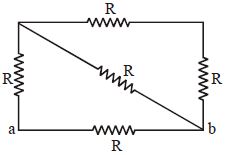
Find out the equivalent resistance between the points $a$ and $b$
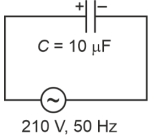
A $10 \mu \mathrm{F}$ capacitor is connected to a $210 \mathrm{~V}, 50 \mathrm{~Hz}$ source as shown in figure. The peak current in the circuit is nearly $(\pi=3.14)$ :
The frequency of $1^{\text {st }}$ line of Balmer series in $H _2$ atom is $v _0$. The frequency of line emitted by singly ionised He atom is
At magnetic poles, the angle of dip is:
In the previous question, the smallest kinetic energy at the bottom of the incline will be achieved by :
A non uniformly shaped conductor is charged then at it's sharpest point
Two electric dipoles $A, B$ with respective dipole moments $\overrightarrow {{d_A}}  =  - 4\,qa\,\hat i$ and $\overrightarrow {{d_B}}  =  2\,qa\,\hat i$ are placed on the $x-$ axis with a separation $R$, as shown in the figure. The distance from $A$ at which both of them produce the same potential is
A negative test charge is moving near a long straight wire carrying a current. The force acting on the test charge is parallel to the direction of the current. The motion of the charge is