MCQ
A non uniformly shaped conductor is charged then at it's sharpest point
  • A
    Electric potential will be maximum
  • Electric field will be maximum
  • C
    Charge density will be minimum
  • D
    Electric potential will be minimum

Answer

Correct option: B.
Electric field will be maximum
b
Potential at every point of a conductor is same but electric field is maximum at shortest point

Need a full question paper?

Generate a complete, print-ready paper with questions like this in minutes — across 16+ boards, with answer keys.
Start Generating Free

Similar questions

A uniform electric field pointing in positive x-direction exists in a region. Let A be the origin, B be the point on the x-axis at x = +1 cm and C be the point on the y-axis at y = +1 cm. Then the potentials at the points A, B and C satisfy 
$125$ identical drops each charged to the same potential of $50\;volts$ are combined to form a single drop. The potential of the new drop will be......$V$
If the path difference between the slits $S_1$ and $S_2$ is $\lambda$, the central fringe will have an intensity of:
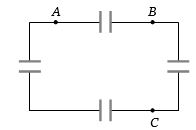
Four capacitors of each of capacity $3\,\mu F$ are connected as shown in the adjoining figure. The ratio of equivalent capacitance between $A$ and $B$ and between $A$ and $C$ will be
Diode can work as :
A conducting sphere of radius a has charge $Q$ on it. It is enclosed by a neutral conducting concentric spherical shell having inner radius $2a$ and outer radius $3a.$ Find electrostatic energy of system.
Assertion : Ferro-magnetic substances become paramegnetic above Curie temp.

Reason : Domains are destroyed at high temperature.

The primary winding of a transformer has 100 turns and its secondary winding has 200 turns. The primary is connected to an ac supply of 120 V and the current flowing in it is 10 A. The voltage and the current in the secondary are
An electric dipole when placed in a uniform electric field $E$ will have minimum potential energy, if the positive direction of dipole moment makes the following angle with $E$
Two charges of same magnitude move in two circles of radii $R_1=R$ and $R_2=2 R$ in a region of constant uniform magnetic field $B _0$. The work $W_1$ and $W_2$ done by the magnetic field in the two cases respectively, are such that