MCQ
Digital movie projectors work on the principle of
  • Reflection from micromirrors
  • B
    Refraction from thin lenses
  • C
    Dispersion from thin prisms
  • D
    Total internal reflection from optical fibres

Answer

Correct option: A.
Reflection from micromirrors
a
(a)

Digital movie projectors need parabolic mirrors to converge all incident rays fo a point.

Need a full question paper?

Generate a complete, print-ready paper with questions like this in minutes — across 16+ boards, with answer keys.

Start Generating Free

Similar questions

Three amplifiers each having voltage gain $10$ , are connected in series. The resultant gain would be
The plot that depicts the behavior of the mean free time $t$ (time between two successive collisions) for the molecules of an ideal gas, as a function of temperature $(T)$, qualitatively, is (Graphs are schematic and not drawn to scale)
Momentum of a photon of wavelength $\lambda$ is
The temperature of equal masses of three different liquids ${x}, {y}$ and ${z}$ are $10^{\circ} {C}, 20^{\circ} {C}$ and $30^{\circ} {C}$ respectively. The temperature of mixture when ${x}$ is mixed with ${y}$ is $16^{\circ} {C}$ and that when ${y}$ is mixed with $z$ is $26^{\circ} {C}$. The temperature of mixture when $x$ and $z$ are mixed will be ...... $^{\circ} {C}$
Find the quantity of heat required to convert $40\; gm$ of ice at $-20^{\circ} C$ into water at $20^{\circ} C$. Given $L _{\text {ice }}$ $=0.336 \times 10^6 J / kg$.

specific heat of ice $=2100 \;J / kg - K$ sp heat of water= $4200\; J / kg - K$
The solids which have the negative temperature coefficient of resistance are :
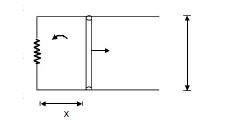
Two long parallel horizontal rails, a distance $l$ apart and each has a resistance $\lambda$ per  unit length are joined at one end by a resistance $R$. A perfectly conducting rod $MN$ of mass  $m$ is free to slide along the rails without friction. There is a uniform magnetic field of  induction $B$ normal to the plane of paper and directed into the paper. A variable force $F$ is applied to the rod $MN$ such that, as the rod moves, a constant current $i$ flows through $P$. The applied force $F$ as function of distance $x$ of the rod from $R$ is


Which of the following cannot be emitted by radioactive substances during their decay
An electron is projected with uniform velocity along the axis inside a current carrying long solenoid. Then :
The potential energy of a point particle is given by the expression $V(x)=-\alpha x+\beta \sin (x / \gamma)$. A dimensionless combination of the constants $\alpha, \beta$ and $\gamma$ is