MCQ
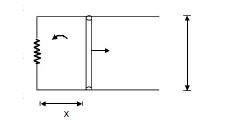
Two long parallel horizontal rails, a distance $l$ apart and each has a resistance $\lambda$ per  unit length are joined at one end by a resistance $R$. A perfectly conducting rod $MN$ of mass  $m$ is free to slide along the rails without friction. There is a uniform magnetic field of  induction $B$ normal to the plane of paper and directed into the paper. A variable force $F$ is applied to the rod $MN$ such that, as the rod moves, a constant current $i$ flows through $P$. The applied force $F$ as function of distance $x$ of the rod from $R$ is
 

  • A
    $i\,lB-\frac{2m \lambda i^2}{B^2 l^2}(R + 2 \lambda x)$
  • B
    $i\,lB+ \frac{4m \lambda i^2}{B^2 l^2}(R - 2 \lambda x)$
  • $i\,lB+ \frac{2m \lambda i^2}{B^2 l^2}(R + 2 \lambda x)$
  • D
    none of these

Answer

Correct option: C.
$i\,lB+ \frac{2m \lambda i^2}{B^2 l^2}(R + 2 \lambda x)$
c
$\mathrm{F}-\mathrm{i} \ell \mathrm{B}=\mathrm{ma}$            ........$(1)$

$\mathrm{B} \ell \mathrm{v}=\mathrm{i}(\mathrm{R}+2 \lambda \mathrm{x})$           ..........$(2)$

$\left(\frac{d V}{d x}\right)=\left(\frac{2 \lambda i}{B \ell}\right)$            ..........$(3)$

$a=V\left(\frac{d v}{d x}\right)=\left(\frac{2 \lambda i}{B \ell}\right)\left(\frac{i(R+2 \lambda x)}{B \ell}\right)$

$\mathrm{a}=\frac{2 \lambda \mathrm{i}^{2}}{\mathrm{B}^{2} \ell^{2}}(\mathrm{R}+2 \lambda \mathrm{x})$             ...........$(4)$

Need a full question paper?

Generate a complete, print-ready paper with questions like this in minutes — across 16+ boards, with answer keys.

Start Generating Free

Similar questions

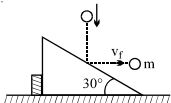
As shown in the figure $a$ body of mass $m$ moving vertically with speed $3\, m/s$ hits a smooth fixed inclined plane and rebounds with a velocity $v_f$ in the horizontal direction. If $\angle$ of inclined is $30^o$, the velocity $v_f$ will be
A container, whose bottom has round holes with diameter $0.1$ $mm $ is filled with water. The maximum height in cm upto which water can be filled without leakage will be ........ $cm$

Surface tension $= 75 \times 10^{-3}$ $ N/m $  and $g = 10$ $ m/s^2$:

$STATEMENT-1$ It is easier to pull a heavy object than to push it on a level ground. and

$STATEMENT-2$ The magnitude of frictional force depends on the nature of the two surfaces in contact.

A radioactive substance emits
If the initial velocity in horizontal direction of a projectile is unit vector $\hat{i}$ and the equation of trajectory is $y =5 x (1- x )$. The $y$ component vector of the initial velocity is.

(Take $g=10\,m / s ^{2}$ )

A micron is related to centimetre as
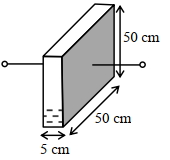
A container has a base of $50 \mathrm{~cm} \times 5 \mathrm{~cm}$ and height $50 \mathrm{~cm}$, as shown in the figure. It has two parallel electrically conducting walls each of area $50 \mathrm{~cm} \times 50 \mathrm{~cm}$. The remaining walls of the container are thin and non-conducting. The container is being filled with a liquid of dielectric constant $3$ at a uniform rate of $250 \mathrm{~cm}^3 \mathrm{~s}^{-1}$. What is the value of the capacitance of the container after $10$ seconds? [Given: Permittivity of free space $\in_0=9 \times 10^{-12} \mathrm{C}^2 \mathrm{~N}^{-1} \mathrm{~m}^{-2}$, the effects of the non-conducting walls on the capacitance are negligible]
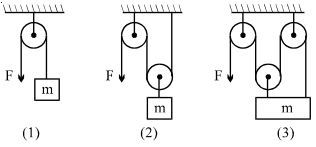
Equal force $F ( > mg)$ is applied to string in all the $3$ cases. Starting from rest, the point of application of force moves a distance of $2 m$ down in all cases. In which case the block has maximum kinetic energy?
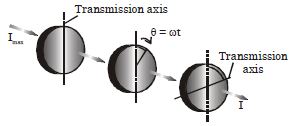
In figure suppose the transmission axes of the left and right polarizing disks are perpendicular to each other. Also, let the center disk be rotated on the common axis with an angular speed $\omega$. That if unpolarized light is incident on the left disk with an intensity $I_{max}$ the intensity of the beam emerging from the right disk is given by :-
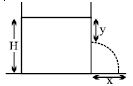
Acylindrical vessel is filled with a liquid up to height H.A small hole is made in the vessel at a distance $y$ below the liquid surface as shown in figure. The liquid emerging from the hole strike the ground at distance $x$