MCQ
Dimensional formula for latent heat is
  • ${M^0}{L^2}{T^{ - 2}}$
  • B
    $ML{T^{ - 2}}$
  • C
    $M{L^2}{T^{ - 2}}$
  • D
    $M{L^2}{T^{ - 1}}$

Answer

Correct option: A.
${M^0}{L^2}{T^{ - 2}}$
a
a) $Q = mL \Rightarrow L = \frac{Q}{m}$ (Heat is a form of energy)

= $\frac{{M{L^2}{T^{ - 2}}}}{M} = [{M^0}{L^2}{T^{ - 2}}]$

Need a full question paper?

Generate a complete, print-ready paper with questions like this in minutes — across 16+ boards, with answer keys.

Start Generating Free

Similar questions

From the top of a tower of height $40\,m$, a ball is projected upwards with a speed of $20\,m / s$ at an angle of elevation of $30^{\circ}$. The ratio of the total time taken by the ball to hit the ground to its time of flight (time taken to come back to the same elevation) is (take $g=10\,m / s ^2$ )
A particle at a distance of $1 m$ from the origin starts moving, such that $d r / d \theta=r$, where $r$ and $\theta$ are polar co-ordinates. Then, the angle between resultant velocity and tangential velocity is
A given quantity of an ideal gas is at pressure P and absolute temperature T. The isothermal bulk modulus of the gas is:
Name the type of energy (kinetic energy K or potential energy In the) possessed in the following case.
A piece of stone placed on the roof.
A solid sphere and a hollow cylinder roll up without slipping on same inclined plane with same initial speed $v$. The sphere and the cylinder reaches upto maximum heights $h_1$ and $h_2$, respectively, above the initial level. The ratio $h_1: h_2$ is $\frac{n}{10}$. The value of $\mathrm{n}$ is__________.
The centre of a wheel rolling on a plane surface moves with a speed v0. A particle on the rim of the wheel at the same level as the centre will be moving at speed:

  1. $\text{Zero.}$

  2. $\text{v}_0$

  3. $\sqrt2\text{v}_0$

  4. $2\text{v}_0$

A machine gun fires a bullet of mass $40\, g$ with a velocity $1200\, ms^{-1}$. The man  holding it, can exert maximum force of $144\, N$ on the gun. How many bullets can he  fire per second at the most ?
A length-scale $(l)$ depends on the permittivity $(\varepsilon)$ of a dielectric material. Boltzmann constant $\left(k_B\right)$, the absolute temperature $(T)$, the number per unit volune $(n)$ of certain charged particles, and the charge $(q)$ carried by each of the particless. Which of the following expression($s$) for $l$ is(are) dimensionally correct?

($A$) $l=\sqrt{\left(\frac{n q^2}{\varepsilon k_B T}\right)}$

($B$) $l=\sqrt{\left(\frac{\varepsilon k_B T}{n q^2}\right)}$

($C$)$l=\sqrt{\left(\frac{q^2}{\varepsilon n^{2 / 3} k_B T}\right)}$

($D$) $l=\sqrt{\left(\frac{q^2}{\varepsilon n^{1 / 3} k_B T}\right)}$
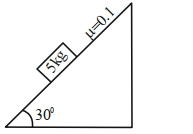
A block of mass $5 \mathrm{~kg}$ is placed on a rough inclined surface as shown in the figure.If $\vec{F}_1$ is the force required to just move the block up the inclined plane and $\vec{F}_2$ is the force required to just prevent the block from sliding down, then the value of $\left|\vec{F}_1\right|-\left|\vec{F}_2\right|$ is : [Use $g=10 \mathrm{~m} / \mathrm{s}^2$ ]
A composite rod made of three rods of equal length and cross-section as shown in the fig. The thermal conductivities of the materials of the rods are $K/2, 5K$ and $K$ respectively. The end $A$ and end $B$ are at constant temperatures. All heat entering the face Agoes out of the end $B$ there being no loss of heat from the sides of the bar. The effective thermal conductivity of the bar is
