MCQ
Dimensional formula for pressure head is ............
- A$[ M ^0 L ^0 T ^0]$
- B$[ML^{-1}T ^{-2}]$
- C$[ M ^0 L ^1 T ^{-2}]$
- ✓$[ M ^0 L ^1 T ^0]$
Pressure $=\frac{\text { F orce }}{\text { Area }}$
But,Force $=$ Mass $\times$ Accelaration $=[ M ]\left[ LT ^{-2}\right]=\left[ MLT ^{-2}\right]$
Then,
$[\text { Pressure }]=\frac{\left[ MLT ^{-2}\right]}{\left[ L ^2\right]}=\left[ ML ^{-1} T ^{-2}\right]$
[Density $]=\frac{[ Mass ]}{[\text { V olume }]}=\frac{[ M ]}{\left[ L ^3\right]}= ML ^{-3}$
Now,
$[\text { Presure head }]=\frac{[\text { Pressure }]}{[\text { Density }] \times[ g ]}=\frac{\left[ ML ^{-1} T ^{-2}\right]}{\left[ ML ^{-3}\right]\left[ LT ^{-2}\right]}=\left[ M ^0 L ^1 T ^0\right]$
Generate a complete, print-ready paper with questions like this in minutes — across 16+ boards, with answer keys.
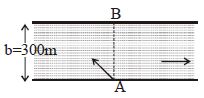
$(I)$ $R$ and $S$ moved in the same direction after the collision.
$(II)$ Kinetic energy of the system $(R$ & $S)$ is minimum at $t = 2$ milli sec.
$(III)$ The mass of $R$ was greater than mass of $S.$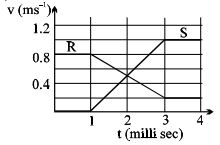
$Reason$ : The accuracy and precision of measuring instruments along with errors in measurements should be taken into account, while expressing the result.