MCQ
Dimensional formula for torque is
  • ${L^2}M{T^{ - 2}}$
  • B
    ${L^{ - 1}}M{T^{ - 2}}$
  • C
    ${L^2}M{T^{ - 3}}$
  • D
    $LM{T^{ - 2}}$

Answer

Correct option: A.
${L^2}M{T^{ - 2}}$
a
(a) Torque = force $ \times $ distance = $[M{L^2}{T^{ - 2}}]$

Need a full question paper?

Generate a complete, print-ready paper with questions like this in minutes — across 16+ boards, with answer keys.
Start Generating Free

Similar questions

A copper and a steel wire of the same diameter are connected end to end. A deforming force F is applied to this composite wire which causes a total elongation of 1cm. The two wires will have
  1. The same stress.
  2. Different stress.
  3. The same strain.
  4. Different strain.
The result after adding $3.8 \times 10^{-6}$ with $4.2 \times 10^{-5}$ with due regard to  significant figures is-
An object is projected at an angle of $45^°$ with the horizontal. The horizontal range and the maximum height reached will be in the ratio.
Standing waves are produced in $10 \,m$ long stretched string fixed at both ends. If the string vibrates in $5$ segments and wave velocity is $20 \,m / s$, the frequency is ....... $Hz$
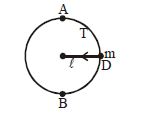
A particle of mass $m$ , attached with a string of length $l$ is moving in a vertical circle. If the particle is just looping the loop without slackening of the string and $v_A, v_B, v_D$ are speeds at positions $A, B, D$ shown in figure, then
Energy equals of a mass of one microgram in kilo joules is:
Weight of a body of mass m decreases by $1\%$ when it is raised to height $h$ above the earth’s surface. If the body is taken to a depth h in a mine, change in its weight is
The maximum error in the measurement of resistance, current and time for which current flows in an electrical circuit are $1 \%, 2 \%$ and $3 \%$ respectively. The maximum percentage error in the detection of the dissipated heat will be
A body is sliding down an inclined plane (angle of inclination $45^o$). If the coefficient of friction is $0.5$ and $g = 9.8\, m/s^2$. then the acceleration of the body downwards in $m/s^2$ is
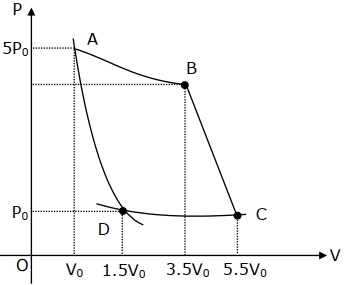
In the reported figure, there is a cyclic process $ABCDA$ on a sample of $1\, {mol}$ of a diatomic gas. The temperature of the gas during the process ${A} \rightarrow {B}$ and ${C} \rightarrow {D}$ are ${T}_{1}$ and ${T}_{2}\left({T}_{1}\,>\,{T}_{2}\right)$ respectively.

Choose the correct option out of the following for work done if processes $B C$ and $D A$ are adiabatic.