MCQ
Dimensions of $\frac{1}{(\mu_0\in_0)}$ is:
- A$\frac{\text{L}}{\text{T}}$
- B$\frac{\text{T}}{\text{L}}$
- C$\frac{\text{L}^2}{\text{T}^2}$
- D$\frac{\text{T}^2}{\text{L}^2}$
Explanation:
The speed of light, $\text{C}=\frac{1}{\sqrt{\mu_0\in_0}}$
The dimensions of $\frac{1}{\sqrt{\mu_0\in_0}}$ are of velocity, i.e., $\frac{\text{L}}{\text{T}}$
Therefore, $\frac{1}{\in_0\mu_0}$ will have dimensions $\frac{\text{L}^2}{\text{T}^2}$
Generate a complete, print-ready paper with questions like this in minutes — across 16+ boards, with answer keys.
AB is a potentiometer wire of length 100 cm and its resistance is 10 ohms. It is connected in series with a resistance R = 40 ohms and a battery of e.m.f. 2 V and negligible internal resistance. If a source of unknown e.m.f. E is balanced by 40 cm length of the potentiometer wire, the value of E is
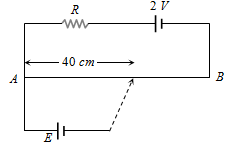
|
(a) 0.8 V |
(b) 1.6 V |
(c) 0.08 V |
(d) 0.16 V |
Assertion : Amongst alpha, beta and gamma rays, a-particle has maximum penetrating power.
Reason : The alpha particle is heavier than beta and gamma rays.
|
(a) If both assertion and reason are true and the reason is the correct explanation of the assertion. |
|
(b) If both assertion and reason are true but reason is not the correct explanation of the assertion. |
|
(c) If assertion is true but reason is false. |
|
(d) If the assertion and reason both are false. |
Activity of radioactive element decreased to one third of original activity  in 9 years. After further 9 years, its activity will be
|
(a)
|
(b) 
|
(c) |
(d) |
The half life period of a radioactive substance is 5 min. The amount of substance decayed in 20 min will be
|
(a) 93.75% |
(b) 75% |
(c) 25% |
(d) 6.25% |
$\text{B}_\text{y},=\text{B}_\text{y}+\frac{\text{vE}_\text{z}}{\text{c}^2}$
$\text{E}_\text{y},=\text{E}_\text{y}+\frac{\text{vB}_\text{z}}{\text{c}^2}$
$\text{B}'_\text{y}=\text{B}_\text{y}+\text{v}\text{E}_\text{z}$
$\text{E}'_\text{y}=\text{E}_\text{y}+\text{vB}_\text{z}$
In a Young’s double slit experiment, the slit separation is 0.2 cm, the distance between the screen and slit is 1m. Wavelength of the light used is 5000 Å. The distance between two consecutive dark fringes (in mm) is
|
(a) 0.25 |
(b) 0.26 |
(c) 0.27 |
(d) 0.28 |
Light of two different frequencies whose photons have energies 1eV and 2.5eV respectively, successively illuminates a metal of work function 0.5eV. The ratio of maximum kinetic energy of the emitted electron will be
|
(a) 1 : 5 |
(b) 1 : 4 |
(c) 1 : 2 |
(d) 1 : 1 |
