Dipole having dipole moment $4\,C-m$ is placed on origin along $x-$ axis. Point charge of $8\,\mu C$ is fixed at $(4, 0, 0)$ . Now dipole is rotated by an angle of $\frac{\pi }{2}$ . Find the work done (in $mJ$ ) in rotating the dipole.......$mJ$
Medium
Download our app for free and get started

Download our appand get started for free
Experience the future of education. Simply download our apps or reach out to us for more information. Let's shape the future of learning together!No signup needed.*
Similar Questions
- 1If the capacity of a spherical conductor is $1$ picofarad, then its diameter, would beView Solution
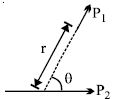
- 2View SolutionTwo short electric dipoles are placed as shown. The energy of electric interaction between these dipoles will be
- 3The radius of a charged metal sphere $(R)$ is $10\,cm$ and its potential is $300\,V$. Find the charge density on the surface of the sphereView Solution
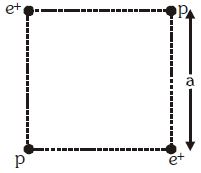
- 4Two positrons $(e^+)$ and two protons $(p)$ are kept on four corners of a square of side $a$ as shown in figure. The mass of proton is much larger than the mass of positron. Let $q$ denotes the charge on the proton as well as the positron then the kinetic energies of one of the positrons and one of the protons respectively after a very long time will be-View Solution
- 5Three capacitors each of capacity $4\,\mu \,F$ are to be connected in such a way that the effective capacitance is $6\,\mu \,F$. This can be done byView Solution
- 6A condenser of $2\,\mu F$ capacitance is charged steadily from $0$ to $5$ $Coulomb$. Which of the following graphs correctly represents the variation of potential difference across its plates with respect to the charge on the condenserView Solution
- 7The potential function of an electrostatic field is given by $V = 2x^2$. Determine the electric field strength at the point $(2\,m, 0, 3\,m)$View Solution
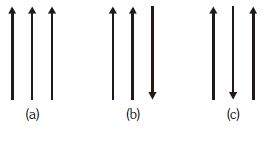
- 8When three electric dipoles are near each other, they each experience the electric field of the other two, and the three dipole system has a certain potential energy. Figure below shows three arrangements $(1)$ , $(2)$ and $(3)$ in which three electric dipoles are side by side. All three dipoles have the same magnitude of electric dipole moment, and the spacings between adjacent dipoles are identical. If $U_1$ , $U_2$ and $U_3$ are potential energies of the arrangements $(1)$ , $(2)$ and $(3)$ respectively thenView Solution
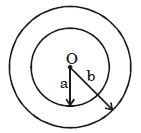
- 9If electric potential of the inner sphere is $10\, volt$ and that of the outer shell is $50\, volt$ then potential at common centre is :-......$V$View Solution
- 10At a distance $l$ from a uniformly charged long wire, a charged particle is thrown radially outward with a velocity $u$ in the direction perpendicular to the wire. When the particle reaches a distance $2 l$ from the wire, its speed is found to be $\sqrt{2} u$. The magnitude of the velocity, when it is a distance $4 l$ away from the wire is (ignore gravity)View Solution