At a distance $l$ from a uniformly charged long wire, a charged particle is thrown radially outward with a velocity $u$ in the direction perpendicular to the wire. When the particle reaches a distance $2 l$ from the wire, its speed is found to be $\sqrt{2} u$. The magnitude of the velocity, when it is a distance $4 l$ away from the wire is (ignore gravity)
KVPY 2011, Advanced
Download our app for free and get started
(a)
Distances and velocities of charged particle given are as below.
Energy conservation between $A$ and $B$ gives,
$q V_A+\frac{1}{2} m u^2=q V_B+\frac{1}{2} m(\sqrt{2} u)^2$
$\Rightarrow \quad q\left(V_A-V_B\right)=\frac{1}{2} m u^2$
$\Rightarrow \quad q \frac{\lambda}{2 \pi \varepsilon_0} \cdot \ln 2=\frac{1}{2} m u^2 \quad \dots(i)$
Now, energy conservation between $A$ and $C$ gives,
$q V_A +\frac{1}{2} m u^2=q V_C+\frac{1}{2} m v^2$
$\Rightarrow \frac{1}{2} m v^2 =q\left(V_A-V_C\right)+\frac{1}{2} m u^2$
$=q \frac{\lambda}{2 \pi \varepsilon_0} \cdot \ln 4+\frac{1}{2} m u^2$
$=\frac{2 q \lambda}{2 \pi \varepsilon_0} \cdot \ln 2+\frac{1}{2} m u^2$
Substituting value of $\left(\frac{q {\lambda}}{2 \pi \varepsilon_0} \ln 2\right)$ from Eq. $(i)$ in above equation, we have
$\frac{1}{2} m v^2=2\left(\frac{1}{2} m u^2\right)+\frac{1}{2} m u^2$
$\Rightarrow \quad v=\sqrt{3} u$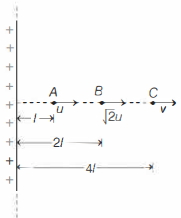

Download our appand get started for free
Experience the future of education. Simply download our apps or reach out to us for more information. Let's shape the future of learning together!No signup needed.*
Similar Questions
- 1An elementary particle of mass $m$ and charge $ + e$ is projected with velocity $v$ at a much more massive particle of charge $Ze,$ where $Z > 0.$What is the closest possible approach of the incident particleView Solution
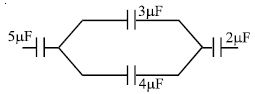
- 2If charge on left plane of the $5\ \mu F$ capacitor in the circuit segment shown in the figure is $-20\ \mu C$, the charge on the right plate of $3\ \mu F$ capacitor is.......$ \mu C$View Solution
- 3The potential at a point $P$ due to an electric dipole is $1.8\times 10^5\,V$ . If $P$ is at a distance of $50\,cm$ apart from the centre $O$ of the dipole and if $CP$ makes an angle $60^o$ with the positive side of the axial line of the dipole, what is the moment of the dipole?View Solution
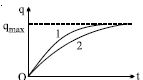
- 4The charge across the capacitor in two different $RC$ circuits $1$ and $2$ are plotted as shown in figure. Choose the correct statement $(s)$ related to the two circuits.View Solution
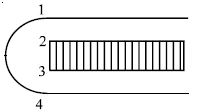
- 5Four identical plates $1, 2, 3$ and $4$ are placed parallel to each other at equal distance as shown in the figure. Plates $1$ and $4$ are joined together and the space between $2$ and $3$ is filled with a dielectric of dielectric constant $k$ $=$ $2$. The capacitance of the system between $1$ and $3$ $\&$ $2$ and $4$ are $C_1$ and $C_2$ respectively. The ratio $\frac{{{C_1}}}{{{C_2}}}$ isView Solution
- 6There is $10$ units of charge at the centre of a circle of radius $10\,m$. The work done in moving $1\, unit$ of charge around the circle once is...........$units$View Solution
- 7If the electric potential at any point $(x, y, z) \,m$ in space is given by $V =3 x ^{2}$ volt. The electric field at the point $(1,0,3) \,m$ will be ............View Solution
- 8View SolutionFour very large metal plates are given the charges as shown in figure. The middle two are then connected through a wire. Find the charge that will flow through the wire
- 9The electric potential varies in space according to the relation $V = 3x + 4y$. A particle of mass $0.1\,\, kg$ starts from rest from point $(2, 3·2)$ under the influence of this field. The charge on the particle is $+1\,\, μC$. Assume $V$ and $(x, y)$ are in $S.I.$ $units$ . The time taken to cross the $x-$ axis is.....$s$View Solution
- 10A charge $Q$ is distributed over three concentric spherical shell of radii $a, b, c (a < b < c)$ such that their surface charge densities are equal to one another. The total potential at a point at distance $r$ from their common centre, where $r < a$, would beView Solution