Question
Discuss structure of the carbonyl group.

Answer

→ The carbonyl carbon atom is sp2-hybridised and forms three sigma (σ) bonds.
→ The fourth valence electron of carbon remains in its p-orbital and forms a π-bond with oxygen by overlap with p-orbital of an oxygen.
→ In addition, the oxygen atom also has two non bonding electron pairs. Thus, the carbonyl carbon and the three atoms attached to it lie in the same plane and the π-electron cloud is above and below this plane.
→ The bond angles are approximately 120° as expected of a trigonal coplanar structure (Fig.).
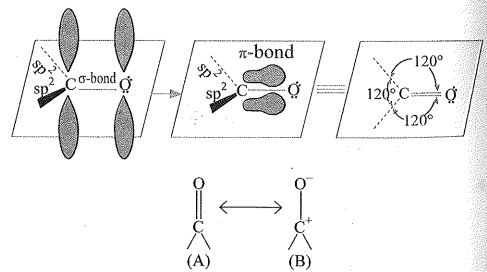
Image
→ The carbon-oxygen double bond is polarised due to higher electronegativity of oxygen relative to carbon. Hence, the carbonyl carbon is an electrophilic (Lewis acid), and carbonyl oxygen, a nucleophilic (Lewis base) centre. Carbonyl compounds have significant dipole moments and are polar than ethers. The high polarity of the carbonyl group is explained on the basis of resonance involving neutral (A) and a dipolar (B) structures as shown.

Need a full question paper?

Generate a complete, print-ready paper with questions like this in minutes — across 16+ boards, with answer keys.

Start Generating Free

Similar questions

Write the formulae of the following coordination compounds:
  1. Tetraamminediaquacobalt(III)chloride .
  2. Tris (ethane-1,2-diamine)chromium(III)chloride.
What is galvanic cell? Give half cell reaction of Daniell cell.
How would you account for the following:
  1. Among lanthanoids, Ln (III) compounds are predominant. However, occasionally in solutions or in solid compounds, +2 and +4 ions are also obtained.
  2. The EoM2+/M for copper is positive (0.34V). Copper is the only metal in the first series of transition elements showing this behaviour.
  3. The metallic radii of the third (5d) series of transition metals are nearly the same as those of the corresponding members of the second series.
What is the secondary structure of proteins?
Write electrode reactions taking place in:
  1. Ni–Cd cell.
  2. Lead Acid Accumulator.
Calculate the emf of the following cell at 25oC:
Ag(s)|Ag+(10-3M)||Cu2+(10-1M)|Cu(S).
Given Eocell=+0.46 V and log 10n=n.
Calculate the boiling point of a 1M aqueous solution (density 1.04g mL-1) of potassium chloride (Kb for water = 0.52K kg mol-1, Atomic masses: K = 39u, Cl = 35.5u) Assume, potassium chloride is completely dissociated in solution.
Resistance of a conductivity cell filled with 0.1 mol L-1 KCl solution is $100\Omega.$ If the resistance of the same cell when filled with 0.02 mol L-1 KCl solution is $520\Omega,$ calculate the conductivity and molar conductivity of 0.02 mol L-1 KCl solution. The conductivity of 0.1 mol L-1 KCl solution is $1.29\times10^{-2}\Omega^{-1}\text{cm}^{-1}.$
  1. Calculate $\Delta$rGfor the reaction:

Mg (s)+Cu2+ (aq) $\rightarrow$ Mg2+ (aq) + Cu (s)
Given: Eocell = + 2.71 V, 1 F = 96500 C mol–1

  1. Name the type of cell which was used in Apollo space programme for providing electrical power.
What is the standard electrode potential? Explain it details.