Question
Discuss the classification of monohydric alcohols containing $C_{sp}^3-OH$ bond.

Answer

$\rightarrow$ $C_{sp}^3 - OH$ bond: In this class of alcohols. the $-OH$ group is attached to an $sp^3$ hybridised $3$ carbon atom of an alkyl group. They are further classified as follows:
$\rightarrow$ Primary, secondary and tertiary alcohols: In these three types of alcohols, the $-OH$ group is attached to primary, secondary and tertiary carbon atom, respectively as depicted below :
Image
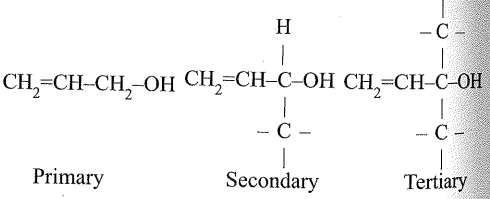
$\rightarrow$ Allylic alcohols : In these alcohols, the $-OH$ group is attached to an $sp^3$ hybridised carbon next the carbon$-$carbon double bond, that is to an allylic carbon. For example,
Image
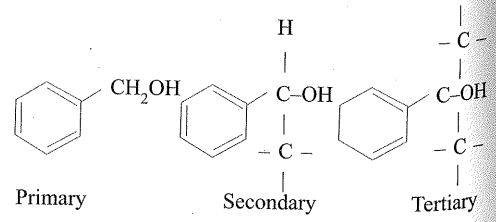
$\rightarrow$ Benzylic alcohols : In these alcohols, the $-OH$ group is attached to an $sp^{3-}$ hybridised carbon atom next to an aromatic ring. For example,
Image
$\rightarrow$ Allylic and benzylic alcohols may be primary, secondary or tertiary.

Need a full question paper?

Generate a complete, print-ready paper with questions like this in minutes — across 16+ boards, with answer keys.
Start Generating Free

Similar questions

Short note on: Sucrose.
An aqueous solution of $2\%$ non-volatile solute exerts a pressure of $1.004$ bar at the normal boiling point of the solvent. What is the molar mass of the solute?
  1. Name the method of refining of nickel.
  2. What is the role of cryolite in the extraction of aluminium?
  3. What is the role of limestone in the extraction of iron from its oxides?
Discuss in details the oxidation of methyl ketones by haloform reaction. And also mention that for detection of which type of group this reaction is useful?
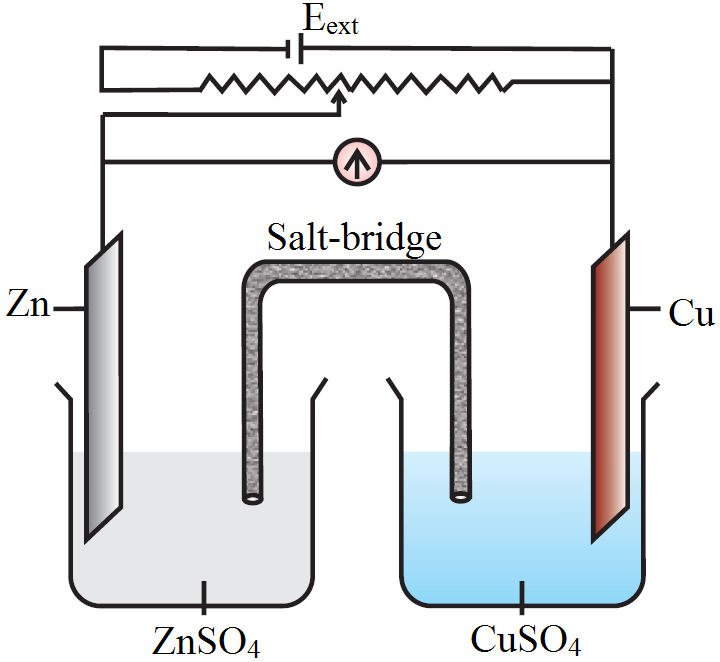
The electrochemical cell given alongside converts the chemical energy released during the redox reaction
$\text{Zn(s) + Cu}^{2+}\text{(aq)}\xrightarrow{ \ \ \ \ \ \ \ }\text{Zn}^{2+}(\text{aq) + Cu(s)}$
to electrical energy. It gives an electrical potential of $1.1V$ when concentration $Zn^{2+}$ and $Cu^{2+}$ ions is unity. State the direction of flow of current and also specify whether zinc and copper are deposited or dissolved at their respective electrodes when:
  1. An external opposite potential of less than $1.1V$ is applied.
  2. An external potential of $1.1V$ is applied.
  3. An external potential of greater than $1.1V$ is applied.
An octahedral complex is prepared by mixing $\mathrm{CoCl}_3$ and $\mathrm{NH}_3$ in the molar ratio $1: 4,0.1 \mathrm{~m}$ solution of this complex was found to freeze at $0.372^{\circ} \mathrm{C}$. What is the formula of the complex? Given that molal depression constant ( Kf ) for water $=1.86^{\circ} \mathrm{C} / \mathrm{m}$.
  1. Why are crystalline solids anisotropic?
  2. What type of semiconductor is formed when silicon is doped with boron?
  3. Define the term coordination number. What is the coordination number of atoms in a cubic closed packed structure?
Give two reactions that show the acidic nature of phenol. Compare acidity of phenol with that of ethanol.
Match the type of unit cell given in Column I with the features given in Column II.
  Column I   Column I
(i)
Primitive cubic unit cell
(a)
Each of the three perpendicular edges compulsorily have the different edge length i.e; a ≠ b ≠ c.
(ii)
Body centred cubic unit cell
(b)
Number of atoms per unit cell is one.
(iii)
Face centred cubic unit cell
(c)
Each of the three perpendicular edges compulsorily have the same edge length i.e.; a = b = c
(iv)
End centred orthorhombic unit cell
(d)
In addition to the contribution from the corner atoms the number of atoms present in a unit cell is one.
 
 
(e)
In addition to the contribution from the corner atoms the number of atoms present in a unit cell is three.
Give reasons for the following:
  1. Acetylation of aniline reduces its activation effect.
  2. $CH_3NH_2$ is more basic than $C_6H_5NH_2$.
  3. Although $-NH_2$ is o/p directing group, yet aniline on nitration gives a significant amount of m-nitroaniline.