Question
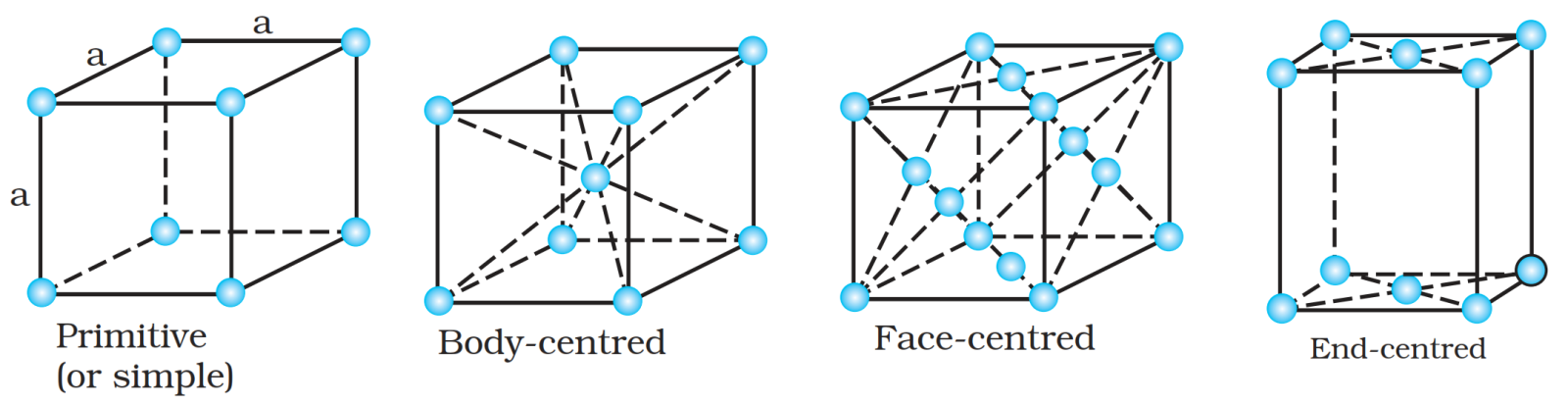
Match the type of unit cell given in Column I with the features given in Column II.
  Column I   Column I
(i)
Primitive cubic unit cell
(a)
Each of the three perpendicular edges compulsorily have the different edge length i.e; a ≠ b ≠ c.
(ii)
Body centred cubic unit cell
(b)
Number of atoms per unit cell is one.
(iii)
Face centred cubic unit cell
(c)
Each of the three perpendicular edges compulsorily have the same edge length i.e.; a = b = c
(iv)
End centred orthorhombic unit cell
(d)
In addition to the contribution from the corner atoms the number of atoms present in a unit cell is one.
 
 
(e)
In addition to the contribution from the corner atoms the number of atoms present in a unit cell is three.

Answer

  Column I   Column I
(i)
Primitive cubic unit cell
(b)
(c)
Number of atoms per unit cell is one.
Each of the three perpendicular edges compulsorily have the same edge length i.e.; a = b = c
(ii)
Body centred cubic unit cell
(C)
(d)
Each of the three perpendicular edges compulsorily have the same edge length i.e.; a = b = c
In addition to the contribution from the corner atoms the number of atoms present in a unit cell is one.
(iii)
Face centred cubic unit cell
(c)
(e)
Each of the three perpendicular edges compulsorily have the same edge length i.e.; a = b = c
In addition to the contribution from the corner atoms the number of atoms present in a unit cell is three.
(iv)
End centred orthorhombic unit cell
(a)
(d)
Each of the three perpendicular edges compulsorily have the different edge length i.e; a ≠ b ≠ c.
In addition to the contribution from the corner atoms the number of atoms present in a unit cell is one.
Explaination:
  1. For primitive unit cell, a = b = c
    Total number of atoms per unit cell $= \frac{1}{8}\times 8 = 1$
    Here, $\frac{1}{8}$ is due to contribution of each atom present at corner.
  2. For body centred cubic unit cell, a = b = c
    This lattice contain atoms at corner as well as body centre. Contribution due to atoms at corner $= \frac{1}{8}\times 8 = 1$
    contribution due to atoms at body centre = 8
  3. For face centred unit cell, a = b = c
    Total constituent ions per unit cell present at corners $= \frac{1}{8}\times 8 = 1$
    Total constituent ions per unit cell present at face centre $= \frac{1}{2}\times 6 = 3$
  4. For end centered orthorhombic unit cell, $\text{a}\neq\text{b}\neq\text{c}$ Total contribution of atoms present at corner $= \frac{1}{8}\times 8 = 1$
    Total contribution of atoms present at end centre $=\frac{1}{2}\times2=1$
    Hence, other than corner it contain total one atom per unit cell.

Need a full question paper?

Generate a complete, print-ready paper with questions like this in minutes — across 16+ boards, with answer keys.

Start Generating Free

Similar questions

The purest form of iron is prepared by oxidising impurities from cast iron in a reverberatory furnace. Which iron ore is used to line the furnace? Explain by giving reaction.
Explain the following types of substances with one suitable example, for each case:
  1. Cationic detergents.
  2. Food preservatives.
  3. Analgesics.
A first order reaction takes 20 minutes for 25% decomposition. Calculate the time when 75% of the reaction will be completed. (Given : log 2 = 0·3010, log 3 = 0·4771, log 4 = 0·6021)
Give reasons for the following:
  1. Transition metals form alloys.
  2. $Mn_2O_3$ is basic whereas $Mn_2O_7$ is acidic.
  3. $Eu^{2+}$ is a strong reducing agent.
Image
Write one difference between each of the following :
  1. Multimolecular colloid and Macromolecular colloid.
  2. Sol and Gel.
  3. O/W emulsion and W/O emulsion.
If the radius of the octahedral void is r and radius of the atoms in closepacking is R, derive relation between r and R.
The extraction of Au by leaching with $NaCN$ involves both oxidation and reduction. Justify giving equations.
Calculate e.m.f of the following cell at 298 K :
$2 \mathrm{Cr}(\mathrm{~s})+3 \mathrm{Fe}^{2+}(0.1 \mathrm{M}) \rightarrow 2 \mathrm{Cr}^{3+}(0.01 \mathrm{M})+3 \mathrm{Fe}(\mathrm{~s})$
$\text { Given: } \mathrm{E}^{\circ}\left(\mathrm{Cr}^{3+} \mid \mathrm{Cr}\right)=-0.74 \mathrm{VE}^{\circ}\left(\mathrm{Fe}^{2+} \mid \mathrm{Fe}\right)=-0.44 \mathrm{~V}$
Neeta was experimenting in the lab to study the chemical reactivity of alcohols. She carried out a dehydration reaction of propanol at $140^\circ C$ to $180^\circ C.$ Different products were obtained at these two temperatures.
$a.$ Identify the major product formed at $140^\circ C$ and the substitution mechanism followed in this case.
$b.$ Identify the major product formed at $180^\circ C$ and the substitution mechanism followed in this case.