Question
Discuss the different barrier of innate immunity.

Answer

It is accomplished by providing different types of barriers:
  1. Physical barriers: These barriers do not allow pathogens and foreign agents to enter the body, e.g., skin, mucous membranes of digestive, respiratory and urinogenital tracts trapping microorganisms.
  2. Physiological barriers: Sweat, tears, acid in the stomach and saliva prevent microbial growth.
  3. Cellular barriers: WBCs (polymorphonuclear leukocytes and monocytes, natural killer lymphocytes) and macrophages phagocytose and destroy microbes.
  4. Cytokine barriers: Interferons produced by virus-infected cells protect non-infected cells from further viral infection.

Need a full question paper?

Generate a complete, print-ready paper with questions like this in minutes — across 16+ boards, with answer keys.

Start Generating Free

Similar questions

Answer the following questions:
Draw a sectional view of human ovary and label the different follicular stages, ovum and corpus luteum.
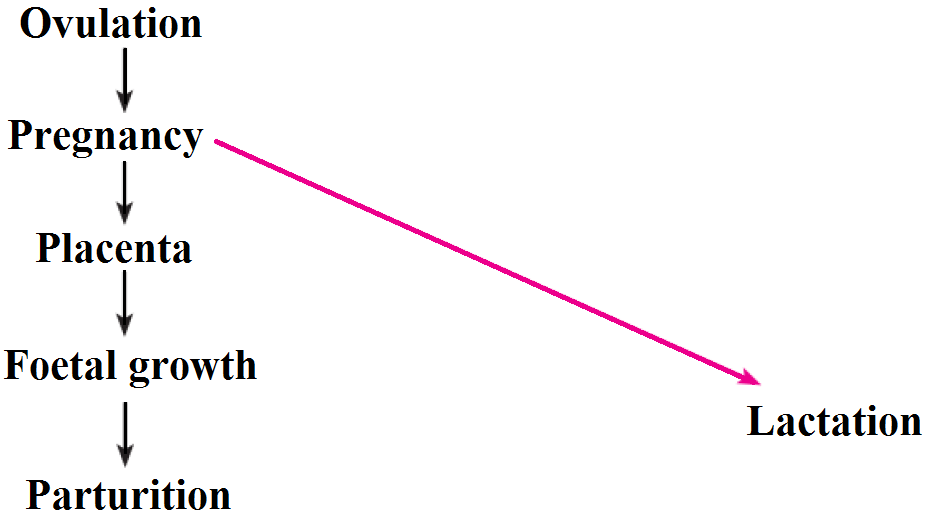
Study the flow chart given below. Name the hormones involved at each stage and explain their role.

What is innate immunity? How is it accomplished in a human body?
How can you, as an individual, prevent the loss of biodiversity?
Observe the representation of genes involved in the lac operon given below:

  1. Identify the region where the repressor protein will attach normally.
  2. Under certain conditions repressor is unable to attach at this site. Explain.
  3. If repressor fails to attach to the said site what products will be formed by z, y and a?
  4. Analyse why this kind of regulation is called negative regulation.
What is oogenesis? Give a brief account of oogenesis.
Describe the change that occur in ovaries and uterus in human female during the reproductive cycle.
  1. Explain with the help of Griffith’s experiment how the search for genetic material was conducted and what was the conclusion drawn?
  2. How did MacLeod, McCarty and Avery establish the biochemical nature of the so called ‘genetic material’ identified by Griffith in his experiment.
Malarial parasite ‘Plasmodium’ completes its life cycle in two hosts. Draw its complete life cycle and explain various stages it follows throughout its life.
Draw a neat diagram of the female reproductive system and label the parts associated with the following.
  1. Production of gamete.
  2. Site of fertilisation.
  3. Site of implantation.
  4. Birth canal.