Question
Discuss the Einstien's explanation for the photoelectric effect.
Answer

In 1905, Einstien gave a historical explanation of the photoelectric effect. For which he was awarded the Nobel prize in physics in 1921.
Einstein accepted Max Planck's concept of radiation.
According to this concept, the energy of radiation is not continuous. Radiation is composed of discrete units of energy, (Bundles of energy) These units of energy are called quanta or photons.
Each quantum (photon) has energy $E =h v$.
Where, $h=$ Planck's constant
$\begin{array}{l}
h=6.625 \times 10^{-34} J s \\
v=\text { Frequency of radiation }
\end{array}$
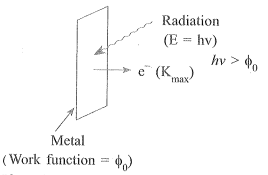
When radiation is incident on a metal surface, the electrons in the metal interact with the quanta of the radiation. If the energy of quantum ( $h v$ ) is greater than the work function $\left(\phi_0\right)$ of a given metal, the electron absorbs this quantum. i.e. the full energy of the quantum ( $h v$ ) is absorbed and is emitted from the metal with a maximum kinetic energy $K _{\max }$.
Thus, $K _{ max }=h v-\phi_0$
This equation is called Einstein's equation of photoelectric effect.
Image
If a photon interacts with an strongly bound electron than electron requires more energy to be ejected. So it is emitted with less energy than $K _{\max }$.

Need a full question paper?

Generate a complete, print-ready paper with questions like this in minutes — across 16+ boards, with answer keys.
Start Generating Free

Similar questions

Huygen's principle is the basis of wave theory of light. Each point on a wavefront acts as a fresh source of new disturbance, called secondary waves or wavelets. The secondary wavelets spread out in all directions with the speed light in the given medium.
An initially parallel cylindrical beam travels in a medium of refractive index $\mu(\text{I})=\mu_0+\mu_2\text{I}$, where $\mu_0$ and $\mu_2$ are positive constants and I is the intensity of the light beam. The intensity of the beam is decreasing with increasing radius.

  1. The initial shape of the wavefront of the beam is:
  1. Planar.
  2. Convex.
  3. Concave.
  4. Convex near the axis and concave near the periphery.
  1. According to Huygens Principle, the surface of constant phase is:
  1. Called an optical ray.
  2. Called a wave.
  3. Called a wavefront.
  4. Always linear in shape.
  1. As the beam enters the medium, it will:
  1. Travel as a cylindrical beam.
  2. Diverge.
  3. Converge.
  4. Diverge near the axis and converge near the periphery.
  1. Two plane wavefronts oflight, one incident on a thin convex lens and another on the refracting face of a thin prism. After refraction at them, the emerging wavefronts respectively become.
  1. Plane wavefront and plane wavefront.
  2. Plane wavefront and spherical wavefront.
  3. Spherical wavefront and plane wavefront.
  4. Spherical wavefront and spherical wavefront.
  1. Which of the following phenomena support the wave theory of light?
  1. Scattering.
  2. Interference.
  3. Diffraction.
  4. Velocity of light in a denser medium is less than the velocity of light in the rarer medium.
  1. 1, 2, 3
  2. 1, 2, 4
  3. 2, 3, 4
  4. 1, 3, 4
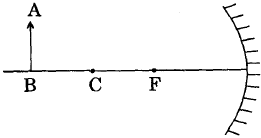
An object AB is kept in front of a concave mirror as shown in the figure.

  1. Complete the ray diagram showing the image formation of the object.
  2. How will the position and intensity of the image be affected if the lower half of the mirror's reflecting surface is painted black?
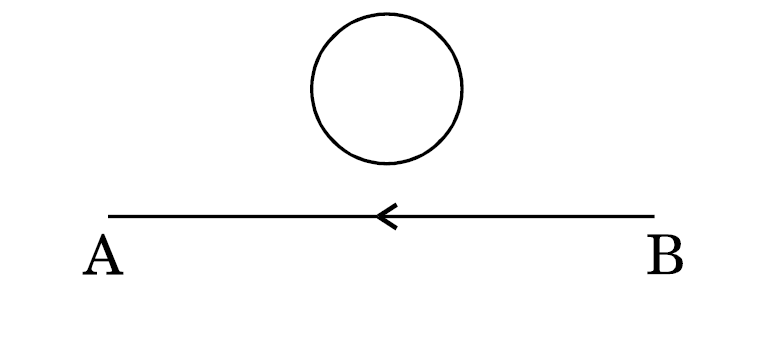
The electric current flowing in a wire in the direction from B to A is decreasing. Find out the direction of the induced current in the metallic loop kept above the wire as shown.

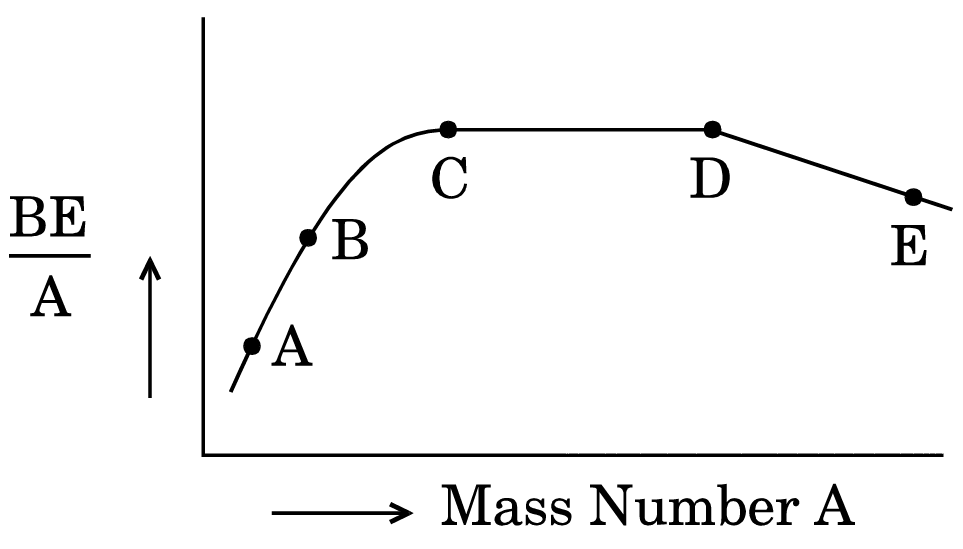
  1. The figure shows the plot of binding energy (BE) per nucleon as a function of mass number A. The letters A, B, C, D and E represent the positions of typical nuclei on the curve. Point out, giving reasons, the two processes (in terms of A, B, C, D and E), one of which can occur due to nuclear fission and the other due to nuclear fusion.

  1. Identify the nature of the radioactive radiations emitted in each step of the decay process given below.

$^{A}_{Z}\text{X}\rightarrow ^{A-4}_{Z-2}\text{Y}\rightarrow ^{A-4}_{Z-1}\text{W}$.

  1. State briefly the processes involved in the formation of p-n junction explaining clearly how the depletion region is formed.
  2. Using the necessary circuit diagrams, show how the V-I characteristics of a p-n junction are obtained in
  1. Forward biasing.
  2. Reverse biasing.

How are these characteristics made use of in rectification?

Maxwell showed that the speed of an electromagnetic wave depends on the penneability and pennittivity of the medium through which it travels. The speed of an electromagnetic wave in free space is given by $\text{c}=\frac{1}{\sqrt{\mu_0\in_0}}.$ The fact led Maxwell to predict that light is an electromagnetic wave. The emergence of the speed of light from purely electromagnetic considerations is the crowning achievement of Maxwell's electromagnetic theory. The speed of an electromagnetic wave in any medium of permeability $\mu$ and pennittivity $\in$ will be $\frac{\text{c}}{\sqrt{\text{K}\mu_\text{r}}}$ where K is the dielectric constant of the medium and $\mu,$ is the relative permeability.
  1. The dimensions of $\frac{1}{2}\in_0\text{E}^2$ ($\in:$ pennittivity of free space; E = electric field) is:
  1. MLT-1
  2. ML2T-2
  3. ML-1T-2
  4. ML2T-1
  1. Let $[\in_0]$ denote the dimensional formula of the permittivity of the vacuum. UM = mass, L = length, T = time and A = electric current, then
  1. $[\in_0]=\text{M}^{-1}\text{L}^{-3}\text{T}^2\text{A}$
  2. $[\in_0]=\text{M}^{-1}\text{L}^{-3}\text{T}^4\text{A}^2$
  3. $[\in_0]=\text{MLT}^{-2}\text{A}^{-2}$
  4. $[\in_0]=\text{ML}^{2}\text{A}^{-1}$
  1. An electromagnetic wave offrequency 3MHz passes from vacuum into adielectricmedium with permittivity $\in=4.$ Then
  1. Wavelength and frequency both remain unchanged.
  2. Wavelength is doubled and the frequency remains unchanged.
  3. Wavelength is doubled and the frequency becomes half.
  4. Wavelength is halved and the frequency remains unchanged.
  1. Which of the following are not electromagnetic waves?
  1. Cosmic rays
  2. $\gamma-\text{rays}$
  3. $\beta-\text{rays}$
  4. X-rays
  1. The electromagnetic waves travel with,
  1. The same speed in all media.
  2. The speed oflight c = 3 × 108ms-1 in free space.
  3. The speed oflight c = 3 × 10⁸ms-1 in solid medium
  4. The speed of light c = 3 × 10⁸ms-1 in fluid medium.
The mean free path of electrons in a gas in a discharge tube is inversely proportional to the pressure inside it. The Crookes dark space occupies half the length of the discharge tube when the pressure is 0.02mm of mercury. Estimate the pressure at which the dark space will fill the whole tube.
  1. A point-object is placed on the principal axis of a convex spherical surface of radius of curvature R, which separates the two media of refractive indices n 1 and n 2 (n 2 > n 1). Draw the ray diagram and deduce the relation between the distance of the object (u),distance of the image (v) and the radius of curvature (R) for refraction to take place at the convex spherical surface from rarer to denser medium.
  2. Use the above relation to obtain the condition on the position of the object and the radius of curvature in terms of n1 and n2 when the real image is formed.
Complete the following table:
Car Model
Driver X
Reaction time 0.20s
Driver Y
Reaction time 0.30s
A (deceleration on hard braking = 6.0m/s2)
Speed = 54km/h
Braking distance
a = ...
Total stopping distance
b = ...
Speed = 72km/h
Braking distance
c = ...
Total stopping distance
d = ...
B (deceleration on hard braking = 7.5m/s2)
Speed = 54km/h
Breaking distance
e = ...
Total stopping distance
f = ...
Speed 72km/h
Braking distance
g = ...
Total stopping distance
h = ...
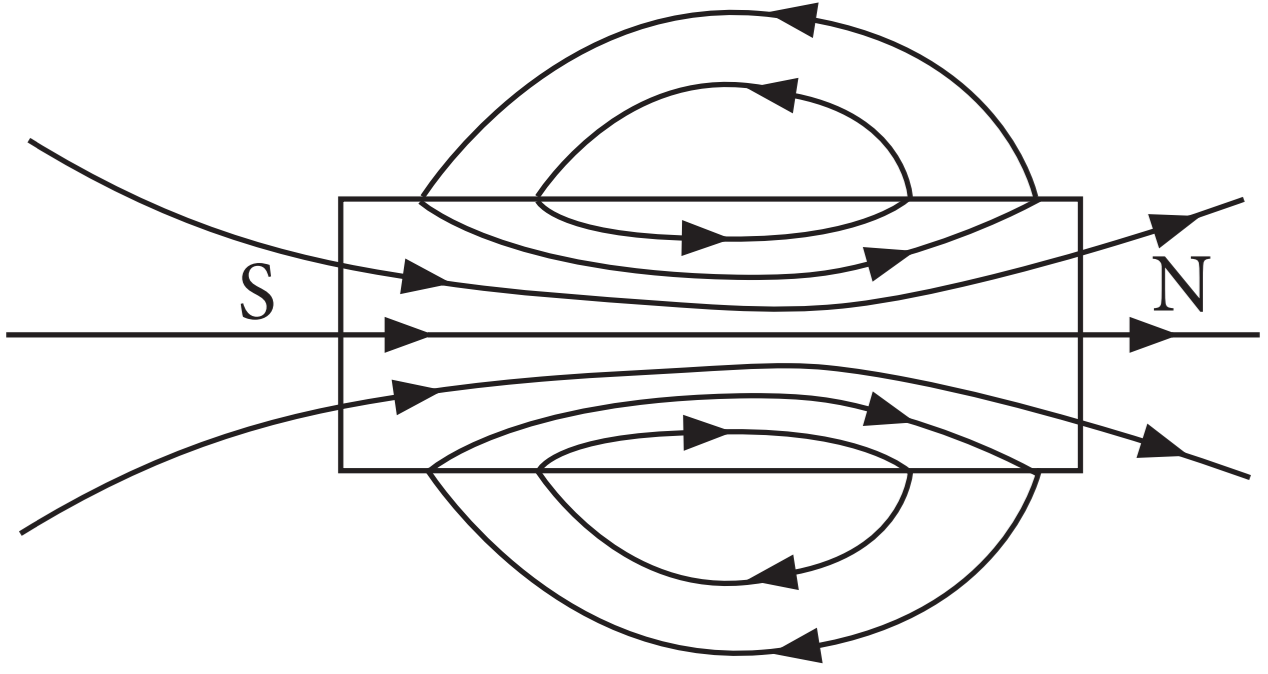
By analogy to Gauss's law of electrostatics, we can write Gauss's law of magnetism as $\oint\vec{\text{B}}.\text{d}\vec{\text{v}}=\mu_0\text{m}_{\text{inside}}$ where $\oint\vec{\text{B}}.\text{d}\vec{\text{s}}$ is the magnetic flux and $\text{m}_{\text{inside}}$ is the net pole strength inside the closed surface. We do not have an isolated magnetic pole in nature. At least none has been found to exist till date. The smallest unit of the source of magnetic field is a magnetic dipole where the net magnetic pole is zero. Hence, the net magnetic pole enclosed by any closed surface is always zero. Correspondingly, the flux of the magnetic field through any closed surface is zero. 

  1. Consider the two idealised systems
  1. a parallel plate capacitor with large plates and small separation and
  2. a long solenoid of length L >> R, radius of cross-section.

(In) (i) $\vec{\text{E}}$ is ideally treated as a constant between plates and zero outside. In (ii) Magnetic field is constant inside the solenoid and zero outside. These idealised assumptions, however, contradict fundamental laws as below

  1. Case (i) contradicts Gauss's law for electrostatic fields.
  2. Case (ii) contradicts Gauss's law for magnetic fields.
  3. Case (i) agrees with $\oint\vec{\text{E}}.\text{d}\vec{\text{l}}=0$
  4. Case (ii) contradicts $\oint\vec{\text{H}}.\text{d}\vec{\text{l}}=\text{l}_{\text{en}}.$ 
  1. The angle between the true geographic north and the north shown by a compass needle is called as:
  1. $\text{Zero}$

  2. $\frac{\mu_0}{4\pi}$

  3. $4\pi\mu_0$

  4. $\frac{4\mu_0}{\pi}$

  1. A closed surface S encloses a magnetic dipole of magnetic moment 2ml. The magnetic flux emerging from the surface is:
  1. $\mu_0\text{m}$

  2. $\text{Zero}$

  3. $2\mu_0\text{m}$

  4. $\frac{2\text{m}}{\mu _0}$

  1. Which of the following is not a consequence of Gauss's law?
  1. The magnetic poles always exist as unlike pairs of equal strength.
  2. If several magnetic lines of force enter in a closed surface, then an equal number of lines of force must leave that surface.
  3. There are abundant sources or sinks of the magnetic field inside a closed surface.
  4. Isolated magnetic poles do not exist.
  1. The surface integral of a magnetic field over a surface:
  1. Is proportional to mass enclosed.
  2. Is proportional to charge enclosed.
  3. S zero.
  4. Equal to its magnetic flux through that surface.