Question
Complete the following table:
Car Model
Driver X
Reaction time 0.20s
Driver Y
Reaction time 0.30s
A (deceleration on hard braking = 6.0m/s2)
Speed = 54km/h
Braking distance
a = ...
Total stopping distance
b = ...
Speed = 72km/h
Braking distance
c = ...
Total stopping distance
d = ...
B (deceleration on hard braking = 7.5m/s2)
Speed = 54km/h
Breaking distance
e = ...
Total stopping distance
f = ...
Speed 72km/h
Braking distance
g = ...
Total stopping distance
h = ...

Answer

Car Model
Driver X
Reaction time 0.25s
Driver Y
Reaction time 0.35s
A (deceleration on hard braking = 6.0m/s2)
Speed = 54km/h
Braking distance
a = 19m
Total stopping distance
b = 22m
Speed = 72km/h
Braking distance
c = 33m
Total stopping distance
d = 39m
B (deceleration on hard braking = 7.5m/s2)
Speed = 54km/h
Breaking distance
e = 15m
Total stopping distance
f = 18m
Speed 72km/h
Braking distance
g = 27m
Total stopping distance
h = 33m

$\text{a}=\frac{0^2-15^2}{2(-6)}=19\text{m}$

So, b = 0.2 × 15 + 19 = 33m

Similarly other can be calculated.

Braking distance: Distance travelled when brakes are applied.

Total stopping distance = Braking distance + distance travelled in reaction time.

Need a full question paper?

Generate a complete, print-ready paper with questions like this in minutes — across 16+ boards, with answer keys.

Start Generating Free

Similar questions

 For the past some time, Aarti had been observing some erratic body movement, unsteadiness and lack of coordination in the activities of her sister Radha, who also used to complain of severe headache occasionally. Aarti suggested to her parents to get a medical check-up of Radha. The doctor thoroughly examined Radha and diagnosed that she has a brain tumour.
  1. What, according to you, are the values displayed by Aarti?
  2. How can radioisotopes help a doctor to diagnose brain tumour? 
Draw the graph of deviation angle $(\delta)$ versus incidence angle (i) and derive the formula for refractive index $n_{21}=\frac{\sin \left(\frac{A+D_m}{2}\right)}{\sin \left(\frac{A}{2}\right)}$ for the material of prism.
In a microwave oven, the food is kept in a plastic container and the microwave is directed towards the food. The food is cooked without melting or igniting the plastic container. Explain.
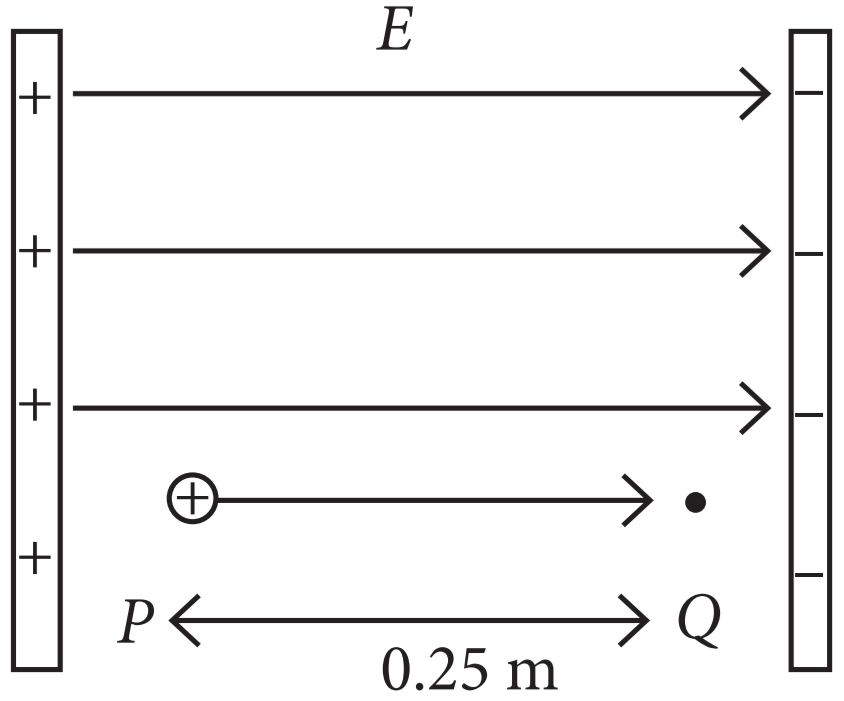
Potential difference $(\triangle\text{V})$ between two points A and B separated by a distance x, in a uniform electric field E is given by $\triangle\text{V}=-\text{Ex},$ where xis measured parallel to the field lines. If a charge q0 moves from P to Q, the change in potential energy $(\triangle\text{U})$ is given as $\triangle\text{U}=-\text{q}_0\triangle\text{V}.$ A proton is released from rest in uniform electric field of magnitude 4.0 × 108Vm-1 directed along the positive X-axis. The proton undergoes a displacement of 0.25m in the direction of E.

Mass of a proton = 1.66 × 10-27kg and charge of proton = 1.6 × 10-19C.

  1. The change in electric potential of the proton between the points A and B is:
  1. -1 × 108V
  2. 1 × 108V
  3. 6.4 × 10⁻¹⁹V
  4. -6.4 × 10⁻¹⁹V
  1. The change in electric potential energy of the proton for displacement from A to B is:
  1. 1.6 × 1011J
  2. 0.5 × 10²³J
  3. -1.6 × 10-11J
  4. 3.2 × 1022J
  1. The mutual electrostatic potential energy between two protons which are at a distance of 9 × 10-15m, in 92U235 nucleus is:
  1. 1.56 × 10-14J
  2. 5.5 × 10-14J
  3. 2.56 × 10-14J
  4. 4.56 × 10-14J
  1. If a system consistsoftwocharges 4mC and -3mC with no external field placed at (-5cm, 0, 0) and (5cm, 0, 0) respectively. The amount of work required to separate the two charges infinitely away from each other is:
  1. -1.1J
  2. 2J
  3. 2.5J
  4. 3J
  1. As the proton moves from P to Q, then:
  1. The potential energy of proton decreases.
  2. The potential energy of proton increases.
  3. The proton loses kinetic energy.
  4. Total energy of the proton increases.
Complete the following table:
Car Model
Driver X
Reaction time 0.20s
Driver Y
Reaction time 0.30s
A (deceleration on hard braking = 6.0m/s2)
Speed = 54km/h
Braking distance
a = ...
Total stopping distance
b = ...
Speed = 72km/h
Braking distance
c = ...
Total stopping distance
d = ...
B (deceleration on hard braking = 7.5m/s2)
Speed = 54km/h
Breaking distance
e = ...
Total stopping distance
f = ...
Speed 72km/h
Braking distance
g = ...
Total stopping distance
h = ...

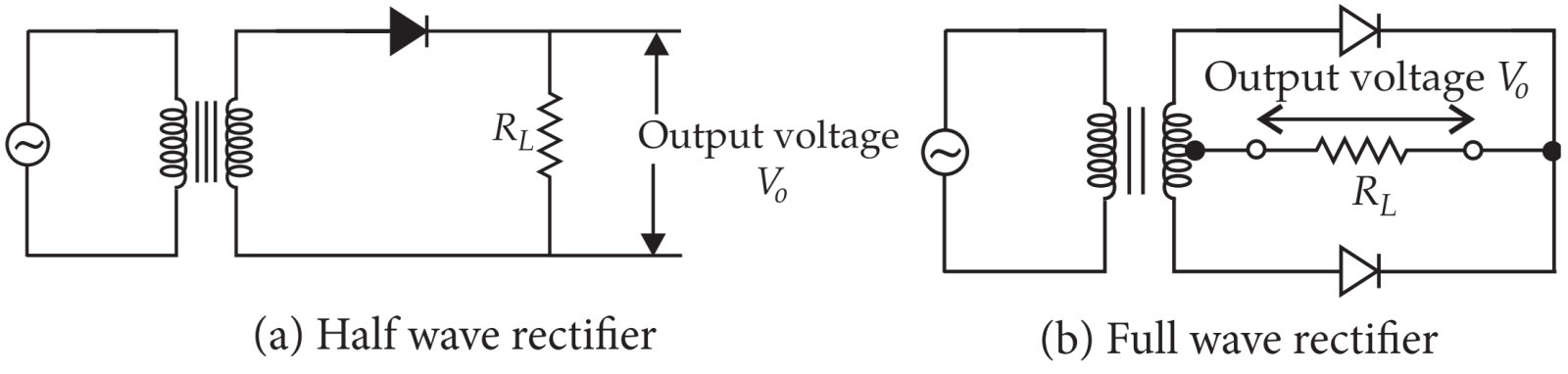
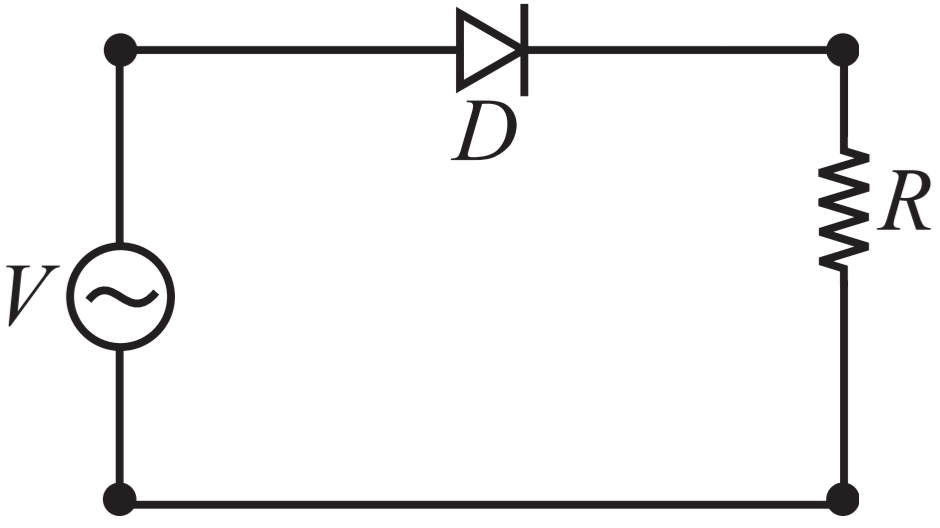
Rectifier is a device which is used for converting alternating current or voltage into direct current or voltage. Its working is based on the fact that the resistance of p-n junction becomes low when forward biased and becomes high when reverse biased. A half-wave rectifier uses only a single diode while a full wave rectifier uses two diodes as shown in figures (a) and (b).

  1. If the rms value of sinusoidal input to a full wave rectifier is $\frac{\text{V}_0}{\sqrt{2}}$ then the rms value of the rectifier's output is:
  1. $\frac{\text{V}_0}{\sqrt{2}}$

  2. $\frac{\text{V}_0^2}{\sqrt{2}}$

  3. $\frac{\text{V}_0^2}{2}$

  4. $\sqrt{2}\text{V}_0^2$

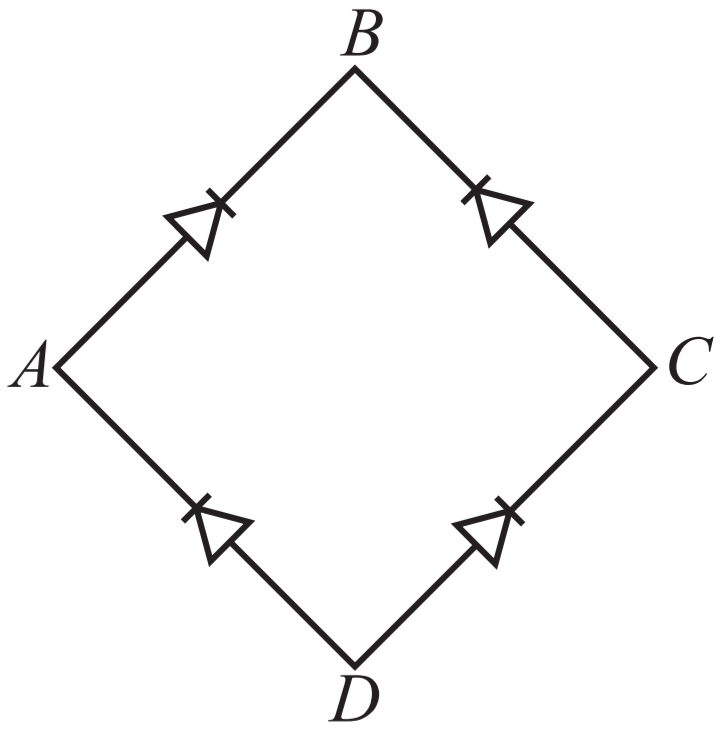
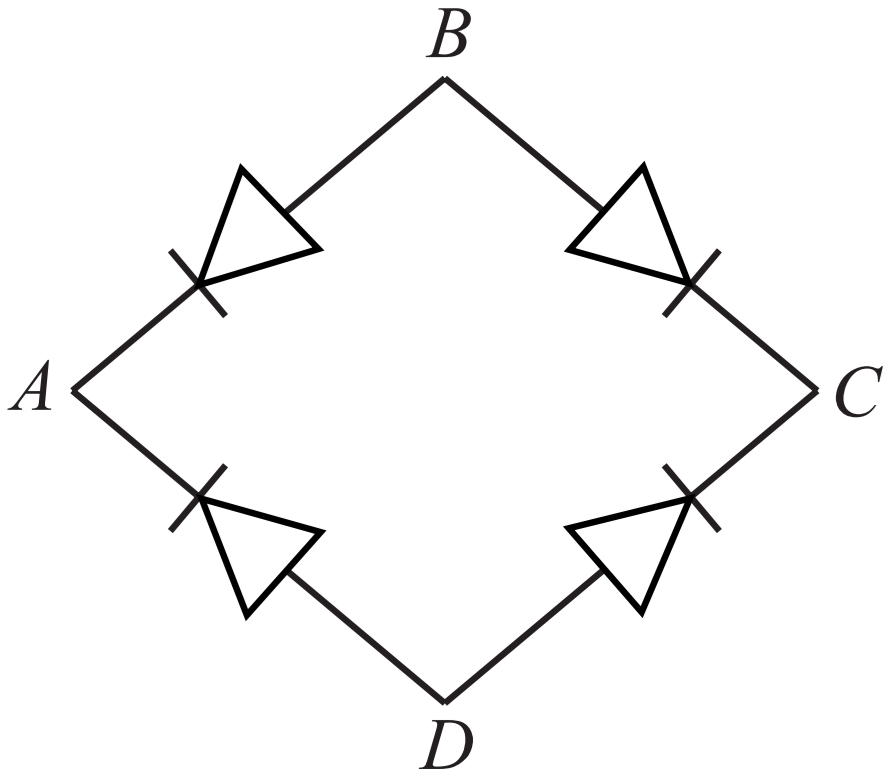
  1. In the diagram, the input ac is across the terminals A and C. The output across B and D is:

  1. Same as the input.
  2. Half wave rectified.
  3. Zero.
  4. Full wave rectified.
  1. A bridge rectifier is shown in figure. Alternating input is given across A and C. If output is taken across BD, then it is:

  1. Zero.
  2. Same as input.
  3. Half wave rectified.
  4. Full wave rectified.
  1. A p-n junction (D) shown in the figure can act as a rectifier. An alternating current source (V) is connected in the circuit. The current (I) in the resistor (R) can be shown by:

  1. With an ac input from 50Hz power line, the ripple frequency is:
  1. 50Hz in the de output of half wave as well as full wave rectifier.
  2. 100Hz in the de output of half wave as well as full wave rectifier.
  3. 50Hz in the de output of half wave and I 00Hz in de output of full wave rectifier.
  4. 100Hz in the de output of half wave and 50Hz in the de output of full wave rectifier.
TV signals broadcast by Delhi studio cannot be directly received at Patna which is about 1000km away. But the same signal goes some 36000km away to a satellite, gets reflected and is then received at Patna. Explain.
An electron in hydrogen atom revolving in a radius of $5.29 \times 10^{11} m$ around the nucleus. According to the condition of Bohr's allowed electron orbits, find the principle quantum number corresponds to this orbit.
$\begin{array}{l}
h=6.625 \times 10^{-34} Js, e=1.6 \times 10^{-19} C \\
\varepsilon_0=8.85 \times 10^{-12} MKS, m=9.1 \times 10^{-31} kg \text { Find out conclusion from your answe }
\end{array}$
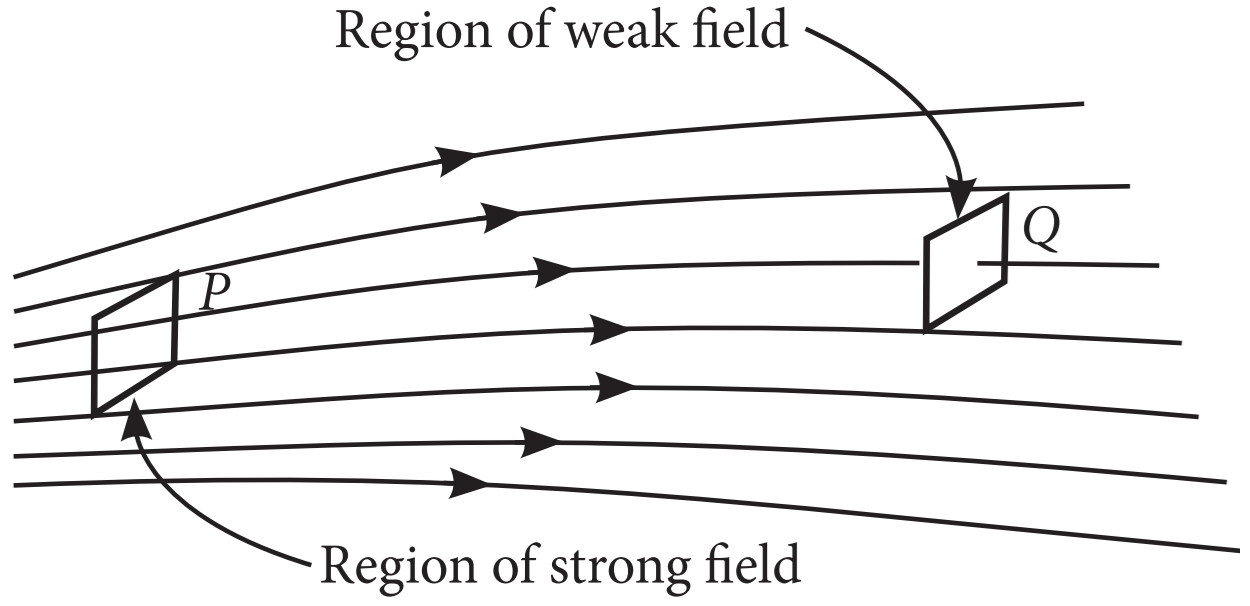
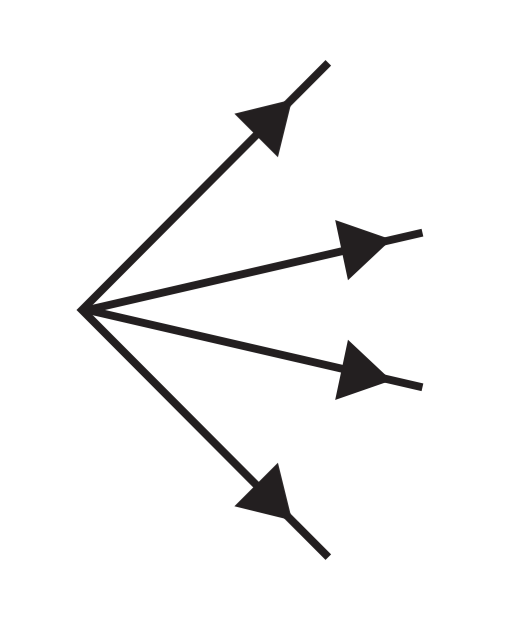
Electric field strength is proportional to the density of lines of force i.e., electric field strength at a point is proportional to the number of lines of force cutting a unit area element placed normal to the field at that point. As illustrated in the given figure, the electric field at P is stronger that at Q.

  1. Electric lines of force about a positive point charge are:
  1. Radially outwards.
  2. Circular clockwise.
  3. Radially inwards.
  4. Parallel straight lines.
  1. Which of the following is false for electric lines of force?
  1. They always start from positive charges and terminate on negative charges.
  2. They are always perpendicular to the surface of a charged conductor.
  3. They always form closed loops.
  4. They are parallel and equally spaced in a region of uniform electric field.
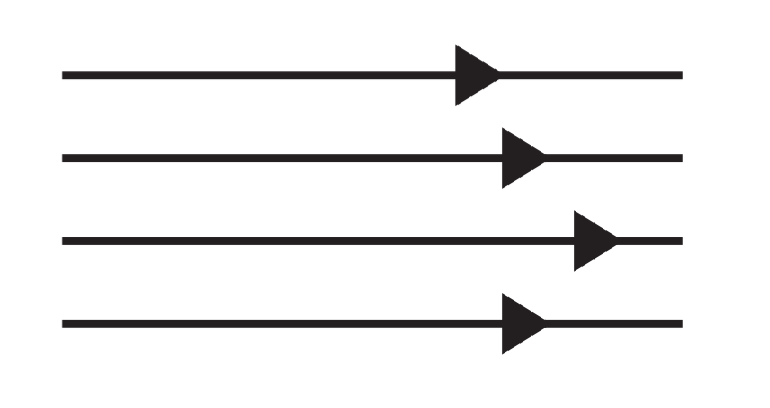
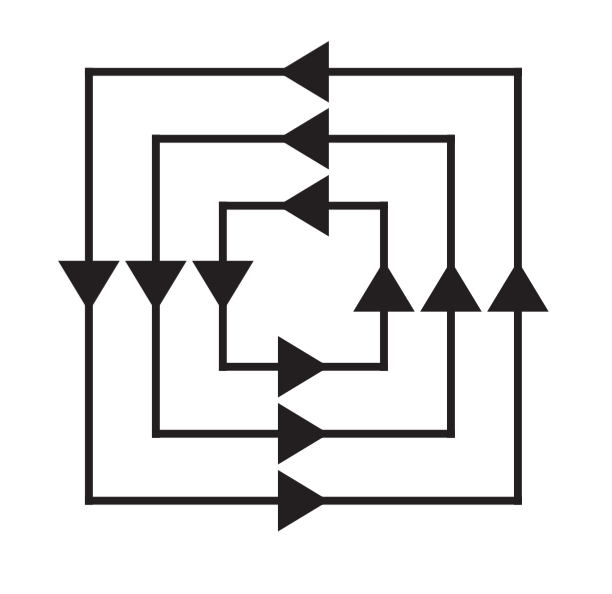
  1. Which one of the following pattern of electric line of force in not possible in filed due to stationary charges?
  1.  

  1.  

  1.  

  1.  

  1. Electric lines of force are curved:
  1. In the field of a single positive or negative charge.
  2. In the field of two equal and opposite charges.
  3. In the field of two like charges.
  4. Both (b) and (c).
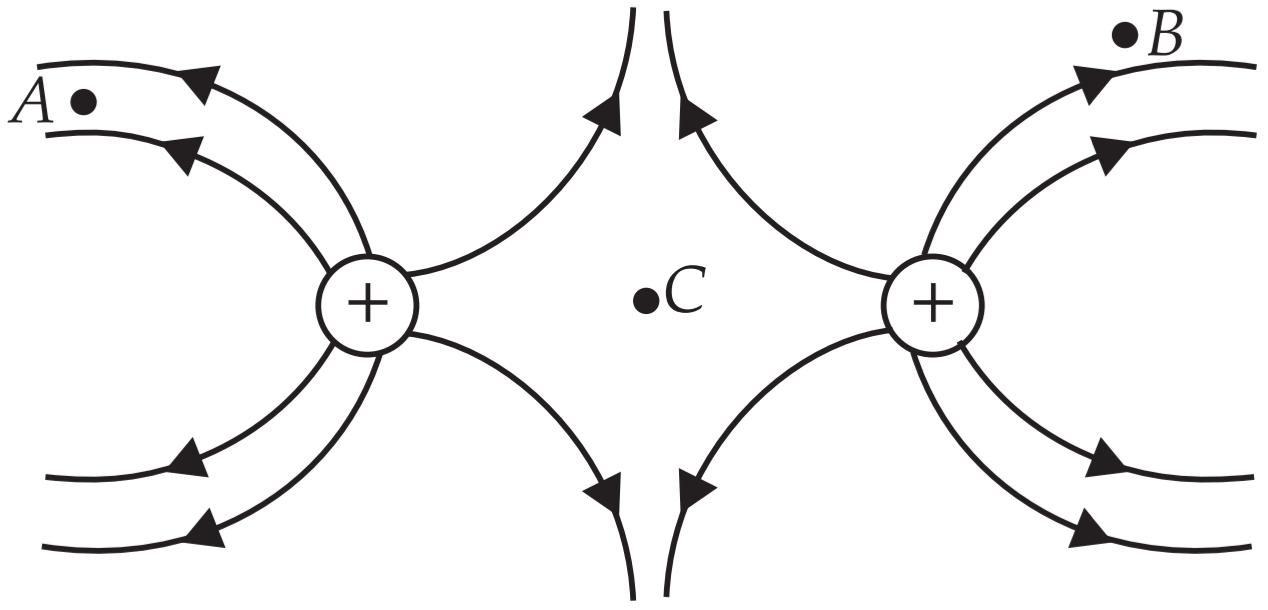
  1. The figure below shows the electric field lines due to two positive charges. The magnitudes EA, EB and EC of the electric fields at points A, Band C respectively are related as:

  1. EA > EB > EC
  2. EB > EA > EC
  3. EA = EB > EC
  4. EA > EB = EC
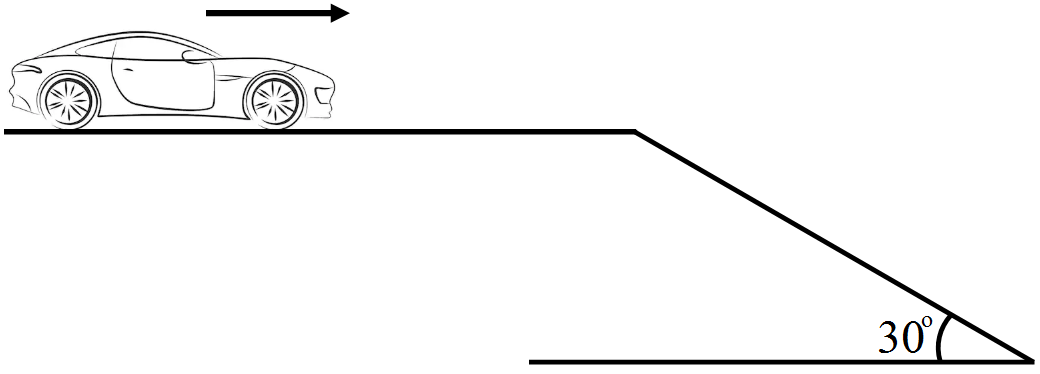
A car is going at a speed of 21.6km/hr when it encounters a 12.8m long slope of angle 30°. The friction coefficient between the road and the tyre is $\frac{1}{2\sqrt{3}}.$ Show that no matter how hard the driver applies the brakes, the car will reach the bottom with a speed greater than 36km/hr. Take g = 10m/s2.