Question
Discuss the health hazards associated with the pollution.

Answer

The impact of pollution on health may be primary or secondary. The primary impact occurs immediately but the secondary impact is delayed and may persist in future.
  1. When contaminated water is supplied to the residents of a locality, it may spread water borne diseases like diarrhea, hepatitis etc.
  2. Release of smoke as vehicular exhaust pollutes the air. When this air is inhaled by the humans it causes asthma and bronchitis.
  3. Large amount of soluble nitrates are released and dissolve in the water. It may contaminate the groundwater including wells of the area. Heavy intake of nitrates by humans may cause serious health hazards.
  4. People who work in the deep coal mines, inhale the fine coal dust. It leads to a disease called black lungs. Many gases are also released in the process of mining like methane and carbon-monoxide.

Need a full question paper?

Generate a complete, print-ready paper with questions like this in minutes — across 16+ boards, with answer keys.
Start Generating Free

Similar questions

List the events taking place in the photo-chemical phase of Photosynthesis.
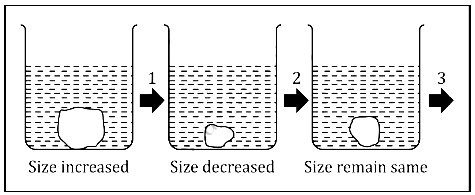
A candidate in order to study the process of osmosis has taken 3 potato cubes and put them in 3 different beakers containing 3 different solutions. After 24 hours, in the first beaker the potato cube increased in size, in the second beaker the potato cube decreased in size and in the third beaker there was no change in the size of the potato cube. The following diagram shows the result of the same experiment:

(i) Give the technical terms of the solutions used in beakers, 1, 2 and 3.
(ii) In beaker 3, the size of the potato cube remains the same. Explain the reason in brief.
(iii) Write the specific feature of the cell sap of root hairs which helps in absorption of water.
(iv) What is osmosis?
(v) How does a cell wall and a cell membrane differ in their permeability?
Column ‘II’ is a list of items related to ideas in Column ‘I’. Match the term in Column ‘II’ with a suitable idea given in Column ‘I’.
Column IColumn II
(i) Acrosome
(ii) Ovulation
(iii) Sperm
(iv) Menopause
(v) Implantation>
(vi) Fertilization
(vii) Contraception in males
(a) Male gamete
(b) Oviduct
(c) Uterus
(d) Spermatozoa
(e) Progesterone
(f) Stoppage of the menstrual cycle
(g) Sudden change in genes
With the help of an experiment, prove that roots are more positively hydrotropic than geotropic.
What part is played by the cell wall?
Match the terms of column I with those in column II:
Column IColumn II
(i) Stomata closed(a) decomposers
(ii) Autotrophs(b) light reaction
(iii) By-products of photosynthesis(c) animals
(iv) Photolysis(d) during night
(v) Bacteria and fungi(e) green plants
(f) oxygen
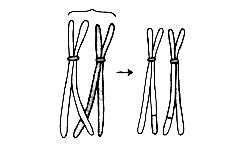
The diagram given below represents a certain phenomenon which occurs during meiosis. Name and explain the phenomenon by using the terms – homologous chromosomes, chromatids, crossing over.
Describe fully one experiment with potted green plant to show that starch is not produced in the leaves when carbon dioxide is not available (diagrams essential)
Describe the main chemical changes which occur during photosynthesis in:
Dark reaction
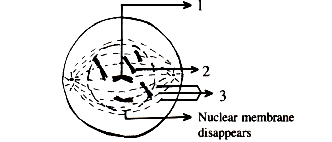
Given below is a diagram representing a stage during mitotic cell division in an animal cell examine it carefully and answer the questions which follow.

a) Identify the stage. Give one reason in support of your answer.
b) Name the cell organelle that forms the ‘aster’
c) Name the parts labelled 1, 2 and 3.
d) Name the stage that follows the one shown above, how is that stage identified?
e) Mention two differences between mitosis and meiosis with regards to:
(i) The number of daughter cells produced.
The chromosome number in the daughter cells.