Question
What part is played by the cell wall?

Answer

Cell wall separates the two solutions - cell sap and soil solution and is permeable which means it allows the water to enter inside the root hair cells by endosmosis.

Need a full question paper?

Generate a complete, print-ready paper with questions like this in minutes — across 16+ boards, with answer keys.
Start Generating Free

Similar questions

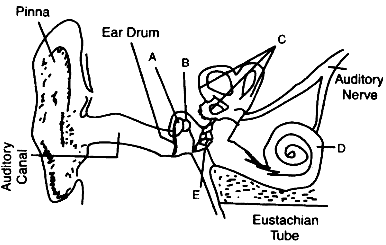
Given below is the diagram of the human ear. Study the diagram and then answer the questions that follow:
(i) What role does the eardrum play in hearing?
(ii) What common term is given to the parts labeled A, B, and E?
(iii) Would there be any difference if these three parts mentioned in (ii) above were replaced by one by one? Why?
(iv) Give the biological term for the parts labeled C and D.
(v) Name the fluid which fills the parts mentioned in (iv) above.
(vi) State the functions of the ear.
With well labelled diagrams explain meiosis.
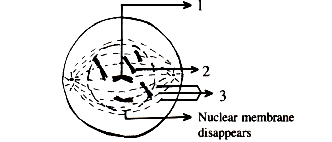
Given below is a diagram representing a stage during mitotic cell division in an animal cell examine it carefully and answer the questions which follow.

a) Identify the stage. Give one reason in support of your answer.
b) Name the cell organelle that forms the ‘aster’
c) Name the parts labelled 1, 2 and 3.
d) Name the stage that follows the one shown above, how is that stage identified?
e) Mention two differences between mitosis and meiosis with regards to:
(i) The number of daughter cells produced.
The chromosome number in the daughter cells.
Describe the main chemical changes which occur during photosynthesis in:
Light reaction
Column ‘II’ is a list of items related to ideas in Column ‘I’. Match the term in Column ‘II’ with the suitable idea given in Column ‘I’.
Column I Column II
(i) Auditory canal (a) Channels pressure waves of air into the middle ear.
(ii) Auditory (Eustachian tube) (b) Collects pressure waves of air.
(iii) Auditory nerve (c) Converts pressure waves of air into vibrations of bone.
(iv) Incus (d) Dissipates sound waves.
(v) Malleus (e) Equalizes pressure between the middle ear and the atmosphere.
(vi) Oval window (f) Provide information about the spatial orientation of the head.
(vii) Pinna (g) Transfers vibrations from a bone to a fluid.
(viii) Round window (h) Transfers vibrations from a bone to a membrane.
(ix) Semi-circular canal (i) Transfers vibrations from a bone to a bone.
(x) Stapes (j) Transfers vibrations from a membrane to a bone.
(xi) Tympanic membrane (k) Transmits action potential to the auditory cortex.
What are the main steps in coagulation of blood?
Match the Columns:
Column 2 is a list of items related to ideas in Column 1. Match the term in Column 2 with the suitable idea given in Column 1.
Column 1Column 2
(i) Family Planning(a) Counting of population
(ii) Vasectomy(b) Sterilization in female
(iii) Tubectomy(c) T.R. Malthus
(iv) Census(d) Sterilization in male
(v) Malthusian theory(e) Red triangle.
Explain the functioning of kidney.
Complete the following:
Gland/OrganHormoneFunction
(i) Stomach____________________
(ii) Parathyroid____________________
(iii) ____________________Lowers blood sugar level.
(iv) Adrenal medulla____________________
(v) Pancreas (Alpha cells)____________________
(vi) Testes____________________
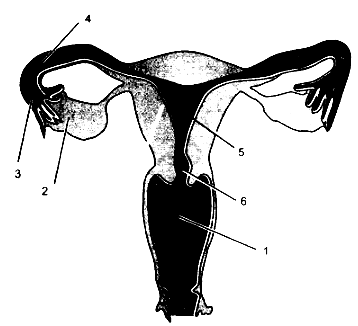
Given below is a diagram of the female reproductive system of a human being

(i) Name the parts numbered 1 to 6.
(ii) Normally after how many days does an ovary release an egg?
(iii) Where are the sperms released during coitus?
(iv) What do the sperms do after being released?
(v) What is the function of the organ numbered 5?
(vi) How many days does it normally take from the fertilization of the egg up to the birth of the baby?