Question
  1. Discuss the motion of a body in a vertical circle. Find the expressions for the minimum velocity at the lowest and highest points while looping a loop.
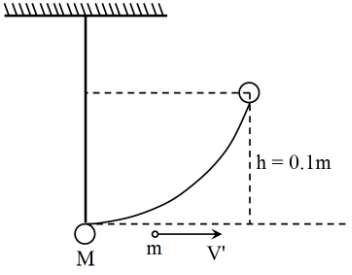
  2. A bullet of mass $0.01\ kg$ travelling at a speed of $500m/ s$ strikes a block of mass $2\ kg$ which is suspended by a string of length $5m$. The centre of gravity of the block is found to rise a vertical distance of $0.1 m$. What is the speed of the bullet after it emerges from the block? $(g = 9.8ms^{-2})$
Answer

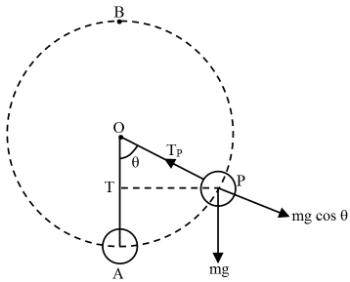
Consider the mass $m$ attached to a string of length $l.$ Let the lower most and top most points be marked $A$ and $B$ respectively. Consider a point $P$ where the length $l$ has turned by $\theta$ from the vertical line through $A.$

Centripetal force is provided by the tension and $mg \cos \theta$ acting in opposite directions.
From the diagram, $\text{OA = OP = l,}$
$\text{OT} =\text{l}\cos\theta,\text{AT}=\text{l}(1-\cos\theta)$
  1. If $v_A$ and $v_p$ are velocities at $A$ and $P$ respectively, using
$v^2 = u^2 + 2$ as, we have
$\text{v}^2_\text{p}=\text{v}_\text{A}^2-\text{2g}(\text{AT})$
$\text{v}_\text{}p^2=\text{v}_\text{A}^2-2\text{gl}(1-\cos\theta)$
Velocity at any point $p,$
$\text{v}_\text{p}=\sqrt{\text{v}^2_\text{A}-2\text{gl}(1-\cos\theta)}$
  • At $P, T_p\ -\text{mg}\cos\theta=\frac{\text{mv}^2\text{p}}{\text{l}}$,
$\text{T}_\text{p}=\text{mg}\cos\theta+\frac{\text{mv}^2\text{p}}{\text{l}}$
$\therefore\text{T}_\text{p}=\text{mg}\cos\theta+\frac{\text{m}}{\text{l}}\sqrt{\text{v}_\text{A}^2-2\text{gl}}(\text{l}-\cos\theta)$
By knowing $V_A$ and $\theta$ , one can find the velocity and tension at any point.
  • To perform verticle circle, the tension should be non$-$zero till the mass reaches the top most point $B$
$\therefore\text{T}_\text{B}\geq0\text{ at }\theta=80^\circ$
$\therefore\text{T}_\text{B}=0 $ will be minimum.
Substituting,
$\text{TP}=0\text{ at } \theta =\pi,$ we have
$0 = \text{mg}\cos\pi+ \frac{\text{M}}{\text{l}}[\text{v}_\text{A}^2-2\text{gl}(1-\cos\pi)]$
$0 = -\text{Mg}+\frac{\text{M}}{\text{l}}[\text{v}_\text{A}^2-2\text{gl}(2)]$
$\text{v}_\text{A}^2-4\text{gl}=\text{gl},\text{v}_\text{A}^2=5\text{gl},=\sqrt{5\text{gl}}$
So, the minimum velocity required at lowermost point to perform verticle circle is $\sqrt{5\text{gl}}$.
  • Given: Mass of a bullet $(m) = 0.01\ kg$
Speed of bullet $(v) = 500\ m/ s$
Mass of block $(M) = 2\ kg$
Length of string $(l) = 5\ m$
Vertical height $(h) = 0.1\ m$

Let $V$ be the velocity acquired by block
$\frac{1}{2}\text{MV}=\text{Mgh}$
$\Rightarrow\text{V}=\sqrt{2\text{gh}}$
$=\sqrt{2\times9.8\times0.1}$
​​​​​​​$=104\text{m/s}$
If $V'$ is the speed of bullet on emerging out of the block then by the law of conservation of energy.
$\text{mv}+\text{M}\times0=\text{MV}+\text{mV}'$
$\therefore\text{V}'=\frac{\text{mv}-\text{MV}}{\text{m}}$
$=\frac{0.01\times500-2\times1.4}{0.01}$
$\text{V}'=\frac{5-2.8}{0.01}=\frac{2.2}{0.01}=220\text{ m/s}$

Need a full question paper?

Generate a complete, print-ready paper with questions like this in minutes — across 16+ boards, with answer keys.

Start Generating Free

Similar questions

Find the components along the x, y, z axes of the angular momentum l of a particle, whose position vector is r with components x, y, z and momentum is p with components px, py and pz. Show that if the particle moves only in the x-y plane the angular momentum has only a z-component.
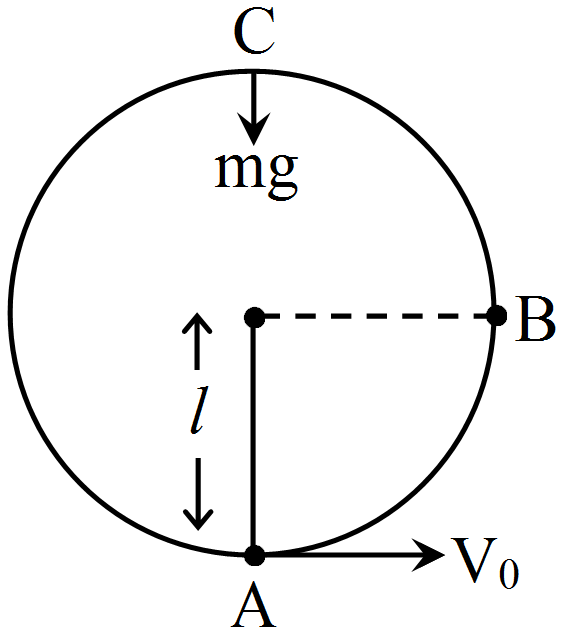
A bob of mass $m$ is suspended by a light string of length $l.$ It is imparted a horizontal velocity $v_o$ at the lowest point $A$ so that it completes a semi$-$circular trajectory in the vertical plane with the string becoming slack only on reaching the topmost point $C.$ This is shown in the figure. Obtain an expression for:
  1. Horizontal velocity $v.$
  2. The speed at point $B$ and $C.$
  3. The ratio of the kinetic energies$\bigg(\frac{\text{K}_\text{B}}{\text{K}_\text{C}}\bigg)$ at $B$ and $C.$
  4. Comment on the nature of the trajectory of the bob after it reaches the point $C.$
A diverging lens of focal length $20cm$ and a converging lens of focal length $30cm$ are placed $15cm$ apart with their principal axes coinciding. Where should an object be placed on the principal axis so that its image is formed at infinity?
A rubber string 10 m long is suspended from a rigid support at its one end. Calculate the extension in the string due to its own weight. The density of rubber is $1.5 \times 10^3 \mathrm{~kg} / \mathrm{m}$ and Young's modulus for the rubber is $5 \times 100 \mathrm{~N} / \mathrm{m}^2$. The breaking stress for a metal is $7.8 \times 10^9 \mathrm{~N} / \mathrm{m}^2$. Calculate the maximum length of the wire made of this metal with may be suspended without breaking. The density of metal $=7.8 \times 10^3 \mathrm{~kg} / \mathrm{m}^3$.
A particle of mass 0.8kg is executing simple harmonic motion with amplitude of 1.0 metre and periodic time $\frac{11}{7}\text{sec}$. Calculate the velocity and the kinetic energy of the particle at the moment when its displacement is 0.6 metre.
A 2kg block is placed over a $4kg$ block and both are placed on a smooth horizontal surface. The coefficient of friction between the blocks is $0.20$. Find the acceleration of the two blocks if a horizontal force of $12N$ is applied to:
  1. The upper block.
  2. The lower block. Take $g = 10m/s^2$​​​​​​​.
Suppose the block of the previous problem is pushed down the incline with a force of 4N. How far will the block move in the first two seconds after starting from rest? The mass of the block is 4kg.
Consider the situation of the previous problem. Suppose each of the blocks is pulled by a constant force F instead of any impulse. Find the maximum elongation that the spring will suffer and the distances moved by the two blocks in the process.
Solve the previous problem if the coefficient of restitution is e. Use $\theta=45^\circ,\ \text{e}=\frac{3}{4}$ and h = 5m
Two particles A and B, having opposite charges $2.0 \times 10^{-6}C$ and $2.0 \times 10^{-6}C$, are placed at a separation of 1.0cm.
  1. Write down the electric dipole moment of this pair.
  2. Calculate the electric field at a point on the axis of the dipole 1.0m awa.y from the centre.
  3. Calculate the electric field at a point on the perpendicular bisector of the dipole and 1.0m away from the centre.