Find the components along the x, y, z axes of the angular momentum l of a particle, whose position vector is r with components x, y, z and momentum is p with components px, py and pz. Show that if the particle moves only in the x-y plane the angular momentum has only a z-component.
Exercise
Download our app for free and get started
$\text{l}_{\text{x}}=\text{yp}_{\text{z}}-\text{zp}_{\text{y}}$ $\text{l}_{\text{y}}=\text{zp}_{\text{x}}-\text{zp}_{\text{z}}$ $\text{l}_{\text{z}}=\text{xp}_{\text{y}}-\text{yp}_{\text{x}}$ Linear momentum of the particle, $\vec{\text{p}}=\text{p}_{\text{x}}\hat{\text{i}}+\text{p}_{\text{y}}\hat{\text{j}}+\text{p}_{\text{z}}\hat{\text{k}}$ Position vector of the particle, $\vec{\text{r}}={\text{x}}\hat{\text{i}}+{\text{y}}\hat{\text{j}}+{\text{z}}\hat{\text{k}}$ Angular momentum, $\vec{\text{l}}=\vec{\text{r}}\times\vec{\text{p}}$ $=({\text{x}}\hat{\text{i}}+{\text{y}}\hat{\text{j}}+{\text{z}}\hat{\text{k}})\times(\text{p}_{\text{x}}\hat{\text{i}}+\text{p}_{\text{y}}\hat{\text{j}}+\text{p}_{\text{z}}\hat{\text{k}})$ $=\begin{vmatrix}\vec{\text{i}}&\vec{\text{j}}&\vec{\text{k}}\\\text{x}&\text{y}&\text{z}\\\text{p}_{\text{x}}&\text{p}_{\text{y}}&\text{p}_{\text{z}}\end{vmatrix}$ $=\text{l}_{\text{x}}\hat{\text{i}}+\text{l}_{\text{y}}\hat{\text{j}}+\text{l}_{\text{z}}\hat{\text{k}}$ $=\hat{\text{i}}(\text{yp}_{\text{z}}-\text{zp}_{\text{y}})-\hat{\text{j}}(\text{zp}_{\text{x}}-\text{zp}_{\text{z}})+\hat{\text{k}}(\text{xp}_{\text{y}}-\text{yp}_{\text{x}})$ Comparing the coefficients of $\hat{\text{i}},\hat{\text{j}}$ and $\hat{\text{k}},$ we get $ \text{l}_{\text{x}}=\text{yp}_{\text{z}}-\text{zp}_{\text{y}},\text{ l}_{\text{y}}=\text{zp}_{\text{x}}-\text{zp}_{\text{z}},\text{ l}_{\text{z}}=\text{xp}_{\text{y}}-\text{yp}_{\text{x}}\ ...(\text{i})$ The particle moves in the x-y plane. Hence, the z-component of the position vector and linear momentum vector becomes zero, i.e., Z = Pz = 0 Thus, equation (i) reduces to, $\text{l}_{\text{x}}=0,\text{ l}_{\text{y}}=0,\text{ l}_{\text{y}}=\text{x}\text{p}_{\text{y}}-\text{y}\text{p}_{\text{x}}\ ...(\text{ii})$ Therefore, when the particle is confined to move in the x-y plane, the direction of angular momentum is along the z-direction.

Download our appand get started for free
Experience the future of education. Simply download our apps or reach out to us for more information. Let's shape the future of learning together!No signup needed.*
Similar Questions
- 1A meter stick held vertically, with one end on the ground, is then allowed to fall. What is the value of the radial and tangential acceleration of the top end of the stick when the stick has turned through on angle $\theta?$ What is the speed with which the top end of the stick hits the ground? Assume that the end of the stick in. contact with the ground does not slip.View Solution
- 2From a uniform circular disc of diameter d, a circular hole of diameter $\frac{\text{d}}{6}$ and having its centre at a distance of $\frac{\text{d}}{4}$ from the centre of the disc is scooped out. Find the centre of mass of the remaining portion.View Solution
- 3View SolutionA wheel in uniform motion about an axis passing through its centre and perpendicular to its plane is considered to be in mechanical (translational plus rotational) equilibrium because no net external force or torque is required to sustain its motion. However, the particles that constitute the wheel do experience a centripetal acceleration directed towards the centre.How do you reconcile this fact with the wheel being in equilibrium? How would you set a half-wheel into uniform motion about an axis passing through the centre of mass of the wheel and perpendicular to its plane? Will you require external forces to sustain the motion?
- 4View SolutionTorques of equal magnitude are applied to a hollow cylinder and a solid sphere, both having the same mass and radius. The cylinder is free to rotate about its standard axis of symmetry, and the sphere is free to rotate about an axis passing through its centre. Which of the two will acquire a greater angular speed after a given time.
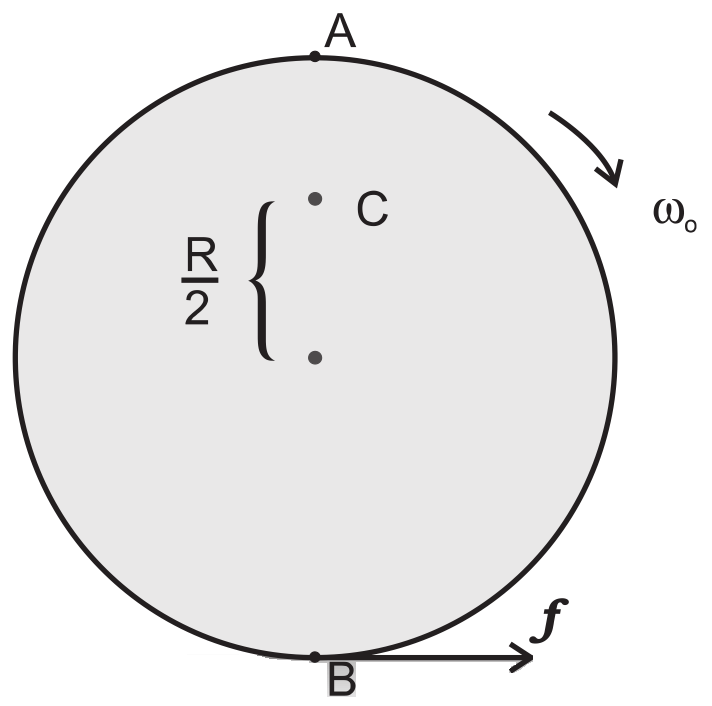
- 5A disc rotating about its axis with angular speed $\omega_0$ is placed lightly (without any translational push) on a perfectly frictionless table. The radius of the disc is R. What are the linear velocities of the points A, B and C on the disc shown in will the disc roll in the direction indicated?View Solution
- 6View SolutionShow that a(b × c) is equal in magnitude to the volume of the parallelepiped formed on the three vectors a, b and c.
- 7View SolutionA hoop of radius 2m weighs 100kg. It rolls along a horizontal floor so that its centre of mass has a speed of 20cm/s. How much work has to be done to stop it?
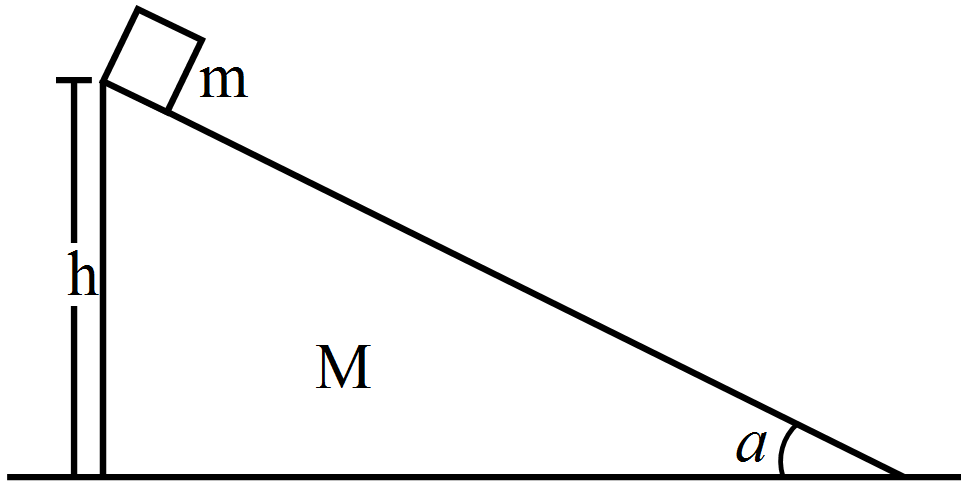
- 8View SolutionA block of mass m is placed on a triangular block of mass M, which in turn is placed on a horizontal surface as shown in figure. Assuming frictionless surfaces find the velocity of the triangular block when the smaller block reaches the bottom end.
- 9A solid sphere of mass 0.50kg is kept on a horizontal surface. The coefficient of static friction between the surfaces in contact is $\frac{2}{7}.$ What maximum force can be applied at the highest point in the horizontal direction so that the sphere does not slip on the surface?View Solution
- 10A solid disc and a ring, both of radius $10cm$ are placed on a horizontal table simultaneously, with initial angular speed equal to $10 π$ rad $s^{-1}$. Which of the two will start to roll earlier? The co-efficient of kinetic friction is $\mu_\text{k}=0.2$View Solution