Question
Discuss the types of seeds. Also describe its structure.

Answer

On the basis cotyledons seeds are of two types :
Monocot seed : It has only one cotyledon which is called scutellum in grass family. It is shield shaped. Scutellam is situated on one side of the embryonal axis laterally at the lower and the embryonal axis has the radical and root cap and closed in an undifferentiated sheet called coleorrhiza. The portion of the embryonal above the level of attrachment of scutellum is the epicotyl. Epicotyl has a shoot apex and a few leaf primordia enclosed in a hollow foliar structure, the oleoptile (Fig.).
Image
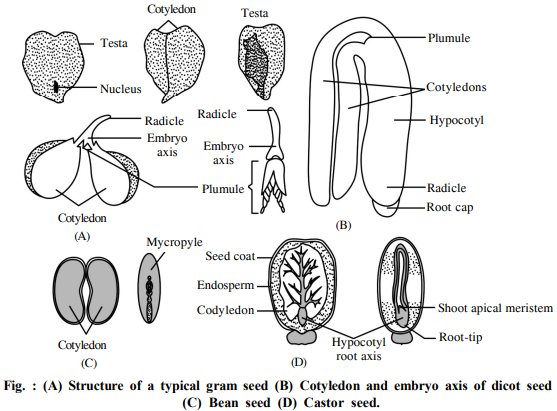
Dicot Seed : Seed is covered by one or two envelope called seed coat. The outer seed coat is called testa and inner seed coat is tegmen. Some seeds have only one seed coat. Outer covering is thick and hard which protect the embryo in adverse condition and during dormancy period. Tegmen is very thin.
Dicot has two cotyledons situated laterally to embryonal axis on both side. The portion of embryonal axis above the level of cotyledons is the epicotyls which terminates with the plumule or stem tip. The cylindrical portion below the level of cotyledons is hypocotyl terminates at its lower and in the radical or root tip. The root tip is covered with a root cap. Those cotyledons which do not have endosperm they become thick and pulpy by absorbing the endosperm. In some seeds, cotyledons come about the surface of soil during germination and synthesize the food by carrying out photosynthesis till the first leaf be formed.
On the basis of presence or absence of endosperm seeds are of two types:
Endospermic seed : In some sheets embryo is bounded by a special parenchyma tissue which stores the food in plenty and provide nourishment to the developing embryo this tissue is called endosperm and those in which endosperm is present are called endospermic or albuminous seeds. Most of the monocot plant e.g. wheat maize, rice, barley and some of the dicot seed like castor bean are endospermic seeds.
Non-endospermic seed : Some plants like gram peer, bean, bottle gourd sunflower etc. seeds are divided of endosperm as it is used by the developing embryo. The sheets are also called X album in a sheet and they store the food in cotyledons thereby they are thick and pulpy.

Need a full question paper?

Generate a complete, print-ready paper with questions like this in minutes — across 16+ boards, with answer keys.
Start Generating Free

Similar questions

Who revealed biochemical nature of the transforming principle? How was it done?
What is a biogeochemical cycle. What is the role of the reservoir in a biogeochemical cycle. Give an example of a sedimentary cycle with reservoir located in earth’s crust.
  1. List any four evidences of evolution.
  2. Explain any one of the evidences that helps to understand the concept of evolution.
Explain the mechanism of sex determination in human being.
Write short notes on the followings : (a) Predation (b) Competition
Distinguish between the following :
(a) Grazing food chain and detritus food chain
(b) Production and Decomposition
(c) Upright and Inverted Pyramids
  1. State one difference and one similarity between geitonogamy and xenogamy.
  2. Explain any three devices developed in flowering plants to discourage self pollination and encourage cross-pollination.
Which methodology is used while sequencing the total DNA from a cell? Explain it in detail.

  1. Which of the above represents the increase or decrease of population?
  2. If N is the population density at time t, then what would be its density at time (t + 1)? Give the formula.
  3. In a barn there were 30 rats. 5 more rats enter the barn and 6 out of the total rats were eaten by the cats. If 8 rats were born during the time period under consideration and 7 rats left the barn, find out the resultant population at time (t + 1).
  4. If a new habitat is just being colonized, out of the four factors affecting the population growth, which factor contributes the most?
Enlist the salient features of the double helix structure of DNA.