There are certain basic resources that are required by all forms of business:
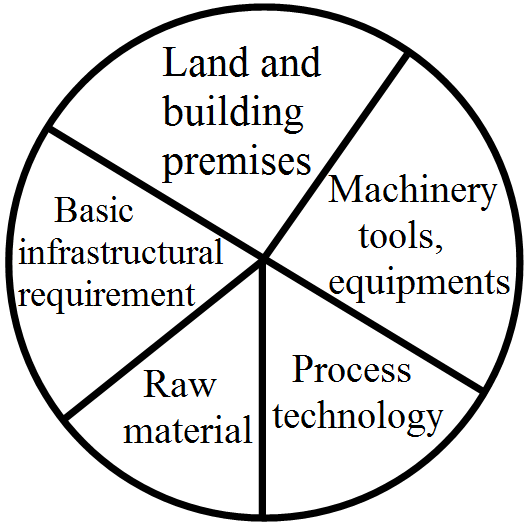
- Physical Resources: These resources are those that are made by humans through their abilities and skills. The category of physical resources covers a wide range of operational resources concerned with the physical capability of the enterprise, encompassing mainly:
- Human Resources: Human resources may be thought of as “The total knowledge, skills, creative abilities, talents and aptitudes of an organisation's workforce as well as, the values, attitudes and benefits of an individual involved”.
These are the most important assets that a firm must have and that the management must be most concerned with, because in the absence of these resources, other non-living resources are useless.
- Herbert G Hicks and C Ray Gullet: As have rightly observed, “The people working in a firm make it what it is". An organisation's performance and resulting productivity are directly proportional to the quantity and quality of its human resource. A rich and continuing supply of qualified people/personnel is the best assurance an enterprise can have that it will flourish.
‘Right man at the right job at the right time'- is the mantra for successful enterprises because it:
- Ensures benefits of specialisation to the firm.
- Minimises wastages of resources.
- Reduces inefficiencies.
- Reduces labour turnover ratio and rate of absenteeism.
- Saves cost of production.
- Financial Resources: Finance is one of the important pre-requisites to start an enterprise. It is the availability of finance that enables an entrepreneur to bring together, personnel, machines, materials, methods, land and convert a dream into reality.
It will not be incorrect to elucidate finance as lubricant to the process of production' or 'life blood of enterprise'.
- Material Resources: For its successful operation, a business enterprise needs a number of material resources. To successfully convert raw material into finished products with value addition, a wide array of arrangements needs to be worked out by the entrepreneur.
Some of the important decisions are regarding:
- Size of the unit and its installed capacity.
- Identifying machinery and the technical know-how required. srategie
- Technical training involved.
- Quality control systems required.
- Type of technical staff required.
- Maintenance cost.
- Availability of spare parts and support services (after sale services).
- Wear and tear rate of assets.
- Type of raw materials required.
- Suppliers of the raw material, their number and location.
- Intangible Resources: The intangible resources are those which can neither be seen nor touched, but enables a business to continue to earn a profit that is in excess of the normal basic rate of profit earned by other business of similar type.
This category generally comprises of the following resources:
- Goodwill: Goodwill of a business is the difference between the value of tangible assets of the business and the value which one is ready to pay for it. Goodwill generally does not exist in case of a new business. But, if an existing business takes in a new partner, then the goodwill of the business will be enjoyed by the new partner.
- Reputation: A business's reputation is also an intangible resource which help it to gather necessary support from employees and suppliers.
- Brands: Strong brands are often the key factor in whether a growth strategy is a success or failure. Being associated with strong brand, an entrepreneur can command and sustain higher margin.
- Intellectual Property: Key commercial rights protected by patents and trademarks may be an important resource for an entrepreneur.