A variety of methods are known for birth control. Methods which delibrately prevent fertilization or conception are referred as
contraception.
There are two main types of methods of birth control—(I) Temporary and (II) Permanent.
(I) Temporary Methods : These include :
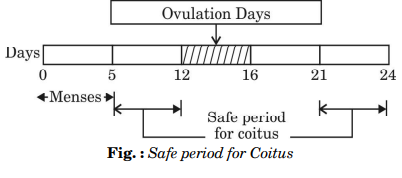
(i) Safe Period (Rhythem Method) : A week before and a week after menses is considered the safe period for sexual intercourse or coitus. This is based on the following facts :
• Ovulation occurs in the middle of normal menstrual cycle of 28 days. i.e., on 14th day. (There could be 1 or 2 days variation in individual cases.)
• Life span of ovum is 1 - 2 days.
• Sperms remain alive gor about 3 days.
This method is also called as
natural method of family planning. It is also referred as
periodic abstinence.
(ii) Coitus Interruptus : It is the oldest method of birth control. It involvees withdrawl of penis by male partner from the vagina just before ejaculation. This is not 100% fool-proof as a lapse in timing or will power may result in late withdrawl and lead to conception.
(iii) Lactational Amenorrhea : During intense lactation following parturition (delivery) the menstrual cycle stops (amenorrhea) and therefore ovulation does not occur. Hence, as long as the mother breast feeds the child fully, the chances of conception are alomost nil. It can last to a maximum period of 6 months after delivery.
(iv) Mechanical Means : These are of three types :
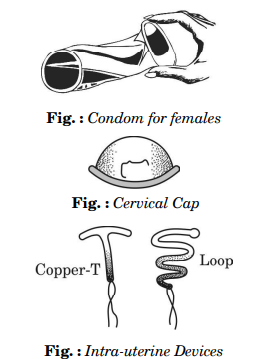
(a) Condom : A condom act as a barrier. A condom is a thin sheath, usually made up of rubber to cover the erect penis. (fig.) It is most widely used contraceptive by males in India as it is cheap and easily available. Condom should be put on before starting intercouse. It also act as a safe guard against STDs and AIDS.
 (b) Diaphragm and Cervical Caps :
 These are condome-shaped rubber covers which are inserted into female genital tract to cover cervix and prevents entry of sperms during coitus.
 (c) Intra-uterine Devices (IUDs) :
 These are plastic or rubber metal objects placed in the uterus by a doctor. These include-loop, Copper-T. IUDs have their own limitations as it can lead to occasional haemorrhage.
(v) Chemical Means or Spermicides : These include foam tablets, jellies and creams. On introduction into vagina before sexual intercourse, adhere to mucous membrane and immobilise and kill the sperms. These contain spermicides such as lactic acid, citric acid, boric acid etc.
(vi) Physiological (Oral) Devices : These are hormonal tablets used by females popularly knowns a
pills. For examples a pill called
Mala-D is taken daily and
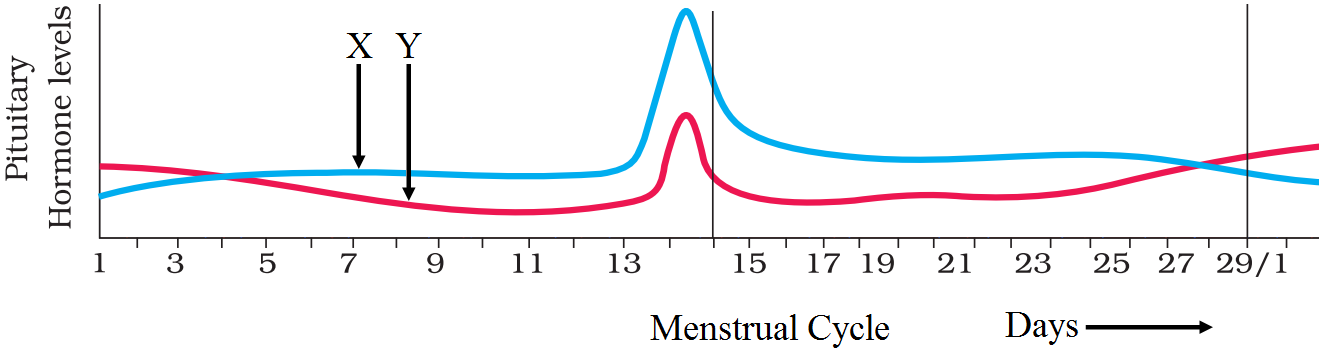
‘Saheli’ a pill developed by Central Drug and Research Institute (CDRI), Lucknow is taken weekly. Then pills check ovulation by inhibition the secretion of Follicle Stimulating Hormone (FSH) and Luteinizing Hormone (LH) which are necessary for ovulation. These are many side effects associated with the use of pills such as nausea, weight gain, high blood pressure and other cardiovascular problems.
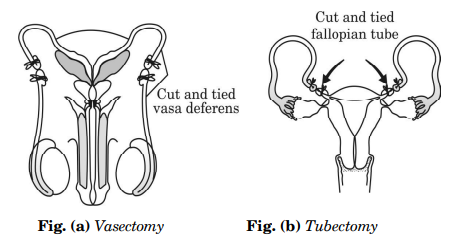
II. Permament Methods : Surgical Method : Surgical methods are referred to as permanent birth control methods. It is generally advised for the male/ female partner as a terminal method for pervent any more pregnancies. It is also called sterlisation. By this method the transport of sperms is blocked and there by conception is prevented. Permanent methods includes the following.
(a) Male Stelization & Vasectomy : In vasectomy, a small part of the vas deferens to removed or tied up through a small incision on the scrotums as a result the sperms produced and absorbed in the body; the semen has no sperms.
(b) Female Sterilization; Tubectomy : In tubectomy a small part of the fallopian tube is removed or tied up through a small incision in the abdomen or throught vagina. This prevents the fertilization of eggs by sperm.