Question
Explain evolution with the help of its embryological evidences.###Explain evidence from embryology in evolution.
Answer

Evidences from Embryology : With the exception of a few, every multicellular animal originates from a zygote. The development from zygote to adult shows many similarities in various organisms. The development is termed as ontogeny.
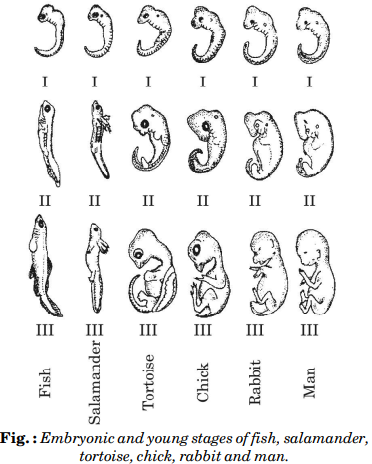
Recapitulation Theory/Biogenetic Law : Haeckel, a German biologist, gave a theory "Ontogeny repeats Phylogeny". An individual organism during its development (ontogeny) tries to repeat the history of its race by different stages (phylogeny).The vertebrate development confirms the above statement. For example, the embryos of all vertebrates pass through a gilled stage. In fishes, the gills are present in the adult condition. In amphibians, gills are present in some forms of frog and in tadpole. While in reptiles, birds and mammals these gills are never functional but nevertheless they are always present in the embryo.
Image
Haeckel, believed that all those stages, which have occurred during the course of evolution of a particular animal, also pass through its development.
There are objections to this theory, but it throws enough light to show the inter -relationship of animals. Besides, the following facts also confirm the evolution :
(i) All the metazoa develop from the zygote which is single celled and is comparable to protozoa. From this we infer that all the metazoans have evolved from protozoans.
(ii) Early stages of embryonic development e.g., morula, blastula, gastrula are basically similar in all the metozoa which also confirms the monophyletic origin of the metozoa.
(iii) Gastrula is a diploblastic stage through which all the metazoa pass during embryonic development, and also some animals like Porifers and Cnidarians have retained their diploblastic nature.
(iv) All the vertebrates have gills in their embryonic stages while animals like fish and amphibians larvae possess gills. Embryos of reptiles, birds and mammals do not retain gills in the adult but during embryonic development pass through the gilled stage.
These examples prove that vertebrates have evolved from common fish-like ancestors.

Need a full question paper?

Generate a complete, print-ready paper with questions like this in minutes — across 16+ boards, with answer keys.

Start Generating Free