MCQ
Displacement between maximum potential energy position and maximum kinetic energy position for a particle exciting $\text{S.H.M.}$ is:
  • A
    $\pm\frac{\text{a}}{2}$
  • B
    $\pm1$
  • $\pm\text{a}$
  • D
    $-1$

Answer

Correct option: C.
$\pm\text{a}$
In $\text{S.H.M.}$, the maximum $\text{P.E.}$ is at the extreme position and maximum $\text{K.E.}$ is at the mean position.

Need a full question paper?

Generate a complete, print-ready paper with questions like this in minutes — across 16+ boards, with answer keys.
Start Generating Free

Similar questions

A ball is projected horizontally with a speed $v$ from the top of inclined an plane which is  inclined at an angle $45^o$ with the horizontal. How far from the point of projection will  the ball strike the plane ?
Two periodic waves of amplitudes $A_1$ and $A_2$ pass through a region. If $A_1>A_2$, the difference in the maximum and minimum resultant amplitude possible is:
A spherical planet has a mass $M$ and diameter $D$ . A particle of mass $m$ falling freely near the surface of this planet will experience an acceleration due to gravity , equal to  
A system $S$ receives heat continuously from an electrical heater of power $10W$. The temperature of S becomes constant at $50^o C$ when the surrounding temperature is $20^o C$. After the heater is switched off, $S$ cools from $35.1^o C$ to $34.9^o C$ in $1$ minute. The heat capacity of $S$ is........ $ J/^oC$
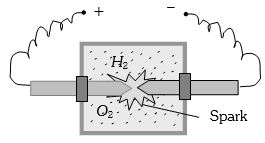
A vessel contains $14 \,gm \,(7 $ moles) of hydrogen and $96\, gm$ ($9$ moles) of oxygen at $STP.$ Chemical reaction is induced by passing electric spark in the vessel till one of the gases is consumed. The temperature is brought back to it's starting value $273 K.$ The pressure in the vessel is ...... $atm$
Three liquids of densities $d,\,2d$ and $3d$ are mixed in equal volumes. Then the density of the mixture is
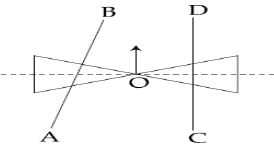
A roller is mad e by joining  together two cones at their vertices $O$. It is kept on two rails $AB$ and $CD$, which are placed asymmetrically (see figure) , with its axis perpendicular to $CD  $ and its centre $O$ at the centre ofline joining $AB$ and $CD$ (see figure) . It is given a light push so that it $A$ starts rolling with its centre $O$ moving parallel to $CD$ in the direction shown. As it moves, the roller will tend to
A body of mass $m$ kg. starts falling from a point $2R$ above the Earth’s surface. Its kinetic energy when it has fallen to a point $‘R’$ above the Earth’s surface [$R-$Radius of Earth, $M-$Mass of Earth, $G-$Gravitational Constant]
A raindrop falls near the surface of the earth with almost uniform velocity because:
A dimensionless quantity: