Question
Distinguish between : Atria and Ventricles.

Answer

AtriaVentricles
1. Atria are upper chambers of the heart.1. Ventricles are lower chambers of the heart.
2. Atria are thin walled.2. Ventricles are thick walled.
3. Atria are receiving chambers.3. Ventricles are distributing chambers.
4. Interatrial septum divides the two auricles (atria).4. Interventricular septum divides the two ventricles.
5. Right atrium is larger in size than left atrium.5. Left ventricle is larger in size than the right ventricle.

Need a full question paper?

Generate a complete, print-ready paper with questions like this in minutes — across 16+ boards, with answer keys.

Start Generating Free

Similar questions

Distinguish between : Epithalamus and hypothalamus.
Column AColumn B (Symptoms observed)
(1) Deficiency of Cu(a) Malformed leaves
(2) Deficiency of Bo(b) Leaves with yellow edges
(3) Deficiency of Zn(c) Brown heart disease
(4) Deficiency of K(d) Die back of shoot
Read the following and answer any four questions from (i) to (v) given below:
According to Mendel, one gene control the expression of one character only. The ability of a gene to have multiple phenotypic effect because it influences a number of characters is an exception. The gene having a multiple phenotypic effect because of its ability to control of two or more characters can be seen in cotton. In cotton, a gene for the lint also influences the height of plant, size of the ball, number of ovules and viability of seeds.
  1. Genes with multiple phenotypic effects are known as?
  1. Hydrostatic genes.
  2. Duplicate genes.
  3. Pleiotropic genes.
  4. Complimentary genes.
  1. Which of the following disorder is an example of genes with multiple phenotypic effects?
  1. Phenylketonuria.
  2. Haemophilia.
  3. Sickle cell anaemia.
  4. Both (a) and (c)
  1. Which of the following is an example of gene with multiple phenotypic effect?
  1. Drosophila white eye mutation.
  2. Kernel colour in wheat.
  3. Height in human beings.
  4. Skin colour in human beings.
  1. Which of the following statements is not correct regarding genes with multiple phenotypic effect?
  1. It is not essential that all the traits are equally influenced.
  2. Occasionally a number of related changes are caused by a gene.
  3. It occurs due to effect of the gene on two or more inter-related metabolic pathways.
  4. None of these.
  1. Assertion: ln garden pea, the gene which controls the flower colour also controls the colour of the seed coat and presence of red spots in the leaf axils.
Reason: A pleiotropic gene influences more than one trait.
  1. Both assertion and reason are true and reason is the correct explanation of assertion.
  2. Both assertion and reason are true but reason is not the correct explanation of assertion.
  3. Assertion is true but reason is false.
  4. Both assertion and reason are false.
Distinguish between : Inspiratory Reserve Volume (IRV) and Expiratory Reserve Volume (ERV).
Read the following and answer any four questions from (i) to (v) given below:DNA replication is a complex multistep process that requires enzymes, protein factors and metal ions. DNA replication in eukaryotes occurs in the nucleus during the S-phase of the cell cycle. It is semidiscontinuous in eukaryotes. in prokaryotes, replication takes place in the cytoplasm. DNA replication in bacteria occurs prior to fission. Nucleoid or viral chromosome is a single molecule of nucleic acid, it may be linear of circular. Nucleic acid in a virus is either DNA or RNA but never both.
  1. In viral DNA, how many origin of replication are present?
  1. Single
  2. Twice
  3. Multiple
  4. None
  1. Select the main enzyme involved in DNA replication.
  1. DNA ligase
  2. DNA dependent DNA polymerase
  3. Topoisomerase
  4. Helicase
  1. Read the given statement and select the option that correctly fill in the blanks. Enzyme (i) acts over the Ori site and unwinds the two strands of DNA by destroying (ii) bonds.
  1. (i)-Helicase (ii) Glycosidic
  2. (i)-Helicase (ii)-Hydrogen
  3. (i)-Unwindase (ii)-Phosphodiester
  4. (i)-Unwindase (ii)-Glycosidic
  1. DNA strand, built up of Okazaki fragments, is called.
  1. Lagging strand.
  2. Leading strand.
  3. Complementary strand.
  4. Parental strand.
  1. Select the incorrect statement about DNA polymerase in eukaryotes.
  1. Polymerase $\alpha$ is required for initiation of replication.
  2. When the RNA primer gets removed the gap is filled by DNA polymerase $\beta$ in eukaryotes.
  3. Polymerase $\in$ helps in elongation of lagging strand.
  4. Polymerase $\delta$ is largest and main enzyme for DNA replication in eukaryotes.
Distinguish between : Carbon cycle and phosphorus cycle.
Read the following and answer any four questions from (i) to (v) given below:
Translation is the process of polymerisation of amino acids to form a polypeptide. The order and sequence of amino acids are defined by the sequence bases in the mRNA. The amino acids are joined by a bond called peptide bond. Ribosome is the site of protein synthesis.
  1. Which ion is essential for association of both units of ribosome at the time of protein formation?
  1. $Mg^{2+}$
  2. $Mn^{2+}$
  3. $CI^-$
  4. $Ca^{2+}​​​​​​​$​​​​​​​
  1. During translation, how many initiation factors are required in eukaryotes for initiation reactions?
  1. 3
  2. 6
  3. 7
  4. 9
  1. Which part of mRNA contains untranslated regions (UTR)?
  1. 3' end
  2. 5' end
  3. Either 3' or 5' end
  4. Both 5' end and 3' end
  1. Name the enzyme that helps in combining amino acid to its particular tRNA?
  1. Activating enzyme
  2. Amino-acyl tRNA-synthetas
  3. PeptidyI transferase
  4. Both (a) and (b)
  1. From the given list, select the translation machinery.
  1. mRNA
  2. Ribosomes
  3. Amino acids
  4. tRNAs
  5. Peptidyl transferase
  6. Amino acyl tRNA synthetase
  7. Pyrophosphatase
  1. (1), (2), (3), (4) and (6)
  2. (1), (2), (3), (4) and (5)
  3. (1), (2), (3), (4), (5) and (6)
  4. (1), (2), (3), (4), (5), (6) and (7)
Distinguish between: Homologous organs and Analogous organs.
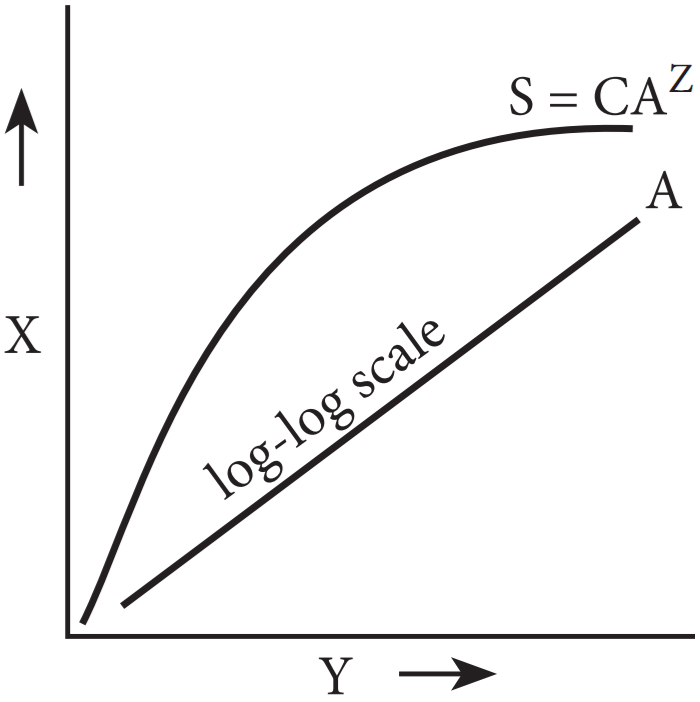
Read the following and answer any four questions from (i) to (v) given below: Within a region, species richness increases with increasing explored area, but only upto a limit. TI1e given graph explains this relationship.
  1. What does the given figure show?
  1. Rivet-popper hypothesis.
  2. Species-area relationship.
  3. Proportionate number of species of major taxa.
  4. $\alpha-\text{ecological diversity }$
  1. Equation for relationship (A) between species richness and area is:
  1. $\log\text{ S}=\log\text{ C}+\text{Z }\log\text{ A}$
  2. $\log\text{ C}=\log\text{ S}+\text{Z }\log\text{ A}$
  3. $\text{Z }\log\text{ A}=\log\text{ S}+\log\text{ C}$
  4. $\log\text{ S}=\log\text{ C}+\log\text{ A}$
  1. What is the value of slope of line or regression coefficient Z for frugivorous birds?
  1. 0.1 - 0.2
  2. 1.15
  3. 0.01 - 0.1
  4. 0.6 - 1.2
  1. The shape of curve for relationship between species richness and areas for wide variety of taxa is:
  1. Straight line.
  2. Parabola.
  3. Rectangular hyperbola.
  4. Bell shaped.
  1. Who gave this concept of increase in species richness with increasing offered area?
  1. Humboldt.
  2. Odum.
  3. Edward Wilson.
  4. Paul Ehrlich.
Read the following and answer any four questions from (i) to (v) given below:
Alcohols are important industrial solvents. Ethanol, methanol, propanol and butanol are produced commercially by fermentation activity of some fungi, majorly yeasts. During fermentation, yeast cells convert cereal derived sugars into ethanol and $CO_2$ At the same time hundreds of secondary metabolites that influence the aroma and taste of alcohol are produced. Sugar concentration affects the rate of fermentation reactions. Yeast cannot grow in very strong sugar solution. In case of complex carbohydrate containing nutrient media, 1% malt or Rhizopus is used along with yeasts. Hydrolysis of starch is carried out at high temperature for 30 ruins. 'Tile crushed food mixed with hot water for obtaining malt in called mash. 'Tile nutrient medium prior to fermentation in called wort. Wort is cooled down to appropriate temperature and inoculated with strain of yeast.
  1. Tile rate of alcohol production is measured on the basis of:
  1. Amount of sugar present in the medium.
  2. Amount of $CO_2$ produced per unit time.
  3. Amount of yeast added in the medium.
  4. All of these.
  1. A number of chemicals are produced at the time of alcoholic fermentation with the change of nutrient media, pH and aeration. Select such by-product from the following.
  1. Phenylethanol.
  2. Amyl alcohol.
  3. Glycerol.
  4. All of these.
  1. During alcoholic fermentation of cereals and potato, the crushed food mixed with hot water for obtaining malt is called:
  1. Juice.
  2. Mash.
  3. Wort.
  4. None of these.
  1. Distilled alcohol with 95% ethanol content is called:
  1. Absolute alcohol.
  2. Rectified spirit.
  3. Gin.
  4. Brandy.
  1. Assertion: Rhizopus or 1% malt is used in the nutrient medium when it contains complex carbohydrates.
Reason: Yeast does not possess sufficient diastase or amylase.
  1. Both assertion and reason are true and reason is the correct explanation of assertion.
  2. Both assertion and reason are true but reason is not the correct explanation of assertion.
  3. Assertion is true but reason is false.
  4. Both assertion and reason are false.